Showing posts with label Type 38. Show all posts

Monday, 10 July 2017

German Projectiles - 150mm Projectiles Part 3


German Projectiles


S.A.P. Projectile for Gun 39, 150mm


German Designation: 15cm Hpzgr. (Halbpanzergranate)

Employment: 15cm K. 39


Dimensions
Overall length (projectile): 23.53 inches
Diameter of bourrelet: 5.866 inches
Diameter of base: 6.102 inches
Total weight (projectile): 99 pounds

No tracer

Overall length (cartridge case): 20.66 inches
Diameter at case base: 7.28 inches

Fuze: Base detonating type

Markings: Black Tip

Remarks: Information is from captured documents.


A.P. Projectile for Gun 39, 150mm


German Designation: 15cm Pzgr. (Panzergranate)

Employment: 15cm K. 39


Dimensions
Overall length (projectile): 23.542 inches
Diameter of base: 5.866 inches
Total weight (projectile): 99 pounds

No tracer

Overall length (cartridge case): 20.67 inches
Diameter at case base: 7.283 inches

Fuze: Base detonating type


Remarks: Information is from captured documents.


L/4.6 with Nose Fuze, 150mm


German Designation: 15cm Sprge. L/4.6 (Kopfzunder)

Employment: 15cm K. 39


Dimensions
Overall length (projectile): 26.88 inches
Diameter of bourrelet: 5.86 inches
Total weight (projectile): 99 pounds

No tracer

Overall length (cartridge case): 20.67 inches
Diameter at case base: 7.28 inches
Type of propellant: Tubular Diglycol

Fuze: Nose percussion fuze E. Kz. m. V.; or
Time and percussion fuze Dopp. Z. s/60


Remarks: Information is from captured documents.


Smoke Projectile, Type 38, 150mm


German Designation: 15cm Gr. 38 Nb (Granate 38 Nebel)

Employment: 15cm s.F.H. 18


Dimensions
Overall length (complete round): 31.751 inches
Overall length (projectile): 24.723 inches
Width of rotating bands: 0.472 inches
Diameter of bourrelet: 5.825 inches
Diameter of base: 5.196 inches

Type of Bursting Charge: TNT
Type of Smoke Mixture: Oleum impregnated in pumice
No tracer

Overall length (cartridge case): 10.255 inches
Diameter at case mouth: 6.338 inches
Diameter at case base: 7.007 inches

Fuze: Nose percussion fuze Kl AZ 40 Nb

Markings: Painted green, stencilled in white.
"38 Nb" stencilled on body.


Packaging: One projectile in a wicker basket


Anti-Concrete Projectile, Type 19, 150mm


German Designation: 15cm Gr. 19 Be (Granate 19 Beton)

Employment: 15cm s.F.H. 18
                      15cm s.F.H. 13
                 15cm s.H.T.


Dimensions
Overall length (complete round): 30.215 inches
Overall length (projectile): 23.267 inches
Distance from base to band: 3.228 inches
Width of bimetallic rotating band: 0.472 inches
Diameter of bourrelet: 5.825 inches
Diameter of base: 5.196 inches
Total weight (projectile): 95.7 pounds
Weight of bursting charge: 7.1 pounds

Type of bursting charge: TNT
No tracer

Overall length (cartridge case): 10.255 inches
Diameter at case mouth: 6.338 inches
Diameter at case base: 7.007 inches

Fuze: Base detonating fuze Bd. Z. f. 15cm Gr. 19 Be

Markings: Painted green.


Packaging: One projectile in wicker basket - 100 pounds


H.E. Projectile with Disintegrating Rotating Bands (Sabot Type), 150mm


German Designation: Not Known

Employment: Not Known

Dimensions
Overall length (projectile): 25.6 inches
Diameter of bourrelet: 5.84 inches
Diameter of base: 6.01 inches
Total weight (projectile): 63.14 pounds
Weight of bursting charge: 7.48 pounds

No tracer


Fuze: Nose percussion fuzes AZ 23v

Markings: "R9" stencilled in body


 Remarks: At the shoulder of the projectile is a detachable guide band.  This band is trisected by cuts almost completely through the band and the complete band, which is a push fit on the shoulder, it is held in position by three ball bearings.  These are seated in cavities spaced equally round the periphery of the shoulder of the shell and project into cylindrical drillings through each segment of the guide band.  The drillings are threaded towards the outer circumference and the ball bearings after insertion are finally located by screws which seat the outer surface of the bearings.  After insertion of the balls and the positioning of the three screws, therefore, the guide band is firmly attached to the shell body, but should trisection of the guide band be completed, each segment, together with its retaining ball, would therefore be free to fall away from the shell body.

The rotating band holder is located at the base of the shell, which is keyed to receive it.  The holder itself is in three detached segments held in position only by the soft iron driving band.  Movement is prevented by three cylindrical pieces fitting into cavities located in the shell body and the driving band holder.  There are also three cylindrical pins between the segments.

It is believed that after leaving the gun the guide band and the rotating band holder are each split into three separate segments which, together with the ball bearings, pins and cylindrical pieces retaining them, are flung off.  The remaining projectile is then of much better aero-dynamic shape than is possible with a conventional projectile.


A.P.C. Projectile for Unknown Weapon, 150mm


German Designation: Not Known

Employment: Not Known but believe to be for naval use.

Dimensions
Overall length (projectile): 24.8 inches (approx.)
Total weight (projectile): 98.47 pounds


Fuze: Not Known

Markings: Painted yellow with black tip, black arrow pointed down towards base, black stencilling.


 Remarks: Information is from captured documents.


Rocket Assisted Projectile, 150mm


German Designation: 15cm R. Granate 19

Employment: s.F.H. 18


Dimensions
Total weight (projectile): 99.5 pounds

No tracer

Overall length (cartridge case): 10.23 inches
Diameter at case mouth: 6.338 inches
Diameter at case base: 7.007 inches
Weight of propellant: 13.64 pounds
Type of propellant: Tubular Diglycol

Fuze: Electric Nose percussion fuze, graze operated instantaneous: El. A.Z. or El. A.Z. m. R.
Base fuze R (transition fuze)

Markings: "R" stencilled in red on charge bag.


Remarks: This is an experimental projectile.  No specimens have been recovered as yet.  Two types were designed.  On the first the base plate is held in position with magnesia luting.  Is it thrown clear when the gun fires.  In the new pattern the jets are closed by small individual plugs which fall out when the gun fires.


Next Time: 152mm to 210mm Projectiles

Monday, 15 May 2017

German Projectiles - 47mm to 50mm Projectiles


German Projectiles


H.E. Projectile Type 36 (Czech Design), 47mm


German Designation: 4.7cm Sprgr. Patr. 36 (t) (Sprenggranate Patronen 36 (t) )

Employment: 4.7cm Pak. (t) (Panzerabwehrkanone (t) )
         4.7cm K 36 (t)   (Kanone 36 (t) )


Dimensions

Overall length (complete round): 22.44 inches
Overall length w/o fuze (projectile): 7.36 inches
Diameter at bourrelet: 1.84 inches
Width of rotating band: 0.67 inches
Diameter of projectile base: 1.625 inches
Total weight (complete round): 6.25 pounds
Total weight (projectile): 3.3 pounds
Weight of bursting charge: 6.348 ounces

Type of Bursting Charge: TNT
No tracer

Overall length (cartridge case): 15.944 inches
Diameter at case neck: 1.98 inches
Diameter at case shoulder: 2.12 inches
Depth of extracting groove: 2.52 inches
Weight of propellant: 1 pound, 15.35 ounces
Type of propellant: Strip Nitroglycerine and Nitrocellulose

Fuze: Czech time or S/D


H.E. Projectile for Bohler Gun (Austrian Design), 47mm


German Designation: 4.7cm Sprgr. Patr. (O) (Sprenggranate Patronen (O) )

Employment: 4.7cm Bohler K. (O)


Dimensions

Overall length (complete round): 16.312 inches
Overall length (projectile): 8.625 inches
Width of rotating band: 0.375 inches
Diameter of projectile base: 1.594 inches

No tracer

Overall length (cartridge case): 9.25 inches
Diameter at case neck: 1.875 inches
Depth of extracting groove: 2.187 inches
Weight of propellant: 193 grams
Type of propellant: Strip propellant (Nitroglycerine and Nitrocellulose)

Fuze: 4.7cm M 35

Markings: 4.7cm Pak. O or 4.7cm J.K. 35/36 O


Remarks: Fuze is marked 4.7 Pak 35 or 4.7 M 35.

Fuze is similar to AZ23 except that it has no optional delay.  There is an AP round which is the 47/32 Italian round in an M35 case.


A.P. Projectile for AT Gun (Austrian Design), 47mm


German Designation: 4.7cm Pzgr. Patr. 35 (Panzergranate Patronen 35 (O) )

Employment: 4.7cm Pak. (t) (Panzerabwehrkanone (t) )
         4.7cm K 36 (t)   (Kanone 36 (t) )


Dimensions

Overall length (complete round): 19.48 inches
Overall length (projectile): 5.312 inches
Diameter at bourrelet: 1.844 inches
Width of copper rotating band: 0.687 inches
Diameter of projectile base: 1.719 inches
Distance from base to band: 1.25 inches
Total weight (complete round): 6.7 pounds
Total weight (projectile): 3.14 ounces
Weight of bursting charge: 0.74 ounces

Type of Bursting Charge: TNT
Tracer present

Overall length (cartridge case): 15.944 inches
Diameter at case neck: 1.98 inches
Diameter at case shoulder: 2.12 inches
Depth of extracting groove: 2.52 inches
Weight of propellant: 15.43 ounces
Type of propellant: Strip propellant (Nitroglycerine and Nitrocellulose)

Fuze: None

Markings: Black tip, unpainted projectile.  Blued from rotating band to beginning of 3/8" boat-tailing.
"ENZ" stencilled in red.


Remarks: Same projectile is used in the Bohler gun except that the driving bad is narrower and has two grooves instead of three.  A red band is painted around the shoulder.


A.P.C. Projectile Type 36 (Czech Design), 47mm


German Designation: 4.7cm Pzgr. Patr. 36 (t) (Panzergranate Patronen 36 (t) )

Employment: 4.7cm Flak. 37 (Flugabwehrkanone 37)
                            4.7cm Pak. (t)   (Panzerabwehrkanone (t) )


Dimensions

Overall length (complete round): 21.069 inches
Overall length w/o tracer (projectile): 6.625 inches
Diameter at bourrelet: 1.844 inches
Width of copper rotating band: 0.625 inches
Diameter of projectile base: 1.625 inches
Distance from base to band: 1.5 inches
Total weight (projectile): 3.64 pounds
Weight of bursting charge: 0.74 ounces

Type of Bursting Charge: TNT
Tracer present

Overall length (cartridge case): 15.944 inches
Diameter at case neck: 1.98 inches
Diameter at case shoulder: 2.12 inches
Depth of extracting groove: 2.52 inches
Weight of propellant: 15.49 ounces
Type of propellant: Strip Nitroglycerine and Nitrocellulose

Fuze: Base fuze (2 steel balls)
Set screw in projectile holds fuze in place.

Markings: Painted black, capped.
 "pla", lot number "1" stencilled in red.
Projectile curved in towards base.


A.P. Projectile with Tungsten Carbide Core (Arrowhead Design), 47mm


German Designation: 4.7cm Pzgr. Patr. 40 (Panzergranate Patronen 40)

Employment: 4.7cm Pak. (t) (Panzerabwehrkanone (t) )
        4.7cm K 36 (t)  (Kanone 36 (t) )


Dimensions

Overall length (complete round): 18.94 inches
Overall length w/ tracer (projectile): 5.375 inches
Distance of body midway: 1.187 inches
Width of rotating band: 0.51 inches
Total weight (complete round): 2.5 kilograms
Total weight (projectile): 1.81 pounds

Length of Tungsten carbide core: 3 inches
Diameter of Tungsten carbide core: 0.812 inches
Tracer present

Overall length (cartridge case): 15.944 inches
Diameter at case neck: 1.98 inches
Diameter at case shoulder: 2.12 inches
Diameter of extracting groove: 2.52 inches
Type of propellant: Tubular

Markings: Painted black


A.P. Projectile with Tungsten Carbide Core (Arrowhead), 50mm


German Designation: 5cm Pzgr. Patr. 40 KwK (Panzergranate Patronen 40 Kampfwagenkanone)

Employment: 5cm KwK Kampfwagenkanone
5cm KwK 39 Kampfwagenkanone 39
5cm Pak 38 Panzerabwehrkanone 38


Dimensions

Overall length (complete round): 14.48 inches
Overall length w/ tracer (projectile): 5.75 inches
Diameter of bourrelet: 1.95 inches
Diameter of rotating band: 2.269 inches
Width of rotating band: 0.5 inches
Distance of body midway: 1.258 inches
Total weight (complete round): 5 pounds, 3 ounces
Total weight (projectile): 1.95 pounds

Length of Tungsten carbide core: 2.937 inches
Diameter of Tungsten carbide core: 0.81 inches
Weight of Tungsten carbide core: 0.72 pounds
Tracer present

Overall length (cartridge case): 11.342 inches
Diameter at case neck: 2.035 inches
Diameter at case shoulder: 2.668 inches
Diameter at case base: 3.085 inches
Weight of cartridge case: 1.87 pounds
Type of propellant: Tubular Diglycol
Weight of propellant: 1.2 pounds

Fuze: None


Markings: Painted black


A.P. Projectile without Cap for Tank Gun, 50mm


German Designation: 5cm Pzgr. Patr. KwK (Panzergranate Patronen Kampwagenkanone)

Employment: 5cm KwK. (Kampfwagenkanone)


Dimensions

Overall length (complete round): 16.357 inches
Overall length (projectile): 7.5 inches
Diameter at bourrelet: 1.963 inches
Distance from base to band: 1.156 inches
Diameter at projectile base: 1.938 inches
Width of soft iron rotating band: 0.406 inches
Total weight (complete round): 7 pounds, 10 ounces
Total weight (projectile): 4 pounds, 8.25 ounces
Type of bursting charge: PETN/Wax
Total weight of bursting charge: 0.58 ounces

Tracer present

Overall length (cartridge case): 11.342 inches
Diameter at case neck: 2.035 inches
Diameter at case shoulder: 2.668 inches
Diameter at case base: 3.085 inches
Weight of cartridge case: 1 pound, 12.76 ounces
Type of propellant: Diglycol


Fuze: Base Detonating fuze Rd.Z. 5103


Markings: Painted black.
"164DL 608 1940 C FES" stamped in base.


H.E. Projectile, Type 38, 50mm


German Designation: 5cm Sprgr. Patr. 38 KwK (Sprenggranate Patronen 38 Kampfwagenkanone)

Employment: 5cm KwK Kampfwagenkanone
5cm KwK 39 Kampfwagenkanone 39
5cm Pak 38 Panzerabwehrkanone 38


Dimensions

Overall length (complete round): 18.61 inches
Overall length w/ fuze (projectile): 8.82 inches
Width of soft iron rotating band: 0.376 inches
Distance from base to band: 1.55 inches
Diameter at projectile base: 1.873 inches
Total weight (complete round): 6.85 pounds
Total weight (projectile): 4.16 pounds

Type of filling: TNT with red phosphorus smoke box
Weight of filling: 5.87 ounces
Type of booster charge: PETN/Wax
No tracer present

Overall length (cartridge case): 11.342 inches
Diameter at case neck: 2.035 inches
Diameter at case shoulder: 2.668 inches
Diameter at case base: 3.085 inches
Weight of cartridge case: 1.87 pounds
Type of propellant: Flaked gudol
Weight of propellant: 0.332 pounds

Fuze: Nose percussion fuze AZ 39


Markings: Painted green, red band around fuze.
"L.R. 25.10.40.9" stencilled in black in two places on body.


A.P. Projectile with Cap for Tank Gun, 50mm


German Designation: 5cm Pzgr. Patr. KwK (Panzergranate Patronen Kampfwagenkanone)

Employment: 5cm KwK Kampfwagenkanone
5cm KwK 39 Kampfwagenkanone 39
5cm Pak 38 Panzerabwehrkanone 38


Dimensions

Overall length (complete round): 16.683 inches
Overall length (projectile): 6.51 inches
Diameter at bourrelet: 1.969 inches
Distance from base to band: 1.156 inches
Width of soft iron rotating band: 0.406 inches
Diameter of rotating band: 1.312 inches
Total weight (complete round): 7.7 pounds
Total weight (projectile): 4.56 pounds

Type of bursting charge: PETN/Wax (87/13)
Weight of bursting charge: 0.87 ounces
Tracer present


Overall length (cartridge case): 11.34 inches
Diameter at case neck: 2.035 inches
Diameter at case shoulder: 2.668 inches
Diameter at case base: 3.085 inches
Weight of cartridge case: 1.87 pounds
Type of propellant: Tubular Diglycol
Weight of propellant: 1.1 pounds

Fuze: Base detonating fuze Bd.Z. 5103

Markings: Painted black, unpainted band at nose.


Packaging: Twelve rounds to a metal carrier - 20kg


Next Time: 75mm Projectiles

Monday, 11 January 2016

Soviet Satellite Country Ammunition - Communist China (Part 1)


Examination of Communist Chinese Ammunition Production/Inventory


Communist China

 
Perhaps the most evident generality descriptive of Chinese Communist ammunition is that it is a heterogeneity of foreign designs.  Ninety percent of all weapons and ammunition in use are of foreign manufacture.
At the conclusion of World War II, quantities of Japanese ammunition fell into Chinese Communist hands; later, in the struggle for control of the Chinese mainland, a goal attained in 1949, large Chinese Nationalist stocks were captured and Nationalist arsenals were seized.  Arsenals originally built by the Japanese for their own use continued to produce Japanese ammunition under the Nationalists and their successors, the Chinese Communists.  Soviet ammunition was received in increasing quantities from the start of the Korean War in 1950, and, with captured United States ammunition, was a mainstay of the Chinese Communist war effort in Korea.
 
Over the years, ammunition of British, Swedish, French, Italian, and German origin also found its way into China in varying amounts, and is now in Communist depots.
 
The Chinese Communists have striven to construct new armament plants, and to rebuild and expand the former Nationalist arsenals, which are now their major native source of munitions; the Soviets have assisted them by providing equipment and technical advice.  When, or whether, the native industry will attain a production capacity that will free Communist China of dependence on imported munitions, is not know.  This matter would involved industrial proportions that are not apt to be realized in the neat future, however.
 
For some years to come, then, Chinese Communist Army ammunition probably will be of foreign origin to a large extent, with the most important supplier continuing to be the USSR.  Ammunition of Chinese Communist manufacture is expected to become increasingly significant, and is likely to consist almost entirely of straight or modified copies of foreign designs, again most commonly displaying Soviet influence.
 
 At present, the quality of the native products is erratic - sometimes good, sometimes poor.  There are a variety of reasons for the shortcomings, among them: Loose manufacturing standards; lack of an adequate force of skilled workers; unsatisfactory machinery; and shortages of raw materials.  Deficient packaging is not unusual, and frequently results in serious deterioration of originally undefective contents.  Efforts to improve quality will most certainly be made, and in time will probably succeed.

 
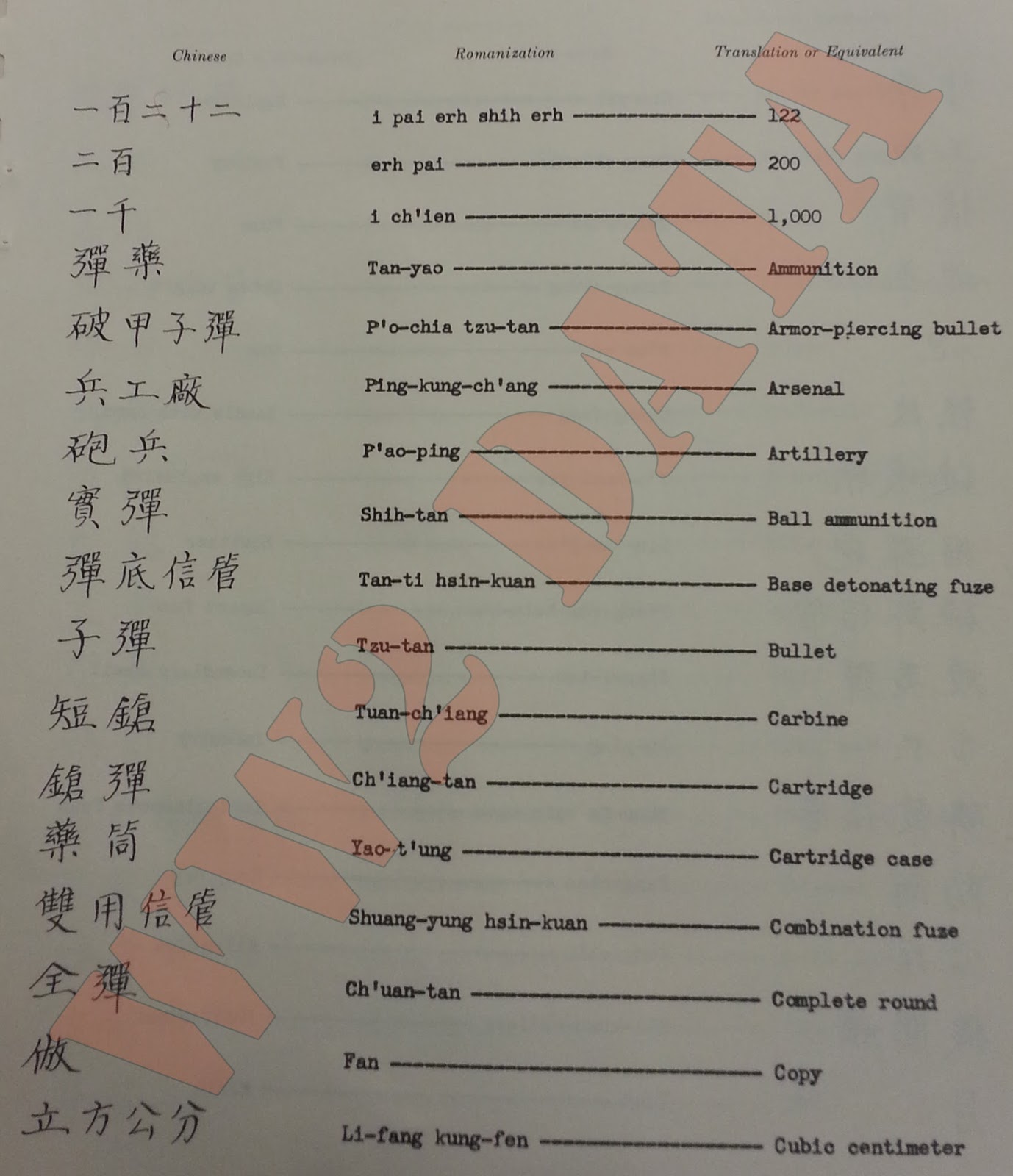
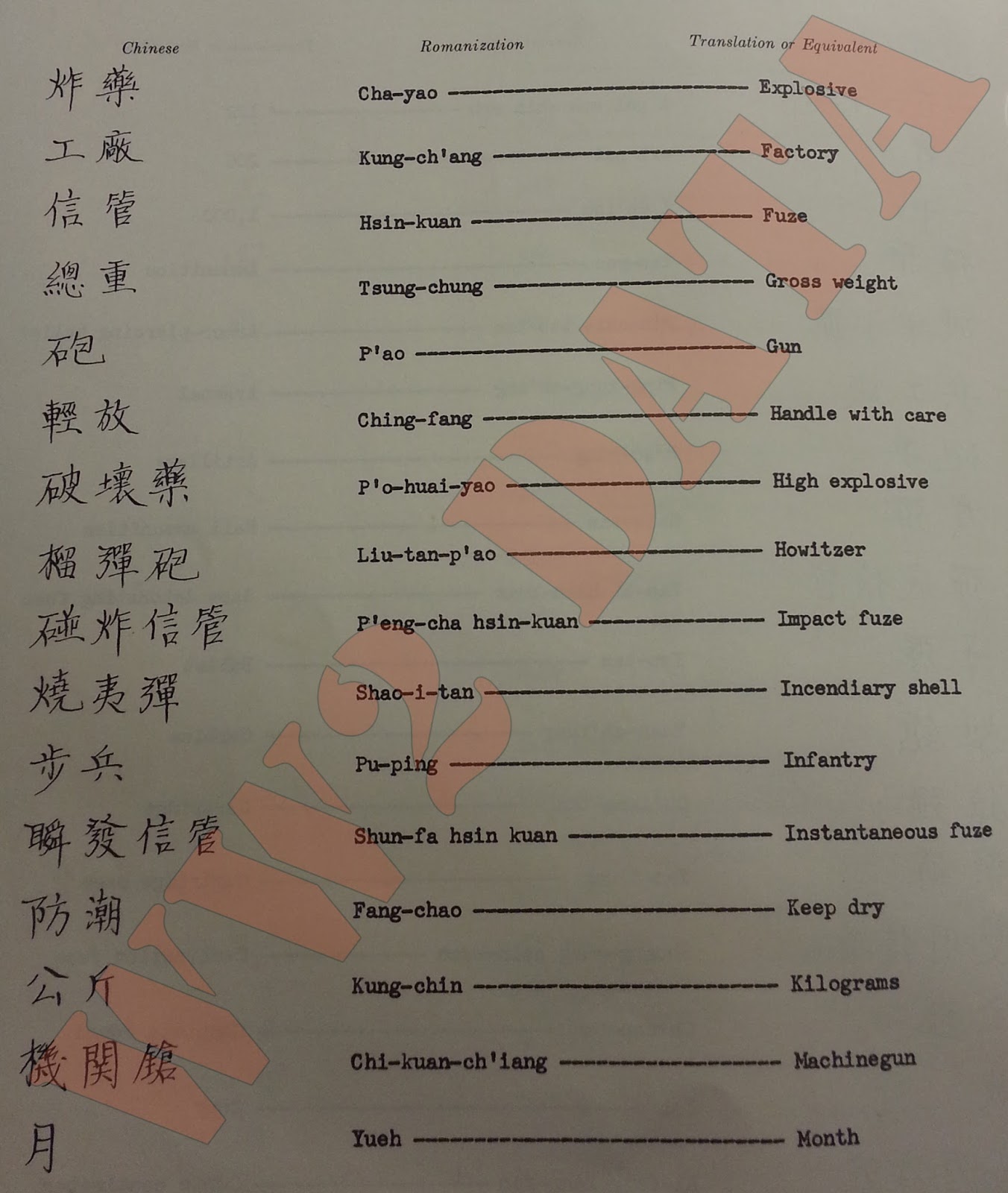
Glossary of Chinese terms


A. Small Arms Ammunition


Although Communist China has sufficient manufacturing facilities to fill her peacetime requirements for small arms ammunition, the Korean War showed that the country could not produce the quantities needed in wartime.  The Chinese Communists used Soviet and captured U.S. ammunition extensively in Korea.

China has manufactured United States .45 cal M1911 pistol cartridges and .30 cal M2 ball ammunition in the past, but no specimens definitely proven to be of Chinese Communist origin have been recovered.  Reports of the rebarreling of .30 cal weapons to 7.92mm suggest that the Chinese may be standardizing on 7.92mm rifles and machineguns.

Standardization between China and the USSR is limited in the field of small arms.  The Chinese Communists manufacture copies of both the Soviet 7.62mm Model PPSh-41 submachinegun and the Soviet 7.62mm Model TT1933 pistol, which they call the Type 50 and Type 51, respectively.  They also manufacture ammunition for these weapons.  They are not known to manufacture any other Soviet types of weapons or ammunition in the small arms class.

Two types of Chinese-made cartridges which are not covered in detail in this pamphlet are the 7.92mm reduced-charge cartridge and the 7.92mm conical-nosed ball.  The reduced-charge cartridge, except for its lighter propellent charge, is the same as the standard 7.92mm pointed ball.  It was manufactured specifically for certain Chinese-made Czech ZB-26's which, being constructed of inferior metal, could not withstand the pressures of the standard cartridges.  The conical-nosed 7.92mm ball is modeled on the German M1888 ball and is intended for the German M1888 service rifle and Chinese copies of that weapon.  Its propellent charge is lighter than that of the standard 7.92mm pointed ball, and its bullet diameter is smaller: 0.318 inch, as opposed to 0.323 inch for the pointed ball.  The pointed ball should not be fired in the M1888 rifle.  These cartridges are not believed to be sued in significant quantities.

The Chinese Nationalists and, in turn, the Chinese Communists continued the manufacture of ammunition types originally produced in China under the Japanese, and apparently also retained the Japanese color marking system for identification.  The Japanese color code for small arms ammunition is as follows:

Ball --- Pink/Salmon
Tracer --- Green
Armor-Piercing --- Black
Incendiary --- Magenta
High-Explosive --- Purple
Blanks --- Wooden or Paper bullets


Chinese Communist small arms ammunition packaging is notable only for its lack of uniformity.  Wooden packing boxes may vary widely in size, zinc or galvanized steel containers may or may not be used; inside the package, the rounds may be in cardboard containers of varying size, or may be loose, with or without clips or feed strips.

Packaging type and quality apparently depend on what happens to be available at the arsenal of manufacture.  In general, the packaging is of poor quality by United States standards, and it did not stand up well through the Korean War.  Water-soaked and corroded cartridges in unbroken Chinese packaging were commonplace in Korea.  An attempt was frequently made to waterproof boxes by the caulking of joints and tops but, because of an apparent lack of definite system or standards, the results were poor.

The Chinese Communists repacked significant quantities of captured ammunition, such as United States .30 cal.  No attempt was made to repack the United States cartridges by type or by headstamp.  A repacked box might, for example, contain a mixture of .30 cal ball, AP, and tracer cartridges produced at varying dates by different manufacturers.  Some of the rounds in the same box might even show signs of having been reloaded by the Chinese.
 

The markings on small arms ammunition boxes vary greatly.  Arabic or Chinese numerals, English or Chinese words, may be used.  One box may show extensive information about the contents; the next may show very little.  Markings often differ widely even between boxes containing the same caliber and type of ammunition.  The illustration below portrays only one of the many markings methods that are found.  The most consistently used symbols are those identifying the box contents by caliber and type number.


6.5mm Ball Cartridge, Type 38
 

This cartridge of Japanese design was continued in manufacture by the Chinese after World War II.  It is used in the Type 38 rifle, the Type 44 carbine, and the machineguns Type 3, Type 11, Type 91, and Type 96.  Ball cartridges usually have a red annulus at the junction of the bullet and cartridge case.  Chinese headstamps usually indicate the arsenal mark, the year and the month of manufacture, and occasionally the caliber.


Characteristics

Caliber: 6.5mm (.256 cal)
Weight of cartridge: 20.97g (323.61 gr)
Weight of case: 9.92g (153.09 gr)
Weight of bullet: 8.79g (135.65 gr)
Weight of propellant: 2.15g (33.18 gr)
Length of cartridge: 75.4mm (2.97 in)
Lenght of case: 50.5mm (1.99 in)
Lenght of bullet: 32.5mm (1.28 in)


Packaging
 
    
This ammunition is packed in 500-round and 600-round quantities.  For the 500-round package, one hundred 5-round clips of ammunition are packed loosely in a sealed galvanized metal container, which in turn is placed in a wooden box.  For the 600-round package, there are 15 rounds to a cardboard carton, 14 cartons to a sealed metal container, and one such container to a wooden box.  The markings on the wooden boxes may vary greatly in both in location and in the individual symbols used; however, unchanging symbols either for the caliber or the type of round normally appear somewhere on the box, and will serve to identify its contents.  These constant symbols are shown above, with other characteristics of the packaging.


7.62mm Ball Pistol Cartridge, Type (50?)


This cartridge is interchangeable with the Soviet 7.62mm Type P pistol cartridge, the Czech 7.62mm pistol cartridge, and the 7.63mm Mauser automatic pistol cartridge.  Chinese Communist forces use these cartridges in their Type 50 submachinegun and Type 51 automatic pistol, which are copies of the Soviet PPSh-41 submachine gun and TT1933 automatic pistol.  All of these cartridges are also used in the original Soviet weapons and in the Soviet PPS-43 submachineguns.  Cases are brass with a Berdan primer.  Base markings indicate manufacturing arsenal, lot number, and date of manufacture.


Characteristics

Caliber: 7.62mm (.30 cal)
Weight of cartridge: 10.68g (165 gr)
Weight of case: 4.5g (70 gr)
Weight of bullet: 5.5g (86 gr)
Weight of propellant: 0.58g (9 gr)
Length of cartridge: 34mm (1.36 in)
Lenght of case: 24mm (0.97 in)
Lenght of bullet: 14mm (0.55 in)


Packaging

No Markings Available

Information on packaging of this round is not available.


7.7mm Semi-Rimmed Ball Cartridge, Type 92


Manufacture of this Japanese-designed cartridge was continued by the Chinese after World War II.  It is used in the Type 92 heavy machinegun.  The ball cartridge usually has a red annulus at the junction of the bullet and cartridge case.  Base markings usually give year and month of manufacture, manufacturer's symbol or number, and sometimes caliber.


Characteristics

Caliber: 7.7mm (.303 cal)
Weight of cartridge: 27.78g (428.75 gr)
Weight of case: 11.34g (175 gr)
Weight of bullet: 13.32g (205.63 gr)
Weight of propellant: 2.86g (44.18 gr)
Length of cartridge: 79.5mm (3.13 in)
Length of case: 57.6mm (2.27 in)
Length of bullet: 35mm (1.39 in)


Packaging


Three different methods of packaging this cartridge have been encountered.  It has been found in a 560-round wooden box, details on the interior packing of which are lacking.  There is also a 600-round wooden box which holds 20 cardboard containers, each enclosing 1 Hotchkiss-type machinegun clip of 30 rounds.  Thirdly, a 1,380-round wooden box contains 92 cardboard packets, each holding three 5-round clips.  Although there is considerable variation in the marking of these boxes, consistent use is made of a symbol broadly identifying the contents by type.  This constant marking, which is shown above, is ordinarily found among other groups of characters, and is apparently placed on the box in whatever location suits the marker.


7.7mm Rimless Ball Cartridge, Type 99


This cartridge is used in Japanese 7.7mm Type 99 rifle and in the Japanese Type 92, Type 99, and Type 1 machineguns.  The cartridge is of Japanese design, but the Chinese are believed to have continued its manufacture after World War II.  The Japanese color marking for the round is a red-colored annulus at the junction of the bullet and the cartridge case.  These cartridges may be found in 5-round clips, or in 30-round feed strips for machineguns.


Characteristics

Caliber: 7.7mm (.303 cal)
Weight of cartridge: 26.93g (415.63 gr)
Weight of case: 11.9g (183.75 gr)
Weight of bullet: 12.47g (192.5 gr)
Weight of propellant: 2.67g (41.13 gr)
Length of cartridge: 79.5mm (3.13 in)
Length of case: 57.6mm (2.27 in)
Length of bullet: 31.2mm (1.23 in)


Packaging


Examination of various types of Communist Chinese packaging has disclosed inconsistent location of markings and considerable variation of identifying symbols even on similar boxes for the same item.  As a rule, however, constant symbols affording general identification of the contents by caliber and type appear on small arms ammunition boxes.  The symbol shown above is thought to be the constant symbol that would normally appear on packaging for this round.


7.92mm Ball Cartridge, Type ?


This cartridge still is manufactured by the Chinese Nationalists, as well as by the Chinese Communists.  It can be fired from any weapon chambered for 7.92mm x 57mm rimless ammunition, and is used by the Chinese Communists in a motley assortment of foreign-designed rifles and machineguns.

During World War II, the cartridge was manufactured in large quantities by the United States.  The United States-made rounds are distinguished by the character below on the base, and by having Boxer-type primers rather than Berdan type used in cartridges of Chinese, Japanese, and European manufacture.

 
A reduced-charge version of the round also was made; it was intended for some early Chinese copies of the Czech ZB 26 light machinegun which were constructed of inferior metal.

To date, all cartridges cases found for this round have been of brass.  Cartridge case base markings are stamped, and usually consist of a symbol for the manufacturing arsenal, a date (month and year) of manufacture, and occasionally the Arabic numerals "79," indicating the caliber.  Because of the many manufacturers of the ammunition, a correspondingly wide variation in headstamps may be encountered.


Characteristics

Caliber: 7.92mm (.311 cal)
Weight of cartridge: 25.5g (394 gr)
Weight of case: 12g (185 gr)
Weight of bullet: 10.5g (162 gr)
Weight of propellant: 3g (47 gr)
Length of cartridge: 80mm (3.14 in)
Length of case: 57mm (2.24 in)
Length of bullet: 29mm (1.16 in)


Packaging


This ammunition has been found in three kinds of packaging.  A 500-round wooden box holds one sealed, galvanized metal container, within which are 10 layers of cartridges loaded in 5-round clips; each layer is seperated from the next by a cardboard sheet, and comprises ten 5-round clips.  A 560-round wooden box contains 28 cardboard boxes, each holding 20 rounds individually seperated by a cardboard divider.  Finally, a 1,000-round wooden box encloses a sealed, galvanized metal container in which the cartridges are packed loosely.  The markings on the three types of packaging differ greatly from box to box, bu the symbols shown above appear among the markings quite consistently and may serve to identify the box contents broadly as 7.92mm ammunition.


Next Time: Communist Chinese Mortar Ammunition