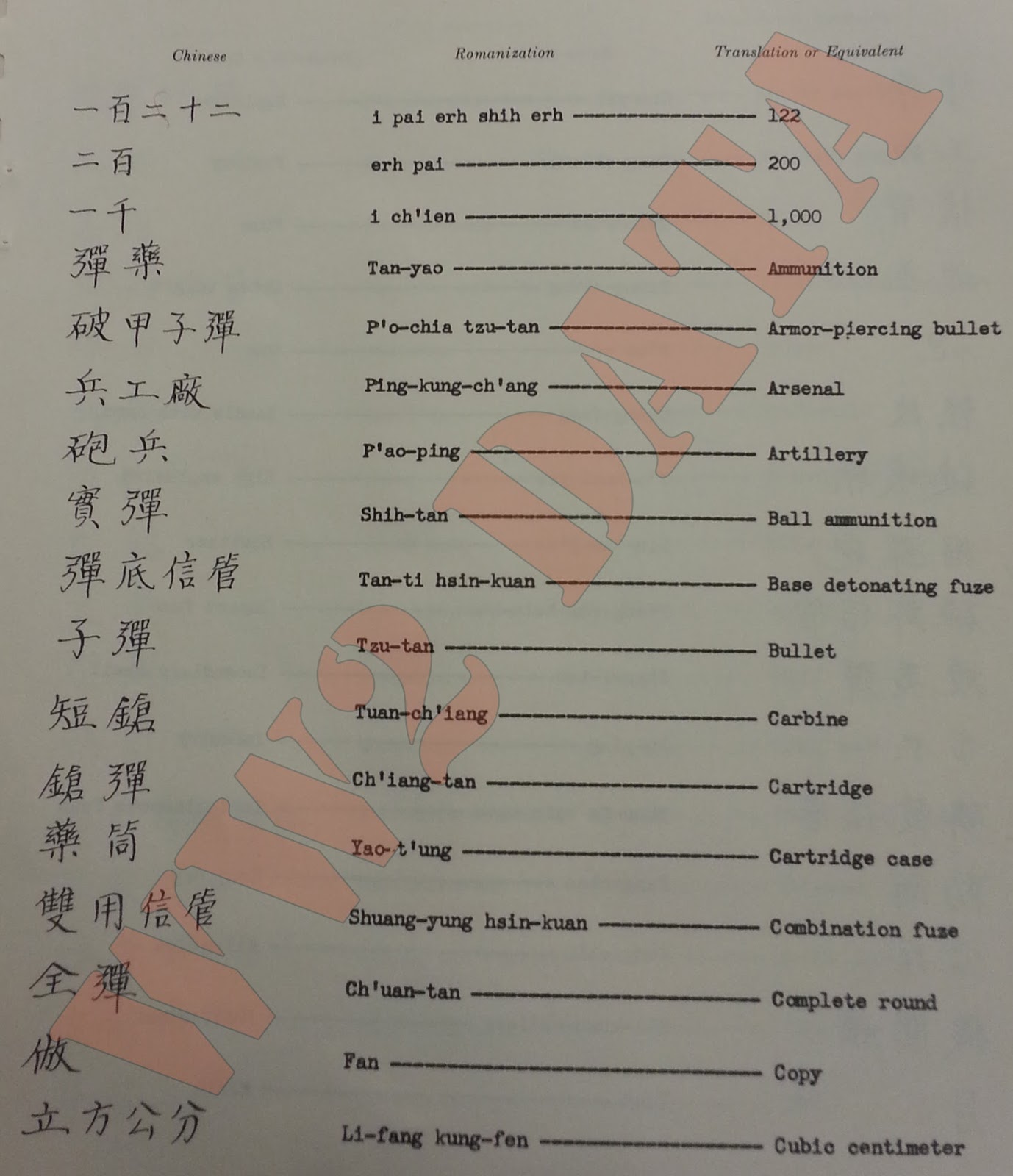
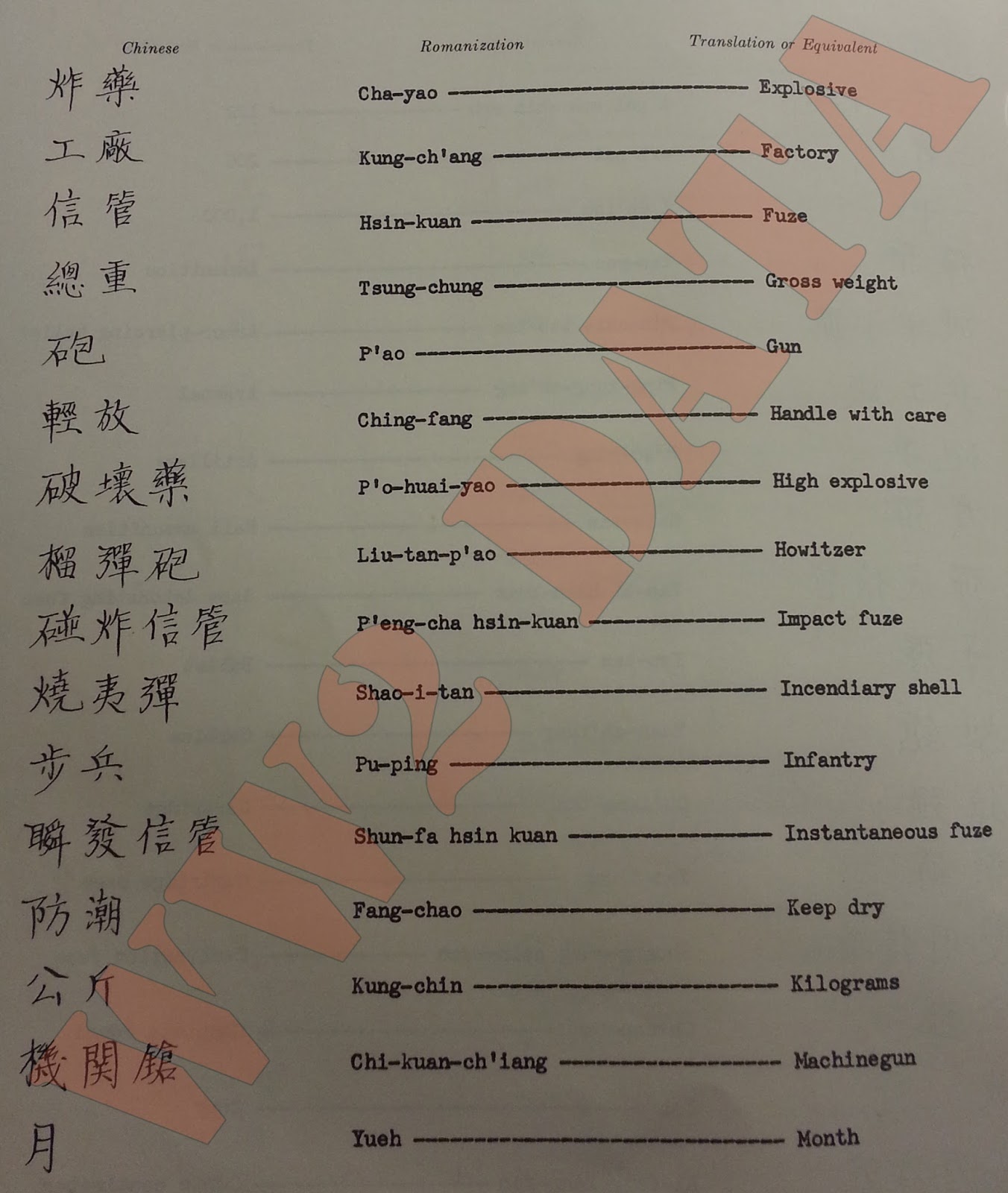
Examination of Communist China Ammunition Production/Inventory
C. Artillery Ammunition
The Chinese Communists have been hard pressed to keep their diverse assortment of artillery supplied with ammunition, and are duplicating foreign rounds wherever possible. Copies of United States 57mm, 75mm, and 105mm ammunition are being produced by the Chinese Communists, as well as all types of artillery ammunition for the many Japanese weapons, or Chinese-manufactured copies thereof.
In general, markings and packaging for artillery ammunition may be expected to be most inconsistent, as is the case with other kinds of Chinese Communist ammunition. However, markings on ammunition manufactured by the Chinese Communists for Japanese weapons follow the Japanese system of World War II.
57mm Complete Round, Fixed, HE

This high-explosive round is fired from the Chinese 57mmm recoilless rifle M36 (1947) (a copy of the United States 57mm recoilless rifle T15E13) and is used principally for fragmentation effect against personnel and open emplacements. It consists of a point-fuzed, TNT-loaded steel shell attached to a perforated steel cartridge case. The round, which cannot be used in any other 57mm weapon, may easily be distinguished from other fixed ammunition by its pre-engraved rotating band and perforated cartridge case.
The rotating band has 24 lands; it is not a ring seated in the shell body, but an integral part of the body. The pre-engraved rotating band permits firing at a lower chamber pressure, which in turn allows thinner chamber and tube walls, resulting in a lighter weapon. The perforation of the cartridge case is a pre-requisite to elimination of recoil. The cartridge case is attached to the shell by means of four stab-type crimps. The body of the cartridge case is manufactured in two halves from strip steel, which is perforated, formed, and butt-welded longitudinally. A brass stop ring encircles the cartridge case at the neck.
The point fuze used with this round is a single-action, instantaneous type. The fuze body is made of aluminum. In the fuze base is a detonator booster which, when assembled to the shell, seats in a cavity provided in the high-explosive charge.
The shell, which is painted yellow, has no stenciled markings. The pre-engraved rotating band and a section extending approximately one-quarter inch forward of the rotating band are unpainted. The perforated cartridge case is painted olive gray.
Characteristics
Caliber: 57mm (2.24 in)
Weight of complete round: 2.56kg (5.65 lbs)
Weight of projectile, as fired: 1.18kg (2.84 lbs)
Weight of projectile, w/o igniter: 0.43kg (0.96 lb)
Type of projectile filler: Cast TNT
Weight of projectile filler: 0.22kg (0.5 lb)
Packaging


This ammunition is packed in wooden cases containing five rounds. Each round is packed in a metal container. Three containers form the bottom layer in the box, and two, the top. The box is of sturdy construction, usually of soft wood; it is cleated on the top, sides, and bottom, with the corners dovetailed. The cover is permanently nailed or screwed; no hinges or hasps are used. Rope carrying handles are attached at both ends of the box.
There is considerable variation in location and constituents of box markings, but the caliber designation is believed to appear with some regularity in the form of Arabic numerals, as shown above.
57mm Complete Round, Fixed, HEAT


This high-explosive round is fired from the Chinese 57mmm recoilless rifle M36 (1947) (a copy of the United States 57mm recoilless rifle T15E13) and is designed for use against vehicles, armored targets, and concrete or log emplacements. The cartridge consists of a point-fuzed, TNT-loaded shell and a primed, perforated, steel cartridge case.
The tetryl booster pellet at the base of the projectile may be either solid, weighing 10.9 grams (0.024lb), or hollow, weighing 7.35 grams (0.016lb). A pre-engraved rotating band having 24 lands is pressed into a seat in the shell. The pre-engraved rotating band permits firing the round at a lower chamber pressure, which in turn allows thinner chamber and tube walls, resulting in a reduction of the rifle's weight. The perforation of the cartridge case permits the controlled escape of the propellent gases, which pass through the chamber and then out openings in the breechlock, to eliminate recoil.
The body of the cartridge case is manufactured in two halves from strip steel, which is perforated, formed, and butt-welded longitudinally. A brass stop ring encircles the cartridge case at the neck. The base is of steel, machined to form a seat for the perforated body, and is attached to the body by ten approximately equidistant spot welds around its circumference.
The fuze body is made of an aluminum alloy and is usually heavy, since it also serves as the nose of the shell; the upper portion of the fuze body forms the shell's ogive and the lower, the bourrelet. Attachment to the projectile body is accomplished by means of threads; the fuze is threaded internally to mate with the external threads on the projectile body.
The shell, which is painted black, has no stenciled markings. The cartridge case has a light coating of olive-gray paint and bears no stenciled markings.
Characteristics
Caliber: 57mm (2.24 in)
Weight of complete round: 2.59kg (5.72 lbs)
Weight of projectile, as fired: 1.22kg (2.7 lbs)
Weight of projectile, w/o igniter: 0.45kg (1 lb)
Type of projectile filler: TNT
Weight of projectile filler: 0.15kg (0.34 lb)
Packaging
No picture available
No picture available
No information is available regarding the number of cartridges to a container or the method of packing this ammunition for the field, but it is believed the same type of packaging would be used for this round as for the 57mm high-explosive recoilless rifle round.
D. Rockets
The Chinese Communist Army has received considerable quantities of Soviet rockets since the start of the Korean War in 1950. The Army is further known to hold rockets obtained from other foreign countries. Communist China itself currently manufactures copies of a few foreign models of rocket launchers and ammunition. Only the rocket ammunition manufactured in significant quantity by the Chinese Communists is given detailed treatment in this section.
In general, Chinese Communist rocket ammunition is similar to that of other major powers. On the whole, the rockets are of a simple and rugged design, though evincing crude workmanship.
The rockets are usually olive drab with yellow stenciled markings, but may also be found painted a brighter green. Markings stenciled in yellow on the head and body presumably identify the manufacturing arsenal, type of round, explosive filler, and date of manufacture.
Basically, rocket packaging encountered to date resembles that for Chinese Communist mortar shells, both in construction and in markings. So far as can be discerned, there is no close adherence to any set standard of construction or marking. The package usually consists of a wooden box, cleated on the top, sides, and bottom, with joints and covers either glued or tarred to exclude moisture. Covers are permanently secured with screws or nails; no hinges or hasps are used.
87mm Rocket, HEAT, Type 135


This high-explosive anti-tank spin-stabilized rocket is fired from the 87mm (3.5 inch) rocket launcher Type 135, which can be fired from the shoulder or from a bipod rest on the ground. The launcher is similar in design to the United States 3.5 inch rocket launcher M20. The Type 135 rocket consists of a spin-type motor with eight canted nozzles, a shaped charge head with base detonating element, and a nose fuze with split-back action.
The explosive portion of the rocket consists of a main charge of cast TNT, weighing 1.4 pounds, and a 30-gram booster charge of pressed tetryl located to the rear of the main charge. The head and motor body appear to be machined from steel tubing or bar stock, and the nose or ogive is of cast iron. Eight directional venture orifices cause the rocket to spin to the right. The fuze found in this rocket is the same unsafe universal fuze found in the Type 241 rocket.
The above-illustrated rocket may be found either painted olive drab with yellow stenciled markings, or black with white stenciled markings.
Note. Dimensions given above for the visible length and the thread diameter of the fuze have not been verified.
Characteristics
Caliber: 87mm (3.5 in)
Total weight of rocket: 5.28kg (11.67 lbs)
Weight of warhead: 2.78kg (6.14 lbs)
Weight of propellant: 0.29kg (0.66 lb)
Type of warhead filler: TNT
Weight of warhead filler: 0.67kg (1.48 lbs)
Maximum velocity: 119 m/s (390 fps) (approx.)
Maximum range: ? m (? yards)
Packaging


The complete rocket is shipped, fuzed, in a cylindrical light gage, hermetically-sealed metal container. The container bears the same stenciled markings as the rocket it holds. The identification of the rocket by type is stenciled on the container in Arabic numerals, as shown above, and is believed to be regularly so represented.
87mm Rocket, HEAT, Type 241


This high-explosive anti-tank spin-stabilized rocket is fired from the 87mm (3.5 inch) rocket launcher Type 135, which can be fired from the shoulder or from a bipod rest on the ground. The launcher is similar in design to the United States 3.5 inch rocket launcher M20.
The Type 241 rocket resembles the United States M28A2 rocket in general appearance, but there are important differences between the two. The Chinese rocket is about four inches shorter, has a nose fuze rather than a base fuze, contains a steel shaped charge cone rather than one of copper, and burns considerably longer out of the launcher. The Chinese rocket consists of a motor body, nozzle, fin shroud assembly, trap, propellent spacer, adapter with wooden plug, igniter assembly, fuze, and head.
The motor is made of steel bar stock, rough machined inside and out. The fin shroud assembly is made of thin welded steel tubing; it surrounds and is joined to the nozzle by four struts, which are punched from thin sheet steel in two pieces and fixed by spot welding. The adapter acts as a motor closure and joins the head to the motor. The head section consists of an ogive, nose adapter, head body, shaped charge cone, flash tube, detonator, booster, and main charge. The fuze is a point initiating spit-back type which activates a "pick-up" detonator located in the rear of the main charge.
This rocket may be found painted either olive drab with yellow stenciled markings, or black with white stenciled markings.
Characteristics
Caliber: 87mm (3.5 in)
Total weight of rocket: 3.8kg (8.42 lbs)
Weight of warhead: 1.9kg (4.28 lbs)
Weight of propellant: 0.17kg (0.38 lb)
Type of warhead filler: TNT
Weight of warhead filler: 0.56kg (1.3 lbs)
Maximum velocity: ? m/s (? fps)
Maximum range: ? m (? yards)
Packaging
No picture available
Information on packaging of this round is not available.
102mm Rocket, HE, Type A3


This high-explosive rocket is believed to be fired from the 102mm six-tube truck-drawn rocket launcher (believed to be Type 505). It is similar in general design to the now obsolete United States 4.5 inch M8 rocket used during World War II. The complete round consists of the motor body, warhead, tail section, and fuze.
The motor body, which contains the propellant, is a steel tube 4 inches in diameter and 18.38 inches long; it is threaded internally at the head end and externally at the nozzle end. The internal threads at the head end of the motor body extend into the body far enough to hold the threaded propellent charge retaining plate.
The one-piece warhead, filled with loose and cast TNT, is apparently a casting. The rear of the head is threaded externally, for attachment to the motor body. The fin assembly consists of a formed ring to which six folding blades are hinged on a welded wire ring. In the collapsed or inoperative position, the fins fold forward to pass freely through the launcher. Upon emerging from the launcher, setback and air drag cause the fins to open outwardly in a position perpendicular to the body. The fin assembly is fitted to a shoulder at the end of the nozzle expansion cone and is retained by flaring the nozzle and by four spot welds to the nozzle.
The fuze is a simple point detonating fuze, threaded for attachment to the head of the rocket. This rocket is painted olive drab, with yellow stenciled markings.
Characteristics
Caliber: 102mm (4.01 in)
Total weight of rocket: 15.8kg (37.05 lbs)
Weight of warhead: 4.8kg (10.68 lbs)
Weight of propellant: 2.5kg (5.52 lb)
Type of warhead filler: TNT
Weight of warhead filler: 1.25kg (2.76 lbs)
Maximum velocity: ? m/s (? fps)
Maximum range: ? m (? yards)
Packaging

Each complete round is packed in a box constructed of soft wood. Three rows of cleats strengthen the box and allow for ventilation when stacked. Each end has a single cleat to which a rope handle of 1/2-inch thickness is attached. The rocket is supported within the box by a wooden nose piece of 1 and 1/2-inch thickness.
Two rows of 1/8-inch felt material are fixed to the inside of the box as cushions. A compartment at the fin end of the rocket houses a fuze in a metal container with a threaded cap. The identification of the rocket is marked on the box is Arabic numerals and letters of the English alphabet, as shown above.
E. Pyrotechnics
Communist China does manufacture signal cartridges locally, although Soviet and United States signal cartridges are also utilized. That the Chinese Communists sometimes reload fired signal cartridge cases was shown by the recovery in Korea of reloaded cases of Soviet manufacture; whether this is a common practice is not known.
The Chinese, who were probably the first in the world to manufacture fireworks, still make great use of signal rockets which are not unlike those used for pyrotechnic displays in the United States. Most of those encountered so far have apparently been made in small workshops or improvised, since there does not appear to be any standard of manufacture in regard to materials or size. As an example, newspaper is frequently used for wadding. Illuminating shells for mortars and artillery weapons are also used.
The inconsistencies in construction and marking of packaging already met in the other kinds of Chinese Communist ammunition probably also hold true for pyrotechnics.
25.5mm Signal Cartridges


These cartridges are used in pyrotechnic pistols for signaling purposes. Although the Chinese call them 25.5mm cartridges, they are believed to be interchangeable with Soviet 26mm and German 27mm signal cartridges. Some cartridges bear horizontal color bands on the paper body, showing the color of the signal, and some may be entirely colored, as No.3 above.
Primers have various coloring which may have no relationship to the color of the signal, as in cartridge No.3 above. The cartridges also have embossed dots on their top wads for identification at night, but not definite code system can be determined for these dots at present.
Marked on the cartridge body, in order from top to base, are: the color of the signal, the nomenclature of the cartridge, the designation of the manufacturing arsenal, and the date of manufacture.
The following identification has been give to the above-illustrated cartridges:
1. Green single star
2. Red single star
3. White single star
Characteristics
Caliber: 25.5mm (1.003 in)
Weight of cartridge: 40gm (617.3 grams) (average)
Color:
-Cartridge 1: Green
-Cartridge 2: Red
-Cartridge 3: White
Type: Single Star
Burning time:
-Cartridge 1: 7.5 seconds
-Cartridge 2: 5.7 seconds
-Cartridge 3: 8.7 seconds
Method of actuation: Fired from pyrotechnic pistol
Packaging
No picture available
No picture available
Information on packaging of these cartridges is not available.
Next Time: Czechoslovakia