Showing posts with label Type 99. Show all posts

Monday, 30 May 2016

Imperial Japanese Explosives - Land Mines and Grenades (Part 4)


Imperial Japanese Explosives


Type 99 Hand Grenade
 

Overall length: 3 and 1/2 inches
Maximum diameter: 1 and 5/8 inches

Total weight: 0.8 pounds
Filling: Cast picric acid
Delay: 4-5 seconds

Color and markings: Body is black with white label pasted around it.  The top of the grenade is painted red; fuze cover, red; fuze, brass. 

Description: The cast steel body has smooth surfaces.  There is a shoulder projecting 1/16 inch from each end of the body.  The inside of the body is finished with lacquer to keep the filler from reacting with the steel case.  The filler is also wrapped in heavy paper.

A light metal flash deflector is fitted in the top of the grenade.  This deflector is 3/8 inch wide and 7/8 inch in diameter.  Two 1/8 inch holes are punched in the outer periphery and match the spanner holes in the fuze body.  This positions the gas vents in the fuze 90 degrees from the holes in the flash deflector.  The flash deflector reduces the possibility of the flash from the cap burning the hand of the thrower and the possibility of the flash being seen by the enemy at night.

The fuze is similar to that used in the Type 91 and Type 97 grenades with a few improvements.  On the old type the striker may turn or spring clear of the grenade when the safety wire is pulled.  In this fuze, a screw in the fuze body projects through a slot in the striker cover and keeps the cover in place.  The slot allows the cover to move down when the striker is struck on a hard object.  Also, the striker and inertia weight are machined together and the striker protrudes so that it does not have to be threaded down to arm the grenade.  In other respects, the fuzes are identical.

Operation: The safety pin is withdrawn and the head of the fuze is truck on some hard object.  This forces the striker down into the primer igniting the delay.

Remarks: A Type 99 grenade has been encountered with a machined, waterproof, metal fuze cover.  The only difference between this variation and the standard grenade is the fact that the flash guard is externally threaded to receive the waterproof fuze cover.


Type 4 Pottery Hand Grenade

  
Height (base to top of neck): 4 inches
Diameter: 3 inches
Body (material): Terra Cotta
Thickness of case: 7/16 inch

Total weight of grenade: 16 ounces
Filling: Type 88 explosive
Delay: 4-5 seconds

Color and markings: Light brown
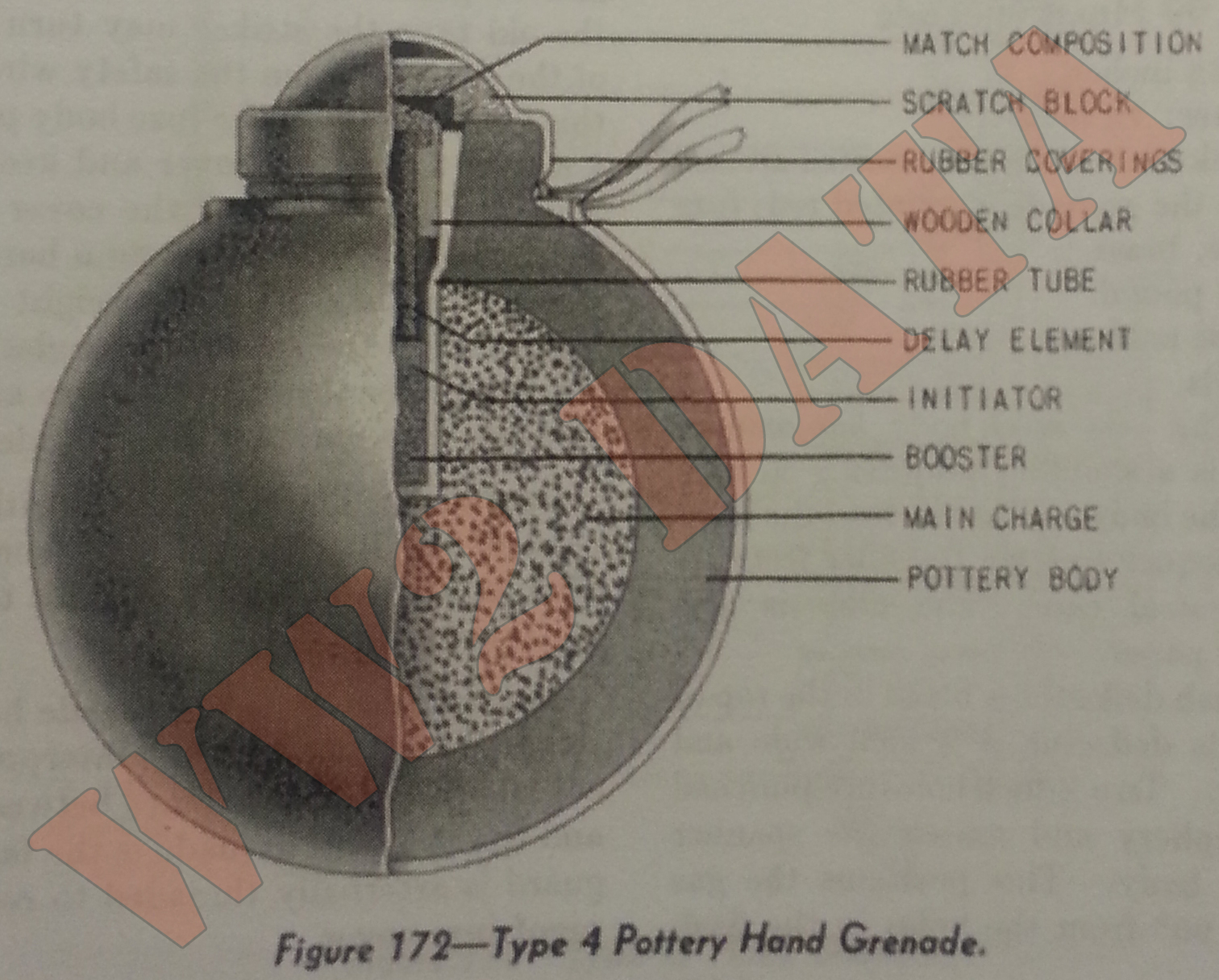
Description: Except for the neck at the top, the grenade is spherical, consisting of two hemispheres baked together.  The pottery body is light brown in color, lightly glazed inside and out.  The grenade is encased in a straw-coloured rubber sack which serves as waterproofing and permits the thrower to take a better grip.

The ignition system consists of a match composition, a 4 or 5 second delay element, a lead azide initiator, and a tetryl booster.  All but the match composition are encased in a rubber tub which is lacquered into the neck of the grenade.  The upper portion of the delay element is surrounded by a wooden collar, the top of which is covered with the match composition.

A wooden scratch block is seated on top of the neck of the grenade.  It is held in place by a small rubber sack which snaps around the neck of the grenade.  This sack serves a second purpose in waterproofing the ignition system.

A cloth band tied around the neck is probably used for carrying.

Operation: The small rubber sack is removed from the top and the scratch block is struck on the protruding match composition, igniting the delay element.  The grenade is thrown and explodes after a 4 or 5 second delay.

Remarks: This grenade appears to be made of the same type pottery as the Type 3 pottery land mine, and like the land mine, uses Type 88 explosive.  For these reasons it may be assumed to be a Navy weapon.

The color of the grenade may vary from white to dark brown, and the exterior may be glazed or unglazed.


Type 23 Hand Grenade


Overall length: 3 and 3/4 inches
Maximum diameter: 2 inches

Total weight of grenade: 1 pound
Filling: Granular TNT
Weight of filling: 39.5 grams
Delay: 5 and 1/2 seconds

Color and markings: Black

Description: The body, unlike the Type 91 or Type 97, has no longitudinal serrations, but does have five transverse depressions.  On one side, fitted top and bottom, are two rings which could be used for carrying or for anchoring.  The lead cover is screwed on to the top of the grenade and is grooved to provide a grip for easy removal.  The thumb cover release holds the cover on and must be depressed before the cover can be removed.

When this is depressed, the cover can be unscrewed in one and one-half turns, thus exposing the firing string which is attached to a friction igniter.

Operation: The thumb cover release must be depressed, and then the cover must be removed.  When the firing string is pulled, it draws a sanded string through a match composition.  The ignition of the match composition will ignite the black powder delay train.


Type 98 Stick Grenade
  

Overall length: 7 and 3/4 inches
Maximum diameter: 1 and 5/16 inches

Total Weight: 1 pound, 3 ounces
Filling: Cast picric acid
Weight of filling: 3 ounces
Delay: 4-5 seconds

Color: Black body; Unpainted handle

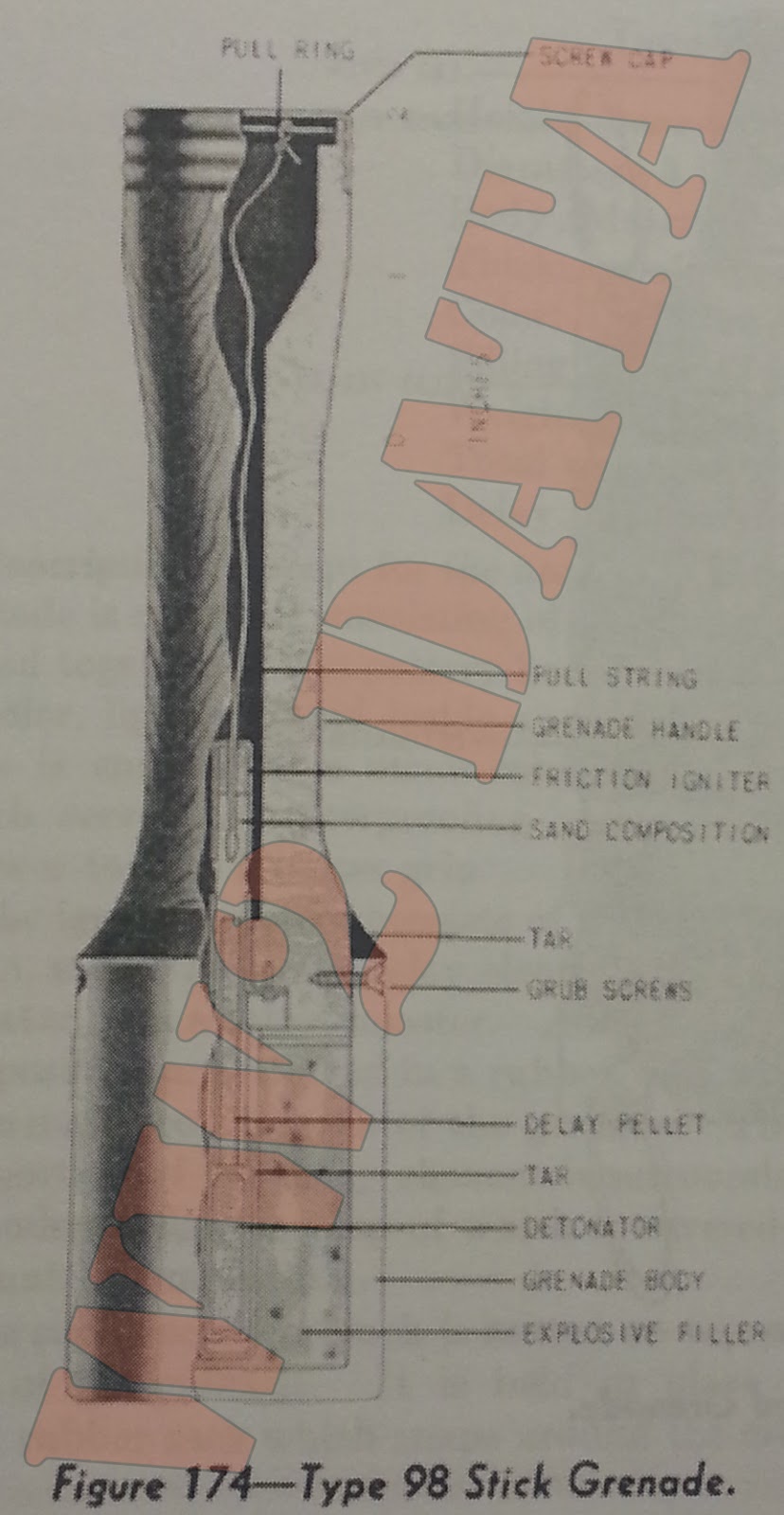
Description: The body is cylindrical in shape and is made of cast steel 1/4-inch thick.  The handle is turned from soft wood and slips into the steel body where it is held by three screws.  This joint is sealed with a coating of tar.  The screw cap at the pull end of the handle is of light, tin-plated steel.

The fuze consists of a friction ignition composition with a sanded string running through it.  This string extends up the hollow handle and is connected to a pull ring which is exposed by removing the screw cap at the top of the handle.

Operation: The screw cap is removed from the top of the handle.  The ring inside the handle is then pulled.  This draws the sanded string through the ignition composition igniting the 4 or 5 second delay.  The delay train detonates a cap which detonates the main charge.

This grenade has more fragmentation effect than the German high explosive stick grenade.


Type 3 Conical Antitank Hand Grenade

 
Small Grenade
Length of grenade: 5 and 7/8 inches
Length of tail: 14 inches
Diameter at base: 4 inches
Length of fuze: 1 and 7/8 inches
Length of cone: 2 and 3/8 inches
Diameter of cone: 2 inches
Cone angle, apex: 38 degrees
Total weight: 0.84 kg
Thickness of cone: 3 mm
Material of cone: Aluminum

Large Grenade
Length of grenade: 6 and 3/4 inches
Length of tail: 14 inches
Diameter at base: 4 and 3/8 inches
Length of fuze: 1 and 7/8 inches
Length of cone: 3 and 3/4 inches
Diameter of cone: 2 and 3/8 inches
Cone angle, apex: 30 degrees
Total weight: 1.25 kg
Thickness of cone: 3 mm
Material of cone: Steel
  
Description:  This grenade is manufactured in two sizes.  The basic principles of construction are the same in both sizes, but variations occur in weights, measurements and the explosive charge.  The grenade consists of a cone-shaped explosive charge, a metal cone, and a wooden base all contained in a silk bag.  A fuze is inserted and a tail attached to the apex of the charge.

The explosive charge is cast in the form of a truncated cone.  A metal cone is inserted in the base and in the upper end is a well which receives the gaine of the fuze.  Surrounding the gaine is a cast ring pellet.  In the large size grenade the explosive is Type 94, and in the small size grenade it is Pentolite (50/50 TNT and PETN).  A thin layer of waxed paper surrounds the charge.

At the bottom of the explosive charge is a wooden base which is flat on the top and rounded on the bottom.  The hole in the base has a slightly smaller diameter than the hole in the cone.

Covering the charge and base is a silk bag either white or olive drab in color.  When the grenade is assembled, a drawstring closes the bottom.  A metal ring is inserted over the top of the bag.  Inside the top of the explosive charge is fitted an adapter ring which is threaded to receive the fuze.  Four screws hold the parts together.

Tied around the top of the grenade is a tail made of hemp to provide stability in flight and to make the grenade strike the tank base first.  The fuze is constructed in two parts which are threaded together.  The lower body has external threads for screwing into the adapter ring and internal threads for receiving the gaine.  The striker is held in position by a safety pin and creep spring.  The under side of the upper body and the top of the striker are curved so that if the grenade strikes at a slight angle the striker will be cammed down.
  
Operation: Before the grenade is thrown the safety pin is pulled out.  On impact the firing pine overcomes the spring and moves down to pierce the primer.  The fuze is not "all-ways action", but will probably function on a slight angle of impact.

A second small grenade has been recovered which is identical to the previously described small grenade in measurements and type of construction but differs in the following details.  The silk bag which covers the charge of the second grenade is made of bright yellow finished silk.  The main explosive charge is picric acid with a small RDX booster.  The adapter ring is bakelite instead of metal, while a straw tail is used in place of hemp.

The fuze of the second grenade has a black finish, a single safety pin, and a gaine which is crimped to the fuze body, but otherwise is similar in construction and operation to the fuze of the first grenade.


Sling Hand Grenade
  

Overall length: 5 and 7/8 inches
Maximum diameter: 1 and 13/16 inches

Total Weight: 1 pound, 3 ounces
Filling: TNT
Weight of filling: 1 ounce
Delay: 4 or 5 seconds

Color: Black

Description: The sling grenade consists of a steel grenade body, wooden base plug, reinforcing cloth, scratch type friction ignited fuze, wooden fuze seat, wooden spacing ring, and a metal protective cap.

The rough, cast steel, cylindrical grenade body has a hollow projection on its forward end into which the wooden fuze seat and fuze are fitted and secured with glue.  The after end of the body opens directly into the TNT filled explosive cavity of the grenade.  This opening is closed by the wooden base plug, which is glued in place.  The throwing line is attached to the after end of the wooden base plug.

A strip of reinforcing cloth is wrapped around the base plug and the after end of the grenade body in order to help prevent the two sections from pulling apart when a line is used to throw the grenade.  The cloth is lashed securely in place by light line, which is tied around the annular groove in the grenade body and the cylindrical after section of the base plug.

A light, sheet metal cap is sealed over the nose of the grenade with waterproof paper tape.  The wooden spacing ring prevents contact between the fuze and the protective cap.  A flat surface on the side of the ring is coated with the abrasive compound used to ignite the fuze.

The fuze for the sling grenade is made in two sections: a long brass detonator tube and a short igniter head.  This tube is pierced by a single gas port and is crimped to the detonator tube.

Operation: The abrasive on the spacing ring is rubbed against the match head of the fuze to ignite the match composition which initiates the firing train.  The grenade is then thrown by hand or by means of the line attached to the ring in its base.  The delay is from 4 to 5 seconds.


1/2kg Incendiary Hand or Mortar Grenade
  

Overall length: 5.6 inches
Maximum diameter: 2 inches
Body material: Brass

Weight: 1.1 pounds
Filling: White Phosphorus
Delay: 4 or 5 seconds

Description:  This grenade may be thrown by hand or projected with the 50mm grenade discharger, Model 89.  The incendiary filling is contained in a brass body which may have a propelling charge on the base.  The fuze is identical to the one used in the Type 91 and Type 97 fragmentation hand grenades.

The steel propellant container is 1 and 1/4 inches long, 1.02 inches in diameter, and has six perforations in its walls.  It is screwed into the base of the body.  A perforated plug screws into the base of this container and in a cavity in this is a percussion cap.  Two flash holes head through the percussion cap holder to a small quantity of black powder.  A perforated steel disc covers the plug and inside the propellant container proper is a copper cup containing flakes of nitrocellulose propellant powder.

Operation: The firing pin must first be threaded down into the inertia weight.  The safety pin must then be withdrawn.  If the grenade is to be thrown by hand, it is necessary to strike the inertia weight on some hard object thus driving the firing pin into the primer to ignite the delay train.

If the grenade is to be fired from the grenade discharger, or knee mortar as it is sometimes called, the grenade with propellant container is dropped base first into the discharger.  When the trigger mechanism of the discharger is operated, its firing pin strikes the percussion cap igniting the propelling charge which propels the grenade.  Force of setback causes the firing pin in the grenade fuze to compress the creep spring and hit the primer to ignite the delay train.


Next Time: More Imperial Japanese Grenades, and Sabotage Devices

Monday, 11 April 2016

Imperial Japanese Navy Explosives - Bombs (Part 6)


Imperial Japanese Navy Explosives


Type 3 No.25 Mk 31 Bomb Model 1
 

Fuzes: Type 3 electric firing device B-3(a)
Overall Length: 62 inches
Length of body: 30 and 3/8 inches
Diameter of body: 11 and 3/4 inches
Thickness of wall: 1/2 inches
Material of wall: Steel
 
Type of suspension: Horizontal
Suspension lug: Normal Navy type suspension lug
 
Length of tail: 32 inches
Width of tail: 16 and 1/8 inches
Width of tail fins: 7 and 1/8 inches
Dimensions of tail struts:
-Length: 17 and 1/4 inches
-Width: 3 and 3/8 inches
-Thickness: 1/8 inch
Material of tail: Steel
 
Type of filling: Type 98 explosive, cast
Weight of filling: 175 pounds
Total weight of bomb: 378 pounds
Charge/weight ratio: 33%
 
Color and markings: Gray overall.  Green tail struts.  No color bands on nose.
 
Construction of body: The bomb consists of a nosepiece, barrel, and tail assembly.

The nose of the bomb is blunt.  A flat metal plate is fitted into the forward end of the barrel and welded there.  The plate is drilled centrally and a gaine pocket is welded in the hole.  A flange 3 and 7/8 inches long, and 7/32-inch thick and of the same outer diameter as the barrel is welded to the forward end of the barrel.  The flange is pierced by four 1/2-inch holes just aft of the forward end.

The barrel is of tubular steel construction.  The tail cone is held by 1 row of 18 plug welds and a continuous weld to a coupling ring which fits inside the barrel.  The ring is held in the barrel by 2 rows of screws numbering 40 in all.  There is a standard tail fuze pocket at the apex of the tail cone.

Construction of tail: Four Navy type fins are spot-welded to the tail cone.  The fins are braced by a single set of box-type struts.
 
Operation: The Type 3 electric firing device is an influence fuze, operated by a photo-electric cell, which is activated by reflection of a beam of light projected from the fuze, and reflected from the target.  Aerial burst at an altitude of 7 meters or above was desired by the designers.  Fifty percent accuracy was considered to have been attained.


Type 3 No.80 Mk 31 Bomb Model 1
 
 
Fuzes: Type 3 electric firing device B-3(b)
Overall Length: 113 inches
Length of body: 72 inches
Diameter of body: 18 inches
Thickness of wall: 9/16 inches
Material of wall: Steel
 
Type of suspension: Horizontal
Suspension lug: Two guide studs on the bomb body position the steel suspension band.
 
Length of tail: 41 inches
Width of tail: 25 inches
Width of tail fins: 10 and 1/2 inches
Dimensions of tail struts:
-Length: 17 and 1/4 inches
-Width: 3 and 3/8 inches
-Thickness: 1/8 inch
Material of tail: Steel
 
Type of filling: Type 98 explosive cast in paper-wrapped blocks
Weight of filling: 922 pounds
Total weight of bomb: 1,584 pounds
Charge/weight ratio: 58%
 
Color and markings: Gray overall.  Green tail struts.  No color bands on nose.
 
Construction of body: The bomb consists of a nosepiece, barrel, and tail assembly.

The slightly tapered longitudinally welded nosepiece is closed at its forward end by a flat plate which has an 11 and 3/8-inch diameter.  The plate is drilled centrally and this nose pocket can only accommodate a Navy gaine.  
 
A metal flange is welded to this plate. It is 5 and 1/4 inches long by 7/32-inch thick and has an 11 and 3/8-inch inner diameter.  It is pierced by four 1/2-inch holes 3/4-inch aft of the forward end.  The nose section is attached to the barrel by a continuous circumferential weld and 17 plug welds.  There is a second circumferential weld at the point where the nose section begins to taper.
 
The barrel is of tubular-steel construction.  The tail cone is attached by 30 plug welds to a coupling ring which fits inside the barrel.  The coupling ring is held in the barrel by 2 rows of screws numbering 34 in all.  There is a standard tail fuze pocket at the apex of the tail cone.
 
Four Navy type tail fins are welded to the tail cone.  The fins are braced by a single set of box-type struts.
   
Remarks: The Type 3 electric firing device is an influence fuze, operated by a photo-electric cell, which is activated by reflection of a beam of light projected from the fuze, and reflected from the target.  Aerial burst at an altitude of 7 meters or above was desired by the designers.  Fifty percent accuracy was considered to have been attained.


Type 5 No.25 Mk 33 Bomb
Please make sure to read the last line of this entry

  
This bomb is designed to detonate upon approach to the earth.  It is a combination of a number of mechanical and electrical devices, all of which must operate if the bomb is to function properly.
 
Proximity detonation is to be initiated through the action of an all-ways action electrical fuze contained in a plummet which falls ahead of the bomb in flight.  An atmospheric fuze functions at the tail to open a set of four drogue plates at the tail, and release the nose plummet.   A type 15 Model 2 tail fuze is provided to detonate the bomb in case of failure of either of the other fuzes.
 
The nose section contains a 20-kilogram spherical plummet housing an all-ways action electrical fuze, connected by 20 meters of silk-clad copper cable to a Type 3 electric gaine projecting into the main explosive charge of the bomb.  The plummet is held in place in the nose of the bomb by two hinged latches held in the closed position by two steel wedges controlled, through wires, by the action of the tail drogue plates.
 
The barrel of the bomb is standard in construction, bu added provision for fragmentation has been made by the addition of a layer of cylindrical steel pellets just under the case of the bomb.
 
The tail cone is standard with the Type 15 Model 2 tail fuze (B-3(a)) in place at its apex.  The tail fin assembly is unique.  It is designed to perform the function of slowing the fall of the bomb.  It consists of a standard set of fins to which are hinged four rectangular drogue plates.  These plates are hinged at their after end so that they may lie either flat against the fins or may be extended to serve as retarding plates.  They are held in position flat against the fin surfaces by four pins which are in turn held in place by a blowout plug.
 
The blowout plug is operated by an atmospheric fuze welded in place at the tail on the longitudinal axis of the bomb.  The tail drogue plates operate the release mechanism for the nose plummet through two wires which run forward through eyelets on the outside of the barrel of the bomb.
 
When the bomb is dropped, the aneroid in the atmospheric tail fuze operates at the preset altitude, firing a squib electrically, which blows out the blowout plug at the tail, allowing the drogue release pins to move, releasing the drogue plates.  The plates assume an angle of 90 degrees with the fin surfaces, and act to slow the fall of the bomb.  
  
Through the action of the plummet release wires, the plummet is release, and falls to the end of its cable.  The all-ways action fuze in the plummet is armed by air travel, and operates through its cable and gaine to fire the main charge of the bomb upon striking the target. The Type 15 Model 2 tail fuze operates in case of failure of the all-ways action nose fuze.
 
Both atmospheric tail fuze and the all-ways action nose fuze carry their own electrical supply for firing in the form of self-contained batteries.  
  
The data on this bomb is the result of incomplete investigation, and must not be considered as specific, accurate information.


1-kg Practice Bomb Modification 2 and Modification 3

  
Fuzes: A-5(a)
Overall Length: 10 and 1/4 inches
Length of body: 2 and 3/4 inches
Diameter of body: 3 inches
Thickness of wall: 1/8 inch
Material of wall: Steel
 
Type of suspension: Horizontal
Suspension lug: A rectangular hinged steel lug on a plate riveted to the body with four rivets.
 
Length of tail: 7 and 1/2 inches
Width of tail: 1 and 1/4 inches
Width of tail fins: 3 and 1/2 inches
 
Dimensions of tail struts: None
Material of tail: Sheet steel
 
Type of filling: Picric burster and a red or white phosphorus main charge.
Weight of filling: 3 ounces (approximately)
Total weight of bomb: 2 pounds 3 ounces
Charge/weight ratio: 9%
 
Color and markings: White rubber nose, black body, white tail cone and fins.  Brass band just aft of rubber nose.
 
Construction of body: A hemispherical rubber nosepiece is attached by screws to the forward end of the one-piece, cast-iron body.  The bomb fuze is contained in the nose and body.  A burster charge is attached to the after end of the fuze and extends into the tail cone which is held to the bomb body by five screws.
 
The burster charge is surrounded by cotton wadding which is contained in a central tube.  The remaining space in the tail cone is filled with red or white phosphorus.

A safety plunger is depressed when the bomb is loaded in the bomb rack.  A screw type safety pin is removed when the bomb is in the bomb rack.
 
Construction of tail: Four fins are welded to the sheet metal tail cone.  There are no tail struts.


No.3 Practice Bomb Model 1
 
 
Fuzes: B-6(a)
Overall Length: 33 and 3/8 inches
Length of body: 16 and 15/16 inches
Diameter of body: 7 inches
Thickness of wall: 1/4 inch
Material of wall: Steel
 
Type of suspension: Horizontal
Suspension lug: 2 Normal Navy type lugs 180 degrees apart
 
Length of tail: 17 and 1/4 inches
Width of tail: 9 and 1/2 inches
Width of tail fins: 4 inches
Thickness of tail fins: 1/16 inch
 
Dimensions of tail struts:
-Length: 6 and 7/8 inches
-Width: 1 and 3/16 inches
-Thickness: 1/16 inch
Material of tail: Steel 
  
Type of filling: Concrete in nose and body.  Titanium tetrachloride and picric burster charge in tail cone.
Total weight of bomb: 68 pounds
 
Color and markings: The body forward of the suspension lugs is black.  Aft of lugs, the bomb is white.  Two red lines 90 degrees on either side of the suspension lugs run the length of the body and tail cone.  New color markings will be found.
 
Construction of body: The nose and body are constructed in one piece of machined steel.  The sheet steel tain cone is attached to the after end of the body by screws.  The nose and body are concrete filled.  A wooden block fills the lower part of the tail cone and a conical steel tank containing a spotting charge of titanium tetrachloride and a picric burster fits into the apex of the cone.

Four slots in the tail cone allow the smoke to escape when the burster charge ruptures the metal container.
 
Construction of tail: Four steel fins are welded tot he tail cone and are braced by a single set of box-type struts.


Type 99 No.3 Practice Bomb

 
Fuzes: B-6(a)
Overall Length: 35 and 3/4 inches
Length of body: 19 and 1/2 inches
Diameter of body: 7 inches
Thickness of wall: 1/4 inch
Material of wall: Steel
 
Type of suspension: Horizontal
Suspension lug: Normal Navy type suspension lug
 
Length of tail: 16 and 1/4 inches
Width of tail: 9 and 1/2 inches
Width of tail fins: 4 inches
 
Dimensions of tail struts:
-Length: 6 and 7/8 inches
-Width: 1 and 3/16 inches
-Thickness: 1/16 inch
Material of tail: Steel 
  
Type of filling: The nose is filled with fine gravel held in place by a steel separating plate.  The body contains 15 glass disks 6 and 1/2 inches in diameter and 3/4-inch thick.  A spotting charge of titanium tetrachloride and a picric burster are contained in a tank in the apex of the tail cone.  A wooden block fills the remainder of the cone.
 
Total weight of bomb: 72 pounds
 
Color and markings: The forward half of the bomb is painted black and has a green band around the nose.  The after half, including the tail cone, fins, and struts, is painted white.
 
Construction of body: The bomb is of three-piece construction.  A steel nosepiece is attached to a tubular-steel body by screws.  A tail cone is attached to a collar by screws.  The collar fits into the after end of the body and is held there by screws.

Four slots in the tail cone allow the smoke to escape when the burster charge ruptures the metal container.
 
Construction of tail: Four steel fins are welded tot he tail cone and are braced by a single set of box-type struts.
 
Remarks: The purpose of the glass disk filling in practice bombs is to lessen the damage to the target ship while still preserving the correct trajectory and ballistics of the bomb.


Type 96 Landing Flare
  

Fuze: Pull Igniter
Overall Length: 16 and 3/8 inches
Length of body: 16 and 3/8 inches
Diameter of body: 5 and 1/8 inches
 
Thickness of wall:
-Nosepiece: 1/8-inch
-Body: 1/32-inch
Material of wall: Brass nose, sheet steel body
 
Type of suspension: Hand thrown
Suspension lug: None
 
Length of tail: 6 and 3/4 inches
Width of tail: 5 and 1/4 inches
Width of tail fins: 1 and 5/8 inches
 
Dimensions of tail struts: None
Material of tail: Sheet Steel 
 
Type of filling: Illuminant
Weight of filling: 1 pound
Total weight of bomb: 6 pounds

Color and markings: Gray overall

Description: A brass nosepiece, ogival in shape is brazed to a conical body.  A brass plug screws into the nose of the flare.  It is threaded internally to hold a central tube containing the pull igniter, delay train, and illuminant.  The after end of the flare is closed by a lead cap.

Four fins are soldered to the after end of the body.

Operation: The igniter cord is pulled firing the primer which ignites the delay train.  This in turn ignites the quick match which fires the illuminant.  The heat melts the lead cap and the flame escapes through this hole.

The flare burns for 3 to 5 minutes.


 Landing Flare
 
 
Fuze: Pull Igniter
Overall Length: 22 and 9/16 inches
Length of body: 15 and 1/16 inches
Diameter of body: 6 and 1/4 inches
Thickness of wall: 1/32 inch
Material of wall: Sheet steel
 
Type of suspension: Launched by hand
Suspension lug: Two handles held flush against the case by springs are riveted to the body.
 
Length of tail: 7 and 1/8 inches
Width of tail: 10 inches
Width of tail fins: 2 and 1/4 inches
 
Dimensions of tail struts: None
Material of tail: Steel 
 
Type of filling: Illuminant
Weight of filling: 5 and 1/8 pounds
Total weight of bomb: 13 pounds (approximately)
Charge/weight ratio: 39%

Color and markings: Gray.  Label just below carrying handles reads "Manufacturing Date - September 1940. Naval Aerial Factory Illuminating Flare Bomb."

Construction of body: Consists of three distinct parts: Nose, Body, and Tail.  The nose is a solid metal weight which is hemispherical in shape.  It is welded to the body.  The body is of sheet-metal construction and conical in shape.  It is welded to the nose and secured to the tail portion by eight small screws.  On the exterior of the body is a tear strip which covers a small water inlet hole.  
 
Inside the body is a long central tube which extends the full length of the flare.  This tube contains the illuminating composition.  It is held in place by a large wooden spacer disk situated at the junction of the body and the tail with another wooden spacer at the junction of the body and the nose.  Spacers are held in place by small screws, six at the nose and eight at the tail.

Construction of tail: Constructed of light sheet metal with 4 fins soldered to it.  A metal cap is soldered over the end of the tail and fits around the central cylinder.  There is a small air outlet in the cap.  A percussion igniter is inserted through a hole in the cap and soldered into position. 
 
Over the end of the central cylinder is a lead cap which is soldered to the end cap.  This lead cap has a central disk of the same metal but much thinner.  The central cylinder is surrounded by an asbestos liner covered by a metal sheath.  This extends down to the wooden spacer, also covered by a metal disk.

Operation: Before dropped, remove tear strip and safety wire and pull the igniter cord.  When catch has been pulled out approximately 3/4-inch, the spring-loaded striker is released.  The striker then impinges on the primer.

A 10-inch safety fuze is ignited by the flash from the cap and, after burning for 35 seconds, the safety fuze ignites a coil of black powder.  The resultant heat melts the lead cap, allowing flash to escape.  The illumminant burns rapidly with brilliant greenish-white flame which lasts approximately 1 minute and 20 seconds.


Next Time: More IJN flares

Monday, 28 March 2016

Imperial Japanese Navy Explosives - Bombs (Part 4)


Imperial Japanese Navy Explosives


Type 99 No.80 Mk 5 Bomb
  
 
Fuzes: Two B-2(b) tail fuzes
Overall Length: 95 and 1/2 inches
Length of body: 52 and 1/8 inches
Diameter of body: 16 and 1/8 inches
Thickness of wall:
-Nose: 4 inches
-Tail: 2 inches
Material of wall: Forged Steel
 
Type of suspension: Horizontal
Suspension lug: Two guide studs on the bomb bode, position a carrying band, to which a suspension lug is attached.
 
Length of tail: 43 and 3/8 inches
Width of tail: 22 and 1/8 inches
Width of tail fins: 11 and 1/16 inches
 
Dimensions of tail struts:
-Length: 15 and 1/4 inches
-Width: 2 and 3/4 inches
-Thickness: 3/16 inch
Material of tail: Sheet Steel
 
Type of filling: Type 91 explosive (trinitroanisol)
Weight of filling: 66 pounds (approximate)
Total weight of bomb: 1,641 pounds (w/o tail)
Charge/weight ratio: 4%
 
Color and markings: Gray overall.  Green band around the nose, white band aft of green band
 
Construction of body: The bomb body is constructed of one piece of forged machined steel.  There are eight recesses cut in the nose presumably to hold a windshield if the case is used as a projectile.  A male base plate which has two fuze pockets is screwed into the after end of the body.

The tail cone is formed of rolled sheet steel (3/32-inch) welded down one side.  Twelve screws fasten the unreinforced base of the cone to the base plate of the bomb which has holes drilled around the edge to receive the screws.  Three hinged doors in the cone permit access to the fuze pockets.

Two vane assembly supporting rings are located at the apex of the cone.  These rings are constructed to receive the B-2(b) vane assembly bushings which are held in place by set screws. Slots in the tail cone are located beneath the supporting rings to permit passage of the reach rods from the fuze bodies to the vane assembly.
 
Construction of tail: Four sheet-steel fins are spot welded to the tail cone and are braced by a single set of box-type tail struts.


Type 2 No.80 Mk 5 and No.150 Mk 5 Bombs
Please read the general description of this entry

No picture available
  
Type 2 No.80 Mk 5
Fuzes: Two B-2(b) tail fuzes
Gaines: Special Mk 5
Approximate weight of bomb: 1,760 pounds
Material of wall: Forget steel
Material of tail: Sheet Steel
Type of filling: Type 91 explosive
Approximate loading factor: 6%


No.150 Mk 5

Fuzes: Two large fuzes similar to the B-2(b) fuze
Gaines: Special Mk 5
Approximate weight of bomb: 3,300 pounds
Material of wall: Forget steel
Material of tail: Sheet Steel
Type of filling: Type 91 explosive
Approximate loading factor: 6%

 
Color and markings: Gray overall with a green and brown nose band and white tail struts
 
General Description: These two bombs were designed to fill the great need of the Japanese for armor-piercing bombs.  Prior to the design of these two, the Japanese Navy had only one true armor-piercing bomb, the Type 99 No. 80 Mk 5, an adaptation of a large caliber artillery shell produced by turning the shell down to a streamlined shape and adding a tail section and a slightly larger explosive charge.

Type 2 No.80 Mk 5 and No.150 Mk 5, although they were specifically designed as armor-piercing bombs, differ only slightly from the earlier bomb.  Type 2 No.80 Mk 5 differs from the Type 99 No.80 Mk 5 only in having a slightly larger explosive charge, and in having no recesses at the nose to hold a windshield in place.  No.150 Mk 5 is simply a larger version of the Type 2 No.80 Mk 5.

Both bombs of the No.80 size use two B-2(b) fuzes in the tail with the special Mk 5 gaine.  No.150 Mk5 has two large fuzes of similar construction to the B-2(b).  These bombs were never extensively produced and neither Type 2 No.80 Mk 5 or No.150 Mk 5 was ever found outside the Japanese homeland.

The data on these bombs is the result of incomplete investigation, and must not be considered as specific, accurate information.

Note: I'm not sure what the next few paragraphs were intended for, but they are included for accuracy towards the source material.

The Mk 7 bomb was never more than an idea as far as the Japanese Navy was concerned.  It was suggested and discussed by a meeting of designers in 1935, but no experiments were carried out because the idea was considered impractical and unnecessary.  The bomb, as planned, was to consist of the 1 kilogram practice bomb, with a conical glass bottle of bacillus culture in place of the smoke mixture in the tail.

A lengthened striker was to break the bottle, and the culture was to spread by the force of impact.  A spread of 1 meter in diameter was hoped for.  No specific type of bacillus had been selected for the bomb.  Distinctive color marking for the bomb was to have been purple painted nose and tail.


Type 5 No.1 Mk 9 Model 1 and Type 3 No.6 Mk 9 Bombs

No picture available
  
Type 5 No.1 Mk 9 Model 1

Overall length: 35.4 inches
Diameter of body: 3.93 inches
Weight of explosive: 2.2 pounds
Weight of propellant: 4.4 pounds
Total weight of bomb: 33 pounds
Maximum speed: 230m/sec

  
Type 3 No.6 Mk 9
Overall length: 66.9 inches
Diameter of body: 7.87 inches
Weight of explosive: 22 pounds
Weight of propellant: 22 pounds
Total weight of bomb: 184.8 pounds
Maximum speed: 230m/sec
 
Color and markings: Gray overall. Green band on nose, with brown band just aft of green band.  Gray tail struts.
  
General description: Neither of these rockets had been put into production at the end of the war, although experiments had been finished on both of them.  Both were designed as aircraft launched weapons for use against surface targets; Type 5 No.1 Mk 9 Model 1 against surface submarines, and the Type 3 No.6 Mk 9 against landing craft and small ships.

These rockets are similar to the Mk 27 and Mk 28 rockets of comparable sizes, but both are somewhat heavier.  Both carry high-explosive loads, and the Type 5 No.1 Mk 9 Model 1 has a semi-armor piercing nose.
 
Exact fuzing is unknown, but it is known that the Type 5 No.1 Mk 9 Model 1 uses a fuze with a 0-2 second delay.  The Type 3 No.6 Mk 9 is assumed to use an instantaneous fuze.  Both of these rockets are fin stabilized, and more closely resemble American aircraft launched rockets than any of the other Japanese rockets.  However, their small propellant charges result in such low speed that their performance in no way compares with that of American rockets.


Type 98 No.7 Mk 6 Bomb Model 1
  
  
Fuzes: (w/ Magazine) A-3(a), or A-3(b)
Overall Length: 40 inches
Length of body: 21 and 3/4 inches
Diameter of body: 7 and 7/8 inches
Thickness of wall: 1/4 inch
Material of wall: Steel
 
Type of suspension: Horizontal
Suspension lug: Normal Navy suspension lug
 
Length of tail: 18 and 3/16 inches
Width of tail: 10 and 5/8 inches
 
Dimensions of tail struts:
-Length: 7 and 7/8 inches
-Width: 1 and 3/8 inches 
-Thickness: 3/32 inch
Material of tail: Sheet Steel
 
Type of filling: Four thermite-filled electron fire pots are contained within the bomb.  The nose and tail fire pots are cylindrical, while the two in the body are semicircular.  A central channel filled with quick-match runs the length of the bomb.  A black-powder charge is located int he circular recess in the nose piece.
 
Weight of filling: 81 pounds
Total weight of bomb: 156 pounds
Charge/weight ratio: 51%
 
Color and markings: Gray overall with a red nose band and red tail struts.  New type color markings will be found.
 
Construction of body: A cast-steel nose piece is riveted with 2 rows of 10 rivets each to a tubular steel body.  The tail cone is held by 1 row of 24 rivets to a collar which is held in the base of the bomb by 2 rows of screws (14 per row).
 
Construction of tail: Four steel fins are welded to the tail cone and are braced by a single set of box-type struts.

Operation: On impact, the magazine in the nose fuze fires the black powder and the igniting charge.  The black powder ejects the fire pots from the bomb case.  The igniting charge ignites the quick-match which initiates combustion of the thermite.


Type 98 No.7 Mk 6 Bomb Model 2


Fuzes: (w/ Magazine) A-3(a), or A-3(b)
Overall Length: 42 inches
Length of body: 21 inches
Diameter of body: 9 and 3/8 inches
Thickness of wall: 3/16 inch
Material of wall: Steel
 
Type of suspension: Horizontal
Suspension lug: Normal Navy suspension lug
 
Length of tail: 21 inches
Width of tail: 13 and 1/4 inches
Width of tail fins: 6 inches
 
Dimensions of tail struts:
-Length: 9 and 1/2 inches
-Width: 1 and 3/8 inches 
-Thickness: 1/16 inch
Material of tail: Sheet Steel
 
Type of filling: A central thermite core surrounded by solidified kerosene, petrol, and alcohol-soap mixture.

Weight of filling:
-20 pounds of inflammable mixture
-7.5 pounds of thermite
Total weight of bomb: 145 pounds
Charge/weight ratio: 22%
   
Color and markings: Gray overall with two longitudinal diametrically opposite thin red lines.  Red nose and red struts.  New type markings will be found.
 
Construction of body:  cast-steel nose is attached to a tubular-steel body by a continuous circumferential weld and 2 rows of 16 plug welds each.  A wood block and black powder burster charge are located in the nose.  Housed within the body is a steel cylinder which contains the incendiary filling. 
 
A central copper tube within the cylinder contains quick-match.  A tail cone is attached to a collar by a continuous circumferential weld and 16 plug welds.  The collar fits into the after end of the body and is held there by 2 rows of 16 screws each.
 
Construction of tail: Four steel fins are welded to metal strips which are riveted (14 rivets each) to the tail cone.  The fins are braced by a single-set of box-type struts.

Operation: On impact, the magazine in the nose fuze fires the black-powder charge which shears off the tail cone and ejects the incendiary cylinder out of the bomb case.  At the same time, the quick match is ignited.  This in turn sets fire to the thermite and the inflammable mixture.


Type 1 No.7 Mk 6 Bomb Model 3 Modification 1
 

Fuzes: A-3(a)
Overall Length: 42 and 1/4 inches
Length of body: 21 inches
Diameter of body: 9 and 3/8 inches
Thickness of wall: 1/8 inch
Material of wall: Steel

Type of suspension: Horizontal
Suspension lug: Normal Navy suspension lug

Length of tail: 21 inches
Width of tail: 13 and 1/4 inches
Width of tail fins: 6 inches

Dimensions of tail struts:
-Length: 9 and 1/2 inches
-Width: 1 and 3/8 inches
-Thickness: 1/16 inch
Material of tail: Sheet Steel
  
Type of filling: 182 cylindrical incendiary pellets are arranged around a central cardboard tube.  The pellets are bound together with string to form rings.  The rings surround the central tube which is filled with gray powder.  All the space in the bomb not occupied by the pellets is filled with this powder.

Weight of individual pellets: 7 ounces
Total weight of pellets: 81 pounds
Length of pellets: 2 and 1/8 inches
Diameter of pellets: 1 and 1/2 inches

Composition of pellets:
-Barium nitrate: 35%
-Ferric oxide: 28%
-Aluminum: 18%
The remainder is synthetic rubber of polysulphite type resembling "Thiokol."

Weight of igniter powder: 30 pounds

Composition of igniter powder:
-Barium nitrate: 75%
-Aluminum: 24.5%
-Oil: 0.3%
-Moisture: 0.2%

Weight of filling: 111 pounds
Total weight of bomb: 160 pounds
Charge/weight ratio: 69.4%

Color and markings: Gray overall with a 3 and 1/2-inch red band at the nose and red tail struts.  New type markings will be found.

Construction of body: A cast-steel nosepiece is attached to a longitudinally welded steel body by a continuous circumferential weld.  The nose contains a wooden block 1 and 3/4 inches thick to which a light metal gaine well is secured by three nails.

A longitudinally welded tail cone is welded to a collar which fits into the after end of the body and is held there by a single row of 16 screws.

Construction of tail: our steel fins are spot welded to the tail cone.  They are braced by a single set of box-type struts.

Remarks:
-Type 1 No.7 Mk 6 Model 3: This bomb uses the same case as that described above but differs in the filling.  It contains a high-explosive burster charge in a central tube and an explosive filling of approximately 520 wedge-shaped rubber pellets impregnated with iron and aluminum.


Type 3 No.25 Mk 8 Bomb Model 1
  
 
Fuzes: A-3(a)
Overall Length: 67 inches
Length of body: 39 and 5/8 inches
Diameter of body: 12 inches
Thickness of wall: 1/2 inch
Material of wall: Steel

Type of suspension: Horizontal
Suspension lug: Normal Navy suspension lug

Length of tail: 27 and 3/8 inches
Width of tail: 19 and 5/8 inches
Width of tail fins: 6 and 3/8 inches

Dimensions of tail struts: None
Material of tail: Sheet Steel
  
Type of filling: Type 97 explosive
Weight of filling: 263 pounds
Total weight of bomb: 649 pounds
Charge/weight ratio: 40%
 
 Color and markings: Green band around the nose, brown band aft of green band.  Gray body and tail.

Construction of body: A cast-steel nose is attached to a tubular-steel body by a continuous circumferential weld and 12 plug welds.  A tail cone is held to a collar by 8 plug welds.  The collars fits into the after end of the body and is held there by 40 screws.

Construction of tail: The normal tail cone has been cut off 8 and 3/4 inches aft of the junction with the bomb body proper and to this has been welded a 3/16 inch steel cylinder and four 1/8 inch steel hollow tail fins.

Tail cylinder:
-Outside diameter: 5 and 5/8 inches
-Length: 18 and 5/8 inches
-Type of filling: Type 97 explosive
 
Tail fins:
-Shape of cross-section: Triangular
-Overall length: 25 and 1/2 inches
-Height: 6 and 3/8 inches
-Width at base: 2 and 1/2 inches

Reinforcement of fins:

1. A box strut made of 1/8-inch mild steel runs the length of the fin on the inside.  The box strut is 7/8-inch wide at the top and 1 and 3/4 inches high and 22 inches long.  The strut is welded along the two lower edges to the side of the fins proper and spot welded along the sides.

2. Three 1/4-inch mild steel braces, 1 and 1/2 inches wide at the top, 2 and 1/2 inches wide at the bottom and 2 inches high are welded at 5 and 1/2-inch intervals to the box strut and the sides of the fins.  The lower sides of these braces have been shaped to fit the cylinder.

3. The end of the fins is closed by a 1/8-inch steel plate welded in place.


Next Time: More IJN bombs, including cluster munitions

Monday, 14 March 2016

Imperial Japanese Navy Explosives - Bombs (Part 3)


Imperial Japanese Navy Explosives


Type 99 No.6 Mk 2 Bomb Modification 1
  
 
Fuzes: A-3(a)
Overall Length: 42 inches
Length of body: 21 inches
Diameter of body: 9 and 3/8 inches
Thickness of wall: 3/16 inch
Material of wall: Steel
 
Type of suspension: Horizontal
Suspension lug: Normal Navy type suspension lug
 
Length of tail: 21 inches
Width of tail: 13 and 1/4 inches
Width of tail fins: 6 inches
 
Dimensions of tail struts:
Outer Struts
-Length: 9 and 1/2 inches
-Width: 1 and 3/8 inches
-Thickness: 1/16 inch

Inner Struts
-Length: 4 and 3/4 inches
-Width: 1 and 3/8 inches
-Thickness: 1/16 inch
Material of tail: Sheet Steel
 
Type of filling: Type 98 explosive
Weight of filling: 85 pounds (approximate)
Total weight of bomb: 140 pounds
Charge/weight ratio: 60%
 
Color and markings: Gray overall with a green-tipped nose and a blue band just aft of the green.
 
Construction of body: A cast-steel nose is attached to a tubular-steel body by a continuous circumferential weld and 2 rows of 16 plug welds.  An anti-ricochet nose attachment consisting of a cylindrical metal ring 1/8-inch thick bent at a 90 degree angle is spot welded to the bomb at a point 1 and 1/2 inches forward of the junction of the nose and body.

The ring is 9 and 3/8 inches in diameter and 3 and 3/4 inches long.  There are two notches 7/8-inch wide and 2 and 1/4 inches deep cut into the forward edge of the ring 180 degrees apart and in line with the suspension lug.

The tail cone is attached to a collar by a continuous circumferential weld and 16 plug welds held there by 2 rows of 16 screws.
 
Construction of tail: Four tail fins are welded to the tail cone and are braced by four sets of box-type tail struts.


Type 1 No.25 Mk 2 Bomb Model 1

 
Fuzes: A-3(a), B-3(a)
Overall Length: 72 inches
Length of body: 35 and 1/2 inches
Diameter of body: 13 and 3/4 inches
Thickness of wall: 1/4 inch
Material of wall: Steel
 
Type of suspension: Horizontal
Suspension lug: Normal Navy type suspension lug
 
Length of tail:
-First section: 21 and 1/2 inches
-Extension: 15 inches
Width of tail: 14 inches
Width of tail fins: 5 and 1/4 inches
 
Dimensions of tail struts:
Forward Struts
-Length: 5 and 1/4 inches
-Width: 2 inches
-Thickness: 1/8 inch

After Struts
-Length: 5 inches
-Width: 1 and 1/8 inches
-Thickness: 1/16 inch
Material of tail:
-First section: Sheet Steel
-Extension: Plywood

Type of filling: Type 98 explosive
Weight of filling: 317 pounds
Total weight of bomb: 572 pounds
Charge/weight ratio: 56%
 
Color and markings: Gray overall with a green band forward of a blue band on the nose.
 
Construction of body: A cast-steel nose is attached by a continuous circumferential weld and 16 plug welds to a longitudinally welded tubular steel body.  A tail cone is attached to a collar by 36 screws.  The collar is held in the base of the bomb body by a single row of 16 plug welds.
 
Construction of tail: The tail is constructed in two sections, the first section has eight 1/8-inch sheet steel fins welded to the tail cone and supported by seven steel struts.  The second section consists of eight plywood fins in steel frames supported at their inner edges by a metal cylinder 4 inches in diameter and on their outer edges by seven steel struts.  The second section is attached to the first by bolted steel plates on each of the eight fins. 

Apparently the wooden tail section is designed to come off on water impact.


Type 1 No.25 Mk 2 Bomb Model 1 Modification 1


Fuzes: A-3(a), B-3(a)
Overall Length: 72 inches
Length of body: 35 and 1/2 inches
Diameter of body: 13 and 3/4 inches
Thickness of wall: 1/4 inch
Material of wall: Steel
 
Type of suspension: Horizontal
Suspension lug: Normal Navy type suspension lug
 
Length of tail:
-First Section: 21 and 1/2 inches
-Extension: 15 inches
Width of tail: 14 inches
Width of tail fins: 5 and 1/4 inches
 
Dimensions of tail struts:
Forward Struts
-Length: 5 and 1/4 inches
-Width: 2 inches
-Thickness: 1/8 inch

After Struts
-Length: 5 inches
-Width: 1 and 1/8 inches
-Thickness: 1/16 inch
 
Material of tail:
-First Section: Sheet Steel
-Extension: Plywood
 
Type of filling: Type 98 explosive 
Weight of filling: 317 pounds
Total weight of bomb: 585 pounds
Charge/weight ratio: 54%
 
Color and markings: Gray overall with a green band forward of a blue band on the nose.
  
Construction of body: A cast-steel nose is attached by a continuous circumferential weld and 16 plug welds to a longitudinally welded tubular steel body.

An anti-ricochet attachment consisting of a metal ring and two supporting plates is welded to the bomb at a point 1 and 3/4 inches forward of the junction of the nose and body.  The ring has a 13 and 3/4 inch diameter, is 5 inches long and 5/32-inch thick. 
 
The two semicircular supporting plates are welded to the interior of the forward end of the ring and to the nose of the bomb.  There are two notches cut into the forward edge of the ring 180 degrees apart.  One notch is in line with the suspension lug.  The supporting plates fail to meet by 7/8-inch at the two notches.

A tail cone is attached to a collar by 36 screws.  The collar is held in the base of the bomb body by a single row of 16 plug welds.
  
Construction of tail: The tail is constructed in two sections: the first section has eight 1/8-inch sheet steel fins welded to the tail cone and supported by seven steel struts.  The second section consists of eight plywood fins in steel frames supported at their inner edges by a metal cylinder 4 inches in diameter and on their outer edges by seven steel struts.  The second section is attached to the first by bolted steel plates on each of the eight fins. 
 
Apparently the wooden tail section is designed to come off on water impact.


Type 99 No.3 Mk 3 Bomb
  
  
Fuzes:
-Nose: A-1(b), A-3(c)
-Tail: Solid plug or D-2(a), D-2(b), or D-2(c) 
Overall Length: 24 and 1/2 inches
Length of body: 13 and 1/2 inches
Diameter of body: 5 and 3/4 inches
Thickness of wall: 3/16 inch
Material of wall: Steel
 
Type of suspension: Horizontal
Suspension lug: Two normal Navy suspension lugs diametrically opposed
 
Length of tail: 11 inches
Width of tail: 6 and 1/8 inches
Width of tail fins: 1 and 11/16 inches
 
Dimensions of tail struts:
-Length: 4 and 1/8 inches
-Circumference: 3/16 inch
Material of tail: Sheet Steel
 
Type of filling: Canister containing 168 phosphorus-filled steel pellets.  Picric acid in tail cone and central burster charge.
 
Weight of filling: Picric Acid - 3.5 pounds
Total weight of bomb: 70 pounds

Color and markings: Gray body and tail.  A 2-inch silver band around the nose, a 1-inch silver band on the end of the tail fins, and two red lines diametrically opposite run from nose to tail.  New markings will be found.
 
Construction of body: A cast-steel nose piece is circumferentially welded to a longitudinally welded steel body.  A canister containing the incendiary pellets is fitted inside the body.  A steel tube containing the central burster charge is screwed into the nose and extends the length of the body. 

A tail cone is circumferentially welded to a collar which threads into the after end of the body.  The tail cone is filled with picric acid.  A steel plate separates the explosive from the incendiary filler.
 
Construction of tail: Four steel fins are spot welded to the tail cone.  They are braced by a single set of 3/16-inch round struts flattened at each end and riveted to the fins.

To impart the rotary motion necessary to arm the D-2 fuzes, the ends of the tail are bent at an angle of approximately 19 degrees.

Remarks: A factory variation of the incendiary filling consists of 21 lengths of mild steel pipe, 1-inch in diameter, packed vertically in the canister.  Each length is divided into 8 equal sections by being cut completely through except for 1/4 inch of circumference left along 1 side.  The bomb contained 168 phosphorus-filled pellets.

Modification 1: A variation of this bomb listed as Modification 1 has four fins welded to the body and utilizes the new color markings.  The fins, which are 6 inches long, 1 and 1/2 inches wide, and 1/16-inch thick, are welded tot he body at 4 and 5/8 inch intervals, two between each suspension lug. 

They are offset 35 degrees from the longitudinal axis of the bomb and serve to accelerate its clockwise rotation.  The bomb is painted gray.  It has a silver nose tipped with green.  The tail struts are red.


Type 3 No.6 Mk 3 Bomb Model 1


Fuzes: D-2 series
Overall Length: 40 inches
Length of body: 23 inches
Diameter of body: 7 and 7/8 inches
Thickness of wall: 1/8 inch
Material of wall: Steel
 
Type of suspension: Horizontal
Suspension lug: Normal Navy suspension lug
 
Length of tail: 17 inches
Width of tail: 7 and 7/8 inches
Width of tail fins: 2 and 1/2 inches

Dimensions of tail struts:
-Length: 5 inches
-Width: 1 and 1/2 inches
-Thickness: 1/8 inch
Material of tail: Steel
 
Type of filling: Three cylindrical steel canisters each containing 87 white phosphorus filled cylindrical steel pellets.  Each canister has a central exploder tube filled with Type 98 explosive.  A heavy wax coating covers each canister.

Dimensions of filling:
-Length of canister: 4 and 3/8 inches
-Diameter of canister: 7 and 1/4 inches
-Length of pellet: 1 and 1/4 inches
-Diameter of pellet: 1 and 1/8 inches
-Diameter of exploder tube: 1 and 7/16 inches
-Weight of individual canister: 24 pounds
  
Weight of filling: 3 canisters, 72 pounds; tail cone charge - 11.2 pounds
Total weight of bomb: 118 pounds
Charge/weight ratio: 71%
 
Color and markings: Silver nose tipped with a green band.  Body is gray overall, except for red tail struts.  Marked "Provisional designation Type 3 No.6 Mk 3 Model 1".
 
Construction of body: The bomb consists of a nosepiece, body, and tail assembly.  The conical-shaped nosepiece is welded to the body and has a steel plate welded where the fuze pocket would be.  The cavity in the nosepiece is filled with a wooden block.  The body is cylindrical in shape and is welded longitudinally. 

The tail cone is welded to a coupling ring which fits into the body and is held there by a single row of screws. A burster charge of cast Type 98 explosive is contained in the tail cone.  A perforated steel plate separates the explosive from the incendiary filling.
 
Construction of tail: The tail cone is welded longitudinally.  Four angled fins are welded to the cone and braced by a single set of box-type struts.  The angle of these fins imparts a counter-clockwise rotation in flight to the bomb, thereby arming the clockwork fuze.

Operation: Upon release from the plane the aerial burst fuze functions initiating the tail cone charge which detonates the central burster tube.  The bomb case and canisters are ruptured, scattering the incendiary pellets.  The white phosphorus is ignited when it is exposed to the air.


Type 2 No.25 Mk 3 Bomb Model 1
 

Fuzes:
-Nose: A-3(a)
-Tail: D-2(a)
Overall Length: 71 inches
Length of body: 40 inches
Diameter of body: 12 inches
Thickness of wall: 1/4 inch
Material of wall: Steel

Type of suspension: Horizontal
Suspension lug: Normal Navy suspension lug

Length of tail: 31 inches
Width of tail: 12 inches
Width of tail fins: 5 and 1/4 inches

Dimensions of tail struts:
-Width: 2 inches
Material of tail: Sheet Steel
  
Type of filling:
-Incendiary filling: 750 (approx.) steel cylinders containing an incendiary mixture
-Barium nitrate: 35.8%
-Iron oxide: 27.2%
-Aluminum powder: 13.6%
-Magnesium shavings: 10.3%
-Synthetic shavings: 13.1%

Dimensions of cylinders:
-Length: 2 and 3/4 inches
-Width: 1 and 1/16 inches
-Thickness: 1/8 inch

Packing of cylinders: The cylinders are packed in circular rows in nine perforated nitrocellulose containers.

Burster charges: Two burster charges are contained in the nose piece and in the tail cone.  The explosive is also scattered throughout the interstices of each incendiary section.

The composition of the charge is as follows:
-Barium nitrate: 75.2%
-Aluminum powder: 24.2%
-Oil: 2%

Note: Perforated steel plates in the nose and tail separate the burster charges and the incendiary filling.

Weight of filling:
-Burster charges: 73 pounds
-Incendiary filling: 300 pounds
Total weight of bomb: 550 pounds

Color and markings: Gray overall.  Silver nose tipped with green.  Red tail struts.

Construction of body: A cast-steel nose is welded to a tubular-steel body by a continuous weld and a row of 12 plug welds.  The tail cone is held by 1 row of 18 plug welds and a continuous weld to a collar which is held in the base of the bomb by 2 rows of round-headed screws, 20 in each row.

Construction of tail: Four steel fins are welded at an angle to the tail cone.  The fins are braced at the juncture with the tail cone by a steel strip welded to the underside of the bent fin and the cone.

At the after end, the fins are braced by two sets of box-type struts.  The angle of the fins imparts a counter-clockwise rotation in flight to the bomb.

Operation: The aerial burst fuze functions at a preset height.  The detonation of the burster charges ignites the inflammable trays and the incendiary cylinders and ruptures the bomb case.  The fragments are scattered over a 175 yard radius when air-burst occurs 100 feet above ground.


Type 3 No.25 Mk 4 Bomb Modification 1
Please make sure to read the remarks section of this entry
 
 
Overall Length: 1.9 meters
Weight of explosive: 3.5 kilograms
Diameter: 0.3 meters
Weight of propellant: 15.0 kilograms
Maximum speed: 100m/sec
Total weight: 315 kilograms

General description: Design work on this bomb was originally started in 1935, and produced the Basic 3 No.25 Mk 4 bomb, which was used for all early Japanese Navy rocket testing and research.  Production commenced on the Type 3 bomb in 1943, and a reasonable number of the bombs had been produced or were in the process of production at the end of the war.

This bomb is an example of the early ideas on the use of rocket power.  It is essentially an armor-piercing bomb, designed to utilize rocket power to increase penetration.  However, as finally produced, the bomb had a maximum velocity of only 100 meters per second, and consequently was of little value.

The bomb consists of an armor-piercing explosive nose section, a rocket motor tail section, and a cylindrical center section joining the two, and carrying the fuzes for both sections.  The armor piercing nose is of extremely heavy construction, and is fuzed in the base with a fuze incorporating a short delay.  A very small explosive charge, approximately 3.5 kilograms in weight, is used as a burster.  Type 91 explosive is used, as in all other Japanese Navy armor piercing ammunition. 

The rocket motor tail section constituted about half of the overall length of the bomb, and carried 15 kilograms of propellant of the ballistite type.  It is fuzed at its forward end for ignition of the propellant, with a fuze which operates after the bomb leaves the plane.  The tail section is equipped with standard fins for stabilization of the bomb in flight.

The cylindrical center section of the bomb has the function of joining the nose and tail sections and of carrying the fuzes for both.  Both fuzes, with arming vane extensions which project out of the side of the bomb.  Two hinged doors in the side of the bomb allow access to the fuzes.

Remark: The data on this bomb are the result of incomplete investigation, and must not be considered as specific, accurate information.
 
Next Time: Even more Navy bombs!