Showing posts with label Type 98. Show all posts

Monday, 30 May 2016

Imperial Japanese Explosives - Land Mines and Grenades (Part 4)


Imperial Japanese Explosives


Type 99 Hand Grenade
 

Overall length: 3 and 1/2 inches
Maximum diameter: 1 and 5/8 inches

Total weight: 0.8 pounds
Filling: Cast picric acid
Delay: 4-5 seconds

Color and markings: Body is black with white label pasted around it.  The top of the grenade is painted red; fuze cover, red; fuze, brass. 

Description: The cast steel body has smooth surfaces.  There is a shoulder projecting 1/16 inch from each end of the body.  The inside of the body is finished with lacquer to keep the filler from reacting with the steel case.  The filler is also wrapped in heavy paper.

A light metal flash deflector is fitted in the top of the grenade.  This deflector is 3/8 inch wide and 7/8 inch in diameter.  Two 1/8 inch holes are punched in the outer periphery and match the spanner holes in the fuze body.  This positions the gas vents in the fuze 90 degrees from the holes in the flash deflector.  The flash deflector reduces the possibility of the flash from the cap burning the hand of the thrower and the possibility of the flash being seen by the enemy at night.

The fuze is similar to that used in the Type 91 and Type 97 grenades with a few improvements.  On the old type the striker may turn or spring clear of the grenade when the safety wire is pulled.  In this fuze, a screw in the fuze body projects through a slot in the striker cover and keeps the cover in place.  The slot allows the cover to move down when the striker is struck on a hard object.  Also, the striker and inertia weight are machined together and the striker protrudes so that it does not have to be threaded down to arm the grenade.  In other respects, the fuzes are identical.

Operation: The safety pin is withdrawn and the head of the fuze is truck on some hard object.  This forces the striker down into the primer igniting the delay.

Remarks: A Type 99 grenade has been encountered with a machined, waterproof, metal fuze cover.  The only difference between this variation and the standard grenade is the fact that the flash guard is externally threaded to receive the waterproof fuze cover.


Type 4 Pottery Hand Grenade

  
Height (base to top of neck): 4 inches
Diameter: 3 inches
Body (material): Terra Cotta
Thickness of case: 7/16 inch

Total weight of grenade: 16 ounces
Filling: Type 88 explosive
Delay: 4-5 seconds

Color and markings: Light brown
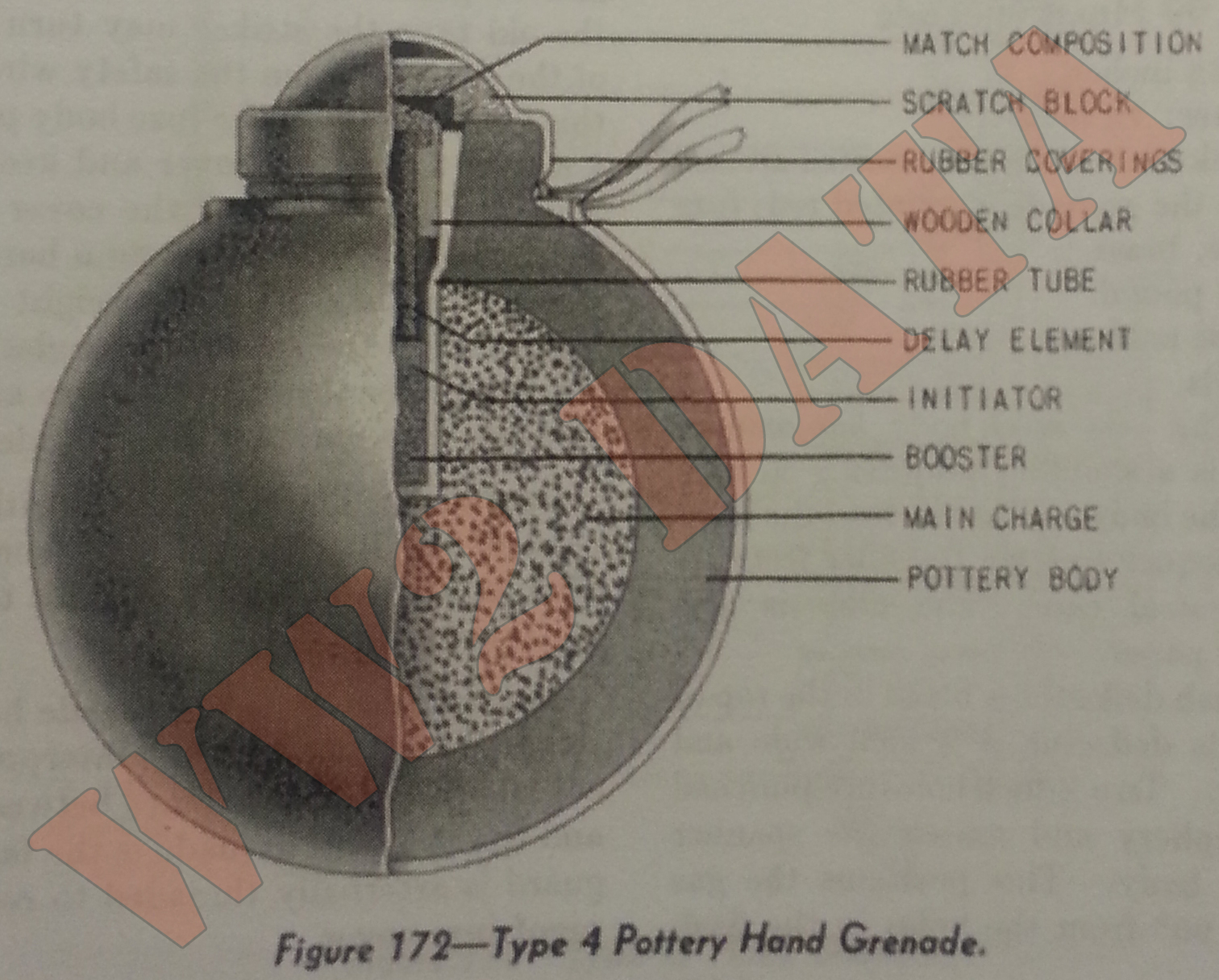
Description: Except for the neck at the top, the grenade is spherical, consisting of two hemispheres baked together.  The pottery body is light brown in color, lightly glazed inside and out.  The grenade is encased in a straw-coloured rubber sack which serves as waterproofing and permits the thrower to take a better grip.

The ignition system consists of a match composition, a 4 or 5 second delay element, a lead azide initiator, and a tetryl booster.  All but the match composition are encased in a rubber tub which is lacquered into the neck of the grenade.  The upper portion of the delay element is surrounded by a wooden collar, the top of which is covered with the match composition.

A wooden scratch block is seated on top of the neck of the grenade.  It is held in place by a small rubber sack which snaps around the neck of the grenade.  This sack serves a second purpose in waterproofing the ignition system.

A cloth band tied around the neck is probably used for carrying.

Operation: The small rubber sack is removed from the top and the scratch block is struck on the protruding match composition, igniting the delay element.  The grenade is thrown and explodes after a 4 or 5 second delay.

Remarks: This grenade appears to be made of the same type pottery as the Type 3 pottery land mine, and like the land mine, uses Type 88 explosive.  For these reasons it may be assumed to be a Navy weapon.

The color of the grenade may vary from white to dark brown, and the exterior may be glazed or unglazed.


Type 23 Hand Grenade


Overall length: 3 and 3/4 inches
Maximum diameter: 2 inches

Total weight of grenade: 1 pound
Filling: Granular TNT
Weight of filling: 39.5 grams
Delay: 5 and 1/2 seconds

Color and markings: Black

Description: The body, unlike the Type 91 or Type 97, has no longitudinal serrations, but does have five transverse depressions.  On one side, fitted top and bottom, are two rings which could be used for carrying or for anchoring.  The lead cover is screwed on to the top of the grenade and is grooved to provide a grip for easy removal.  The thumb cover release holds the cover on and must be depressed before the cover can be removed.

When this is depressed, the cover can be unscrewed in one and one-half turns, thus exposing the firing string which is attached to a friction igniter.

Operation: The thumb cover release must be depressed, and then the cover must be removed.  When the firing string is pulled, it draws a sanded string through a match composition.  The ignition of the match composition will ignite the black powder delay train.


Type 98 Stick Grenade
  

Overall length: 7 and 3/4 inches
Maximum diameter: 1 and 5/16 inches

Total Weight: 1 pound, 3 ounces
Filling: Cast picric acid
Weight of filling: 3 ounces
Delay: 4-5 seconds

Color: Black body; Unpainted handle

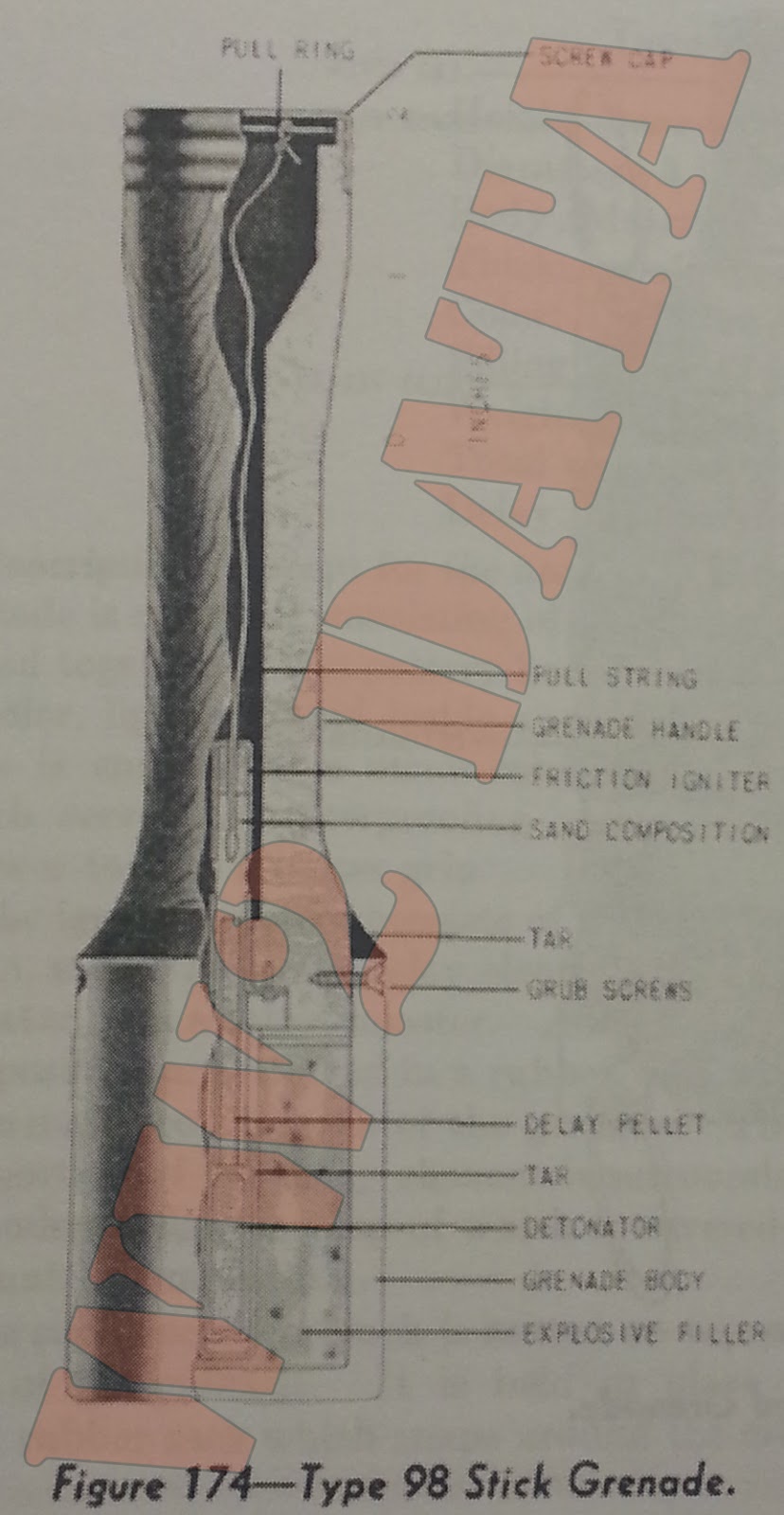
Description: The body is cylindrical in shape and is made of cast steel 1/4-inch thick.  The handle is turned from soft wood and slips into the steel body where it is held by three screws.  This joint is sealed with a coating of tar.  The screw cap at the pull end of the handle is of light, tin-plated steel.

The fuze consists of a friction ignition composition with a sanded string running through it.  This string extends up the hollow handle and is connected to a pull ring which is exposed by removing the screw cap at the top of the handle.

Operation: The screw cap is removed from the top of the handle.  The ring inside the handle is then pulled.  This draws the sanded string through the ignition composition igniting the 4 or 5 second delay.  The delay train detonates a cap which detonates the main charge.

This grenade has more fragmentation effect than the German high explosive stick grenade.


Type 3 Conical Antitank Hand Grenade

 
Small Grenade
Length of grenade: 5 and 7/8 inches
Length of tail: 14 inches
Diameter at base: 4 inches
Length of fuze: 1 and 7/8 inches
Length of cone: 2 and 3/8 inches
Diameter of cone: 2 inches
Cone angle, apex: 38 degrees
Total weight: 0.84 kg
Thickness of cone: 3 mm
Material of cone: Aluminum

Large Grenade
Length of grenade: 6 and 3/4 inches
Length of tail: 14 inches
Diameter at base: 4 and 3/8 inches
Length of fuze: 1 and 7/8 inches
Length of cone: 3 and 3/4 inches
Diameter of cone: 2 and 3/8 inches
Cone angle, apex: 30 degrees
Total weight: 1.25 kg
Thickness of cone: 3 mm
Material of cone: Steel
  
Description:  This grenade is manufactured in two sizes.  The basic principles of construction are the same in both sizes, but variations occur in weights, measurements and the explosive charge.  The grenade consists of a cone-shaped explosive charge, a metal cone, and a wooden base all contained in a silk bag.  A fuze is inserted and a tail attached to the apex of the charge.

The explosive charge is cast in the form of a truncated cone.  A metal cone is inserted in the base and in the upper end is a well which receives the gaine of the fuze.  Surrounding the gaine is a cast ring pellet.  In the large size grenade the explosive is Type 94, and in the small size grenade it is Pentolite (50/50 TNT and PETN).  A thin layer of waxed paper surrounds the charge.

At the bottom of the explosive charge is a wooden base which is flat on the top and rounded on the bottom.  The hole in the base has a slightly smaller diameter than the hole in the cone.

Covering the charge and base is a silk bag either white or olive drab in color.  When the grenade is assembled, a drawstring closes the bottom.  A metal ring is inserted over the top of the bag.  Inside the top of the explosive charge is fitted an adapter ring which is threaded to receive the fuze.  Four screws hold the parts together.

Tied around the top of the grenade is a tail made of hemp to provide stability in flight and to make the grenade strike the tank base first.  The fuze is constructed in two parts which are threaded together.  The lower body has external threads for screwing into the adapter ring and internal threads for receiving the gaine.  The striker is held in position by a safety pin and creep spring.  The under side of the upper body and the top of the striker are curved so that if the grenade strikes at a slight angle the striker will be cammed down.
  
Operation: Before the grenade is thrown the safety pin is pulled out.  On impact the firing pine overcomes the spring and moves down to pierce the primer.  The fuze is not "all-ways action", but will probably function on a slight angle of impact.

A second small grenade has been recovered which is identical to the previously described small grenade in measurements and type of construction but differs in the following details.  The silk bag which covers the charge of the second grenade is made of bright yellow finished silk.  The main explosive charge is picric acid with a small RDX booster.  The adapter ring is bakelite instead of metal, while a straw tail is used in place of hemp.

The fuze of the second grenade has a black finish, a single safety pin, and a gaine which is crimped to the fuze body, but otherwise is similar in construction and operation to the fuze of the first grenade.


Sling Hand Grenade
  

Overall length: 5 and 7/8 inches
Maximum diameter: 1 and 13/16 inches

Total Weight: 1 pound, 3 ounces
Filling: TNT
Weight of filling: 1 ounce
Delay: 4 or 5 seconds

Color: Black

Description: The sling grenade consists of a steel grenade body, wooden base plug, reinforcing cloth, scratch type friction ignited fuze, wooden fuze seat, wooden spacing ring, and a metal protective cap.

The rough, cast steel, cylindrical grenade body has a hollow projection on its forward end into which the wooden fuze seat and fuze are fitted and secured with glue.  The after end of the body opens directly into the TNT filled explosive cavity of the grenade.  This opening is closed by the wooden base plug, which is glued in place.  The throwing line is attached to the after end of the wooden base plug.

A strip of reinforcing cloth is wrapped around the base plug and the after end of the grenade body in order to help prevent the two sections from pulling apart when a line is used to throw the grenade.  The cloth is lashed securely in place by light line, which is tied around the annular groove in the grenade body and the cylindrical after section of the base plug.

A light, sheet metal cap is sealed over the nose of the grenade with waterproof paper tape.  The wooden spacing ring prevents contact between the fuze and the protective cap.  A flat surface on the side of the ring is coated with the abrasive compound used to ignite the fuze.

The fuze for the sling grenade is made in two sections: a long brass detonator tube and a short igniter head.  This tube is pierced by a single gas port and is crimped to the detonator tube.

Operation: The abrasive on the spacing ring is rubbed against the match head of the fuze to ignite the match composition which initiates the firing train.  The grenade is then thrown by hand or by means of the line attached to the ring in its base.  The delay is from 4 to 5 seconds.


1/2kg Incendiary Hand or Mortar Grenade
  

Overall length: 5.6 inches
Maximum diameter: 2 inches
Body material: Brass

Weight: 1.1 pounds
Filling: White Phosphorus
Delay: 4 or 5 seconds

Description:  This grenade may be thrown by hand or projected with the 50mm grenade discharger, Model 89.  The incendiary filling is contained in a brass body which may have a propelling charge on the base.  The fuze is identical to the one used in the Type 91 and Type 97 fragmentation hand grenades.

The steel propellant container is 1 and 1/4 inches long, 1.02 inches in diameter, and has six perforations in its walls.  It is screwed into the base of the body.  A perforated plug screws into the base of this container and in a cavity in this is a percussion cap.  Two flash holes head through the percussion cap holder to a small quantity of black powder.  A perforated steel disc covers the plug and inside the propellant container proper is a copper cup containing flakes of nitrocellulose propellant powder.

Operation: The firing pin must first be threaded down into the inertia weight.  The safety pin must then be withdrawn.  If the grenade is to be thrown by hand, it is necessary to strike the inertia weight on some hard object thus driving the firing pin into the primer to ignite the delay train.

If the grenade is to be fired from the grenade discharger, or knee mortar as it is sometimes called, the grenade with propellant container is dropped base first into the discharger.  When the trigger mechanism of the discharger is operated, its firing pin strikes the percussion cap igniting the propelling charge which propels the grenade.  Force of setback causes the firing pin in the grenade fuze to compress the creep spring and hit the primer to ignite the delay train.


Next Time: More Imperial Japanese Grenades, and Sabotage Devices

Monday, 28 March 2016

Imperial Japanese Navy Explosives - Bombs (Part 4)


Imperial Japanese Navy Explosives


Type 99 No.80 Mk 5 Bomb
  
 
Fuzes: Two B-2(b) tail fuzes
Overall Length: 95 and 1/2 inches
Length of body: 52 and 1/8 inches
Diameter of body: 16 and 1/8 inches
Thickness of wall:
-Nose: 4 inches
-Tail: 2 inches
Material of wall: Forged Steel
 
Type of suspension: Horizontal
Suspension lug: Two guide studs on the bomb bode, position a carrying band, to which a suspension lug is attached.
 
Length of tail: 43 and 3/8 inches
Width of tail: 22 and 1/8 inches
Width of tail fins: 11 and 1/16 inches
 
Dimensions of tail struts:
-Length: 15 and 1/4 inches
-Width: 2 and 3/4 inches
-Thickness: 3/16 inch
Material of tail: Sheet Steel
 
Type of filling: Type 91 explosive (trinitroanisol)
Weight of filling: 66 pounds (approximate)
Total weight of bomb: 1,641 pounds (w/o tail)
Charge/weight ratio: 4%
 
Color and markings: Gray overall.  Green band around the nose, white band aft of green band
 
Construction of body: The bomb body is constructed of one piece of forged machined steel.  There are eight recesses cut in the nose presumably to hold a windshield if the case is used as a projectile.  A male base plate which has two fuze pockets is screwed into the after end of the body.

The tail cone is formed of rolled sheet steel (3/32-inch) welded down one side.  Twelve screws fasten the unreinforced base of the cone to the base plate of the bomb which has holes drilled around the edge to receive the screws.  Three hinged doors in the cone permit access to the fuze pockets.

Two vane assembly supporting rings are located at the apex of the cone.  These rings are constructed to receive the B-2(b) vane assembly bushings which are held in place by set screws. Slots in the tail cone are located beneath the supporting rings to permit passage of the reach rods from the fuze bodies to the vane assembly.
 
Construction of tail: Four sheet-steel fins are spot welded to the tail cone and are braced by a single set of box-type tail struts.


Type 2 No.80 Mk 5 and No.150 Mk 5 Bombs
Please read the general description of this entry

No picture available
  
Type 2 No.80 Mk 5
Fuzes: Two B-2(b) tail fuzes
Gaines: Special Mk 5
Approximate weight of bomb: 1,760 pounds
Material of wall: Forget steel
Material of tail: Sheet Steel
Type of filling: Type 91 explosive
Approximate loading factor: 6%


No.150 Mk 5

Fuzes: Two large fuzes similar to the B-2(b) fuze
Gaines: Special Mk 5
Approximate weight of bomb: 3,300 pounds
Material of wall: Forget steel
Material of tail: Sheet Steel
Type of filling: Type 91 explosive
Approximate loading factor: 6%

 
Color and markings: Gray overall with a green and brown nose band and white tail struts
 
General Description: These two bombs were designed to fill the great need of the Japanese for armor-piercing bombs.  Prior to the design of these two, the Japanese Navy had only one true armor-piercing bomb, the Type 99 No. 80 Mk 5, an adaptation of a large caliber artillery shell produced by turning the shell down to a streamlined shape and adding a tail section and a slightly larger explosive charge.

Type 2 No.80 Mk 5 and No.150 Mk 5, although they were specifically designed as armor-piercing bombs, differ only slightly from the earlier bomb.  Type 2 No.80 Mk 5 differs from the Type 99 No.80 Mk 5 only in having a slightly larger explosive charge, and in having no recesses at the nose to hold a windshield in place.  No.150 Mk 5 is simply a larger version of the Type 2 No.80 Mk 5.

Both bombs of the No.80 size use two B-2(b) fuzes in the tail with the special Mk 5 gaine.  No.150 Mk5 has two large fuzes of similar construction to the B-2(b).  These bombs were never extensively produced and neither Type 2 No.80 Mk 5 or No.150 Mk 5 was ever found outside the Japanese homeland.

The data on these bombs is the result of incomplete investigation, and must not be considered as specific, accurate information.

Note: I'm not sure what the next few paragraphs were intended for, but they are included for accuracy towards the source material.

The Mk 7 bomb was never more than an idea as far as the Japanese Navy was concerned.  It was suggested and discussed by a meeting of designers in 1935, but no experiments were carried out because the idea was considered impractical and unnecessary.  The bomb, as planned, was to consist of the 1 kilogram practice bomb, with a conical glass bottle of bacillus culture in place of the smoke mixture in the tail.

A lengthened striker was to break the bottle, and the culture was to spread by the force of impact.  A spread of 1 meter in diameter was hoped for.  No specific type of bacillus had been selected for the bomb.  Distinctive color marking for the bomb was to have been purple painted nose and tail.


Type 5 No.1 Mk 9 Model 1 and Type 3 No.6 Mk 9 Bombs

No picture available
  
Type 5 No.1 Mk 9 Model 1

Overall length: 35.4 inches
Diameter of body: 3.93 inches
Weight of explosive: 2.2 pounds
Weight of propellant: 4.4 pounds
Total weight of bomb: 33 pounds
Maximum speed: 230m/sec

  
Type 3 No.6 Mk 9
Overall length: 66.9 inches
Diameter of body: 7.87 inches
Weight of explosive: 22 pounds
Weight of propellant: 22 pounds
Total weight of bomb: 184.8 pounds
Maximum speed: 230m/sec
 
Color and markings: Gray overall. Green band on nose, with brown band just aft of green band.  Gray tail struts.
  
General description: Neither of these rockets had been put into production at the end of the war, although experiments had been finished on both of them.  Both were designed as aircraft launched weapons for use against surface targets; Type 5 No.1 Mk 9 Model 1 against surface submarines, and the Type 3 No.6 Mk 9 against landing craft and small ships.

These rockets are similar to the Mk 27 and Mk 28 rockets of comparable sizes, but both are somewhat heavier.  Both carry high-explosive loads, and the Type 5 No.1 Mk 9 Model 1 has a semi-armor piercing nose.
 
Exact fuzing is unknown, but it is known that the Type 5 No.1 Mk 9 Model 1 uses a fuze with a 0-2 second delay.  The Type 3 No.6 Mk 9 is assumed to use an instantaneous fuze.  Both of these rockets are fin stabilized, and more closely resemble American aircraft launched rockets than any of the other Japanese rockets.  However, their small propellant charges result in such low speed that their performance in no way compares with that of American rockets.


Type 98 No.7 Mk 6 Bomb Model 1
  
  
Fuzes: (w/ Magazine) A-3(a), or A-3(b)
Overall Length: 40 inches
Length of body: 21 and 3/4 inches
Diameter of body: 7 and 7/8 inches
Thickness of wall: 1/4 inch
Material of wall: Steel
 
Type of suspension: Horizontal
Suspension lug: Normal Navy suspension lug
 
Length of tail: 18 and 3/16 inches
Width of tail: 10 and 5/8 inches
 
Dimensions of tail struts:
-Length: 7 and 7/8 inches
-Width: 1 and 3/8 inches 
-Thickness: 3/32 inch
Material of tail: Sheet Steel
 
Type of filling: Four thermite-filled electron fire pots are contained within the bomb.  The nose and tail fire pots are cylindrical, while the two in the body are semicircular.  A central channel filled with quick-match runs the length of the bomb.  A black-powder charge is located int he circular recess in the nose piece.
 
Weight of filling: 81 pounds
Total weight of bomb: 156 pounds
Charge/weight ratio: 51%
 
Color and markings: Gray overall with a red nose band and red tail struts.  New type color markings will be found.
 
Construction of body: A cast-steel nose piece is riveted with 2 rows of 10 rivets each to a tubular steel body.  The tail cone is held by 1 row of 24 rivets to a collar which is held in the base of the bomb by 2 rows of screws (14 per row).
 
Construction of tail: Four steel fins are welded to the tail cone and are braced by a single set of box-type struts.

Operation: On impact, the magazine in the nose fuze fires the black powder and the igniting charge.  The black powder ejects the fire pots from the bomb case.  The igniting charge ignites the quick-match which initiates combustion of the thermite.


Type 98 No.7 Mk 6 Bomb Model 2


Fuzes: (w/ Magazine) A-3(a), or A-3(b)
Overall Length: 42 inches
Length of body: 21 inches
Diameter of body: 9 and 3/8 inches
Thickness of wall: 3/16 inch
Material of wall: Steel
 
Type of suspension: Horizontal
Suspension lug: Normal Navy suspension lug
 
Length of tail: 21 inches
Width of tail: 13 and 1/4 inches
Width of tail fins: 6 inches
 
Dimensions of tail struts:
-Length: 9 and 1/2 inches
-Width: 1 and 3/8 inches 
-Thickness: 1/16 inch
Material of tail: Sheet Steel
 
Type of filling: A central thermite core surrounded by solidified kerosene, petrol, and alcohol-soap mixture.

Weight of filling:
-20 pounds of inflammable mixture
-7.5 pounds of thermite
Total weight of bomb: 145 pounds
Charge/weight ratio: 22%
   
Color and markings: Gray overall with two longitudinal diametrically opposite thin red lines.  Red nose and red struts.  New type markings will be found.
 
Construction of body:  cast-steel nose is attached to a tubular-steel body by a continuous circumferential weld and 2 rows of 16 plug welds each.  A wood block and black powder burster charge are located in the nose.  Housed within the body is a steel cylinder which contains the incendiary filling. 
 
A central copper tube within the cylinder contains quick-match.  A tail cone is attached to a collar by a continuous circumferential weld and 16 plug welds.  The collar fits into the after end of the body and is held there by 2 rows of 16 screws each.
 
Construction of tail: Four steel fins are welded to metal strips which are riveted (14 rivets each) to the tail cone.  The fins are braced by a single-set of box-type struts.

Operation: On impact, the magazine in the nose fuze fires the black-powder charge which shears off the tail cone and ejects the incendiary cylinder out of the bomb case.  At the same time, the quick match is ignited.  This in turn sets fire to the thermite and the inflammable mixture.


Type 1 No.7 Mk 6 Bomb Model 3 Modification 1
 

Fuzes: A-3(a)
Overall Length: 42 and 1/4 inches
Length of body: 21 inches
Diameter of body: 9 and 3/8 inches
Thickness of wall: 1/8 inch
Material of wall: Steel

Type of suspension: Horizontal
Suspension lug: Normal Navy suspension lug

Length of tail: 21 inches
Width of tail: 13 and 1/4 inches
Width of tail fins: 6 inches

Dimensions of tail struts:
-Length: 9 and 1/2 inches
-Width: 1 and 3/8 inches
-Thickness: 1/16 inch
Material of tail: Sheet Steel
  
Type of filling: 182 cylindrical incendiary pellets are arranged around a central cardboard tube.  The pellets are bound together with string to form rings.  The rings surround the central tube which is filled with gray powder.  All the space in the bomb not occupied by the pellets is filled with this powder.

Weight of individual pellets: 7 ounces
Total weight of pellets: 81 pounds
Length of pellets: 2 and 1/8 inches
Diameter of pellets: 1 and 1/2 inches

Composition of pellets:
-Barium nitrate: 35%
-Ferric oxide: 28%
-Aluminum: 18%
The remainder is synthetic rubber of polysulphite type resembling "Thiokol."

Weight of igniter powder: 30 pounds

Composition of igniter powder:
-Barium nitrate: 75%
-Aluminum: 24.5%
-Oil: 0.3%
-Moisture: 0.2%

Weight of filling: 111 pounds
Total weight of bomb: 160 pounds
Charge/weight ratio: 69.4%

Color and markings: Gray overall with a 3 and 1/2-inch red band at the nose and red tail struts.  New type markings will be found.

Construction of body: A cast-steel nosepiece is attached to a longitudinally welded steel body by a continuous circumferential weld.  The nose contains a wooden block 1 and 3/4 inches thick to which a light metal gaine well is secured by three nails.

A longitudinally welded tail cone is welded to a collar which fits into the after end of the body and is held there by a single row of 16 screws.

Construction of tail: our steel fins are spot welded to the tail cone.  They are braced by a single set of box-type struts.

Remarks:
-Type 1 No.7 Mk 6 Model 3: This bomb uses the same case as that described above but differs in the filling.  It contains a high-explosive burster charge in a central tube and an explosive filling of approximately 520 wedge-shaped rubber pellets impregnated with iron and aluminum.


Type 3 No.25 Mk 8 Bomb Model 1
  
 
Fuzes: A-3(a)
Overall Length: 67 inches
Length of body: 39 and 5/8 inches
Diameter of body: 12 inches
Thickness of wall: 1/2 inch
Material of wall: Steel

Type of suspension: Horizontal
Suspension lug: Normal Navy suspension lug

Length of tail: 27 and 3/8 inches
Width of tail: 19 and 5/8 inches
Width of tail fins: 6 and 3/8 inches

Dimensions of tail struts: None
Material of tail: Sheet Steel
  
Type of filling: Type 97 explosive
Weight of filling: 263 pounds
Total weight of bomb: 649 pounds
Charge/weight ratio: 40%
 
 Color and markings: Green band around the nose, brown band aft of green band.  Gray body and tail.

Construction of body: A cast-steel nose is attached to a tubular-steel body by a continuous circumferential weld and 12 plug welds.  A tail cone is held to a collar by 8 plug welds.  The collars fits into the after end of the body and is held there by 40 screws.

Construction of tail: The normal tail cone has been cut off 8 and 3/4 inches aft of the junction with the bomb body proper and to this has been welded a 3/16 inch steel cylinder and four 1/8 inch steel hollow tail fins.

Tail cylinder:
-Outside diameter: 5 and 5/8 inches
-Length: 18 and 5/8 inches
-Type of filling: Type 97 explosive
 
Tail fins:
-Shape of cross-section: Triangular
-Overall length: 25 and 1/2 inches
-Height: 6 and 3/8 inches
-Width at base: 2 and 1/2 inches

Reinforcement of fins:

1. A box strut made of 1/8-inch mild steel runs the length of the fin on the inside.  The box strut is 7/8-inch wide at the top and 1 and 3/4 inches high and 22 inches long.  The strut is welded along the two lower edges to the side of the fins proper and spot welded along the sides.

2. Three 1/4-inch mild steel braces, 1 and 1/2 inches wide at the top, 2 and 1/2 inches wide at the bottom and 2 inches high are welded at 5 and 1/2-inch intervals to the box strut and the sides of the fins.  The lower sides of these braces have been shaped to fit the cylinder.

3. The end of the fins is closed by a 1/8-inch steel plate welded in place.


Next Time: More IJN bombs, including cluster munitions

Monday, 29 February 2016

Imperial Japanese Navy Explosives - Bombs (Part 1)


Imperial Japanese Navy Explosives


Type 97 No.6 Land Bomb
 
  
Fuzes: A-3(a)
Overall Length: 40 inches
Length of body: 21 and 3/4 inches
Diameter of body: 7 and 7/8 inches
Thickness of wall: 1/4 inch
Material of wall: Steel
 
Type of suspension: Horizontal
Suspension lug: Normal Navy type
 
Length of tail: 18 and 3/16 inches
Width of tail: 10 and 5/8 inches
Width of tail fins: 4 and 3/4 inches
 
Dimensions of tail struts:
-Length: 7 and 7/8 inches
-Width: 1 and 3/8 inches
-Thickness: 3/32 inch
 
Material of tail: Sheet Steel
 
Type of filling: Picric acid or Type 98 explosive
Weight of filling: 50 pounds
Total weight of bomb: 124 pounds
Charge/weight ratio: 40%
 
Color and markings: Gray overall with a green band on the nose, green tail struts, and a blue band around the body.  Two thin red lines 180 degrees apart run longitudinally along the bomb.  New type markings will be found.
 
Construction of body: A cast-steel nose is attached by a continuous weld and 2 rows of 10 rivets each to a tubular-steel body.  A circumferential weld to a collar which fits into the after end of the body is held there by 2 rows of screws (14 per row).
 
Construction of tail: Four fins are spot welded to the tail cone and braced by a single set of box-type struts.


Type 2 No.6 Land Bomb Model 5
 
  
Fuzes: A-3(a), A-3(b)
Overall Length: 42 inches
Length of body: 25 and 3/4 inches
Diameter of body: 10 inches
Thickness of wall: 1/16 inch
Material of wall: Sheet steel
  
Type of suspension: Horizontal
Suspension lug: Standard Navy type suspension lug
  
Length of tail: 16 and 1/4 inches
Width of tail: 10 inches
Width of tail fins: 4 and 1/4 inches
  
Dimensions of tail struts:
-Length: 10 inches
-Width: 1 inche
-Thickness: 1/16 inch
Material of tail: Sheet Steel
  
Type of filling: Five 7kg high-explosive bombs and a high-explosive central burster
Total weight of bomb: 132 pounds (approx.)
  
Color and markings: Gray overall with a brown nose section.  New type color markings will be found.
  
Construction of body: A hollow-steel nosepiece and a hollow tail cone are connected by an explosive-filled central tube on the inside and two half cylinders of sheet steel on the outside.  The two half cylinders are connected by four metal tabs riveted to each half of the cylinder on the inside. 
 
There are four notches 3/16 inch square and 90 degrees apart in each end of the assembled cylinder.  The notches fit around the four pins which are on the nosepiece and tailpiece.  There is a spacer plate and five space strips attached to the central tube.
 
Construction of tail: Four steel fins are welded to the tail cone and are braced by a single circular strut at the after end.  The fins are set at an angle to the tail cone in such a manner that they will impart a rotary motion to the container when it is dropped. 
 
Description of 7kg high-explosive bomb: No fuze or complete bomb has been found.  The only information available on the bomb and fuze comes from a captured Japanese bomb chart.  The bombs are alleged to be nose fuzed, 20 and 1/4 inches long and 3 and 1/2 inches in diameter.
 
The tail fins from several of the bombs have been found.  The tail fins are painted gray, one has a 4 and 1/4 inch slot which allows the narrower one to fit into it.  The fins are spot-welded at the extreme ends of the slot.  The tail fins are braced by box-type struts welded to the after-most end.
 
Dimensions of "Wide" tail fins:
-Width: 4 and 1/4 inches
-Length (Approx.): 10 and 3/8 inches
-Thickness: 1/16 inch
 
Dimensions of "Narrow" tail fins:
-Width: 3 and 1/2 inches
-Length (Approx.): 10 and 3/8 inches
-Thickness: 1/16 inch
Dimensions of tail struts:
-Width: 15/32 inch
-Length (Approx.): 2 and 3/8 inches
-Thickness: 1/16 inch
 
Remarks: Production of this bomb ceased before the end of the war
 
 
No.25 Land Bomb

 
Fuzes: A-3(a), A-3(b), C-2(a), B-3(a), C-1(a)
Overall Length: 72 inches
Length of body: 35 and 1/2 inches
Diameter of body: 13 and 3/4 inches
Thickness of wall: 1/4 inch
Material of wall: Steel
 
Type of suspension: Horizontal
Suspension lug: Normal Navy suspension lug
 
Length of tail: 36 and 1/2 inches
Width of tail: 19 and 3/16 inches
Width of tail fins: 7 and 5/8 inches
 
Dimensions of tail struts:
-Length: 13 and 7/8 inches
-Width: 2 and 1/4 inches
-Thickness: 3/32 inch
 
Material of tail: Sheet Steel
Type of filling: Type 98 explosive
Weight of filling: 330 pounds
Total weight of bomb: 550 pounds
Charge/weight ratio: 60%
 
Color and markings: Gray overall with a green nose band and green tail struts.  There are two thin, red lines 180 degrees apart along the length of the bomb.  New type color markings will be found.
 
Construction of body: A cast-steel nose is welded to a tubular-steel body by a continuous weld and a row of 16 plug welds.  The tail cone is held by 1 row of 32 screws to a collar which is held in the base of the bomb by a row of 16 plug welds.  There is a threaded fuze pocket in both the nose and tail.
 
Construction of tail: Four fins are spot-welded to the tail cone and braced by a single set of box-type struts.


Type 98 No.25 Land Bomb

 
Fuzes: A-3(a), A-3(b), C-2(a), B-3(a), C-1(a)
Overall Length: 72 inches
Length of body: 39 and 1/2 inches
Diameter of body: 12 inches
Thickness of wall: 1/2 inch
Material of wall: Steel
 
Type of suspension: Horizontal
Suspension lug: Normal Navy suspension lug
 
Length of tail: 32 and 1/2 inches
Width of tail: 16 and 5/8 inches
Width of tail fins: 7 and 5/16 inches
 
Dimensions of tail struts:
-Length: 13 and 7/8 inches
-Width: 2 and 1/4 inches
-Thickness: 3/32 inch
Material of tail: Sheet Steel
 
Type of filling: Picric acid or Type 98 explosive
Weight of filling: 211 pounds
Total weight of bomb: 532 pounds
Charge/weight ratio: 40%
 
Color and markings: Gray overall with a green nose band and green tail struts. There are two thin, red lines 180 degrees apart along the length of the bomb. New type color markings will be found.
  
Construction of body: A cast-steel nose is welded to a tubular-steel body by a continuous weld and 1 row of 12 large plug welds.  The tail cone is held by 1 row of 18 plug welds and a continuous weld to a collar which is held in the base of the bomb by 40 screws in 2 rows of 20 each.  There is a threaded fuze pocket in both the nose and tail.
  
Construction of tail: Four fins are spot-welded to the tail cone and braced by a single set of box-type struts.
Remarks: The Type 98 bomb is reported in some instances to be turned down to appear smooth on the exterior surface.


No.80 Land Bomb
 
  
Fuzes: A-1(c), B-3(b), A-3(d)
Overall Length: 113 inches
Length of body: 72 inches
Diameter of body: 18 inches
Thickness of wall: 1/2 inch
Material of wall: Steel
 
Type of suspension: Horizontal
Suspension lug: Two guide studs on the bomb body position a carrying band to which a suspension lug is attached.
 
Length of tail: 41 inches
Width of tail: 25 inches
Width of tail fins: 10 and 1/2 inches
 
Dimensions of tail struts:
-Length: 17 and 1/4 inches
-Width: 3 and 5/8 inches
-Thickness: 1/8 inch
Material of tail: Steel
 
Type of filling: Picric acid (tail cone is filled), or Type 98 explosive
Weight of filling: 842 pounds
Total weight of bomb: 1,760 pounds
Charge/weight ratio: 48%
 
Color and markings: Grey overall.  Green nose and tail struts.  Two red lines 180 degrees apart along the longitudinal axis of the bomb.  Blue band around the body.  New type markings will be found.
 
Construction of body: A cast-steel nose is attached to a tubular body by a continuous circumferential weld and 3 rows of 14 rivets each.  The tail cone is held by a continuous circumferential weld and 2 rows of 16 rivets each to a collar which is held in the base of the bomb by 2 rows of round-headed screws (32 screws in each row).  This bomb has a threaded fuze pocket in both the nose and tail.
 
Construction of tail: Four 1/8 inch steel fins are spot welded to the tail cone and are braced by a single set of box-type struts.


Type 99 No.6 Ordinary Bomb


Fuzes: A-3(a), A-3(b)
Overall Length: 42 and 1/4 inches
Length of body: 25 and 1/2 inches
Diameter of body: 8 and 7/8 inches
Thickness of wall: 1/4 inch
Material of wall: Steel
 
Type of suspension: Horizontal
Suspension lug: Normal Navy suspension lug
 
Length of tail: 16 and 7/8 inches
Width of tail: 12 and 1/4 inches
Width of tail fins: 5 and 5/8 inches
 
Dimensions of tail struts:
-Length: 9 inches
-Width: 1 inch
-Thickness: 1/16 inch
Material of tail: Steel
 
Type of filling: Picric acid or Type 98 explosive
Weight of filling: 70 pounds
Total weight of bomb: 138 pounds
Charge/weight ratio: 50%
 
Color and markings: Gray overall with a green nose band and green tail struts.  There are two thin red lines 180 degrees apart along the length of the bomb.  New type color markings will be found.
 
Construction of body: The body is constructed of 1 piece of machined forged steel.  It is threaded in the nose to receive a fuze.  The after end of the body is threaded internally to accommodate a male base plate.  A tail cone is secured to the base plate by a signle row of 20 screws.  There is no explosive in the tail cone.
 
Construction of tail: Four fins are spot welded to the tail cone and braced by a single set of box-type struts.


Type 99 No.25 Ordinary Bomb Model 1
  
 
Fuzes: A-3(a), A-3(b), B-2(a)
Overall Length: 68 inches
Length of body: 39 and 3/4 inches
Diameter of body: 11 and 1/2 inches
Thickness of wall: 1/4 inch
Material of wall: Steel
 
Type of suspension: Horizontal
Suspension lug: Normal Navy suspension lug
 
Length of tail: 28 inches
Width of tail: 16 and 1/4 inches
Width of tail fins: 6 and 15/16 inches
 
Dimensions of tail struts:
-Length: 12 inches
-Width: 1 and 5/8 inches
-Thickness: 1/16 inch
Material of tail: Steel
 
Type of filling: Type 91 (Trinitroanisol)
Weight of filling: 132 pounds
Total weight of bomb: 550 pounds
Charge/weight ratio: 24%
 
Color and markings: Gray overall with a green nose band and green tail struts.  There are two thin red lines 180 degrees apart along the length of the bomb.  New type color markings will be found.
 
Construction of body: The body is constructed of one piece of machined forged steel.  It is threaded in the nose to receive a fuze.  The after end of the body is threaded internally to accommodate a male base plate.  The base plate is drilled centrally to receive the tail fuze.  A tail cone is secured to the base plate by six screws.  The cone is empty and has three hinged doors to permit access to the tail fuze pocket in the base plate.
 
Construction of tail: Four fins are spot welded to the tail cone and braced by a single set of box-type struts.


Type 2 No.50 Ordinary Bomb Model 1
  
 
Fuzes: A-3(f), B-2(a)
Overall Length: 78 inches
Length of body: 38 and 1/2 inches
Diameter of body: 15 and 1/2 inches
 
Thickness of wall:
-At base: 1 inch
-At nose: 7 and 1/2 inches
 Material of wall: Steel
 
Type of suspension: Horizontal
Suspension lug: Two guide studs on the bomb body position the Navy type suspension bands
 
Length of tail: 39 and 1/2 inches
Width of tail: 15 and 1/2 inches
Width of tail fins: 7 and 3/4 inches
 
Dimensions of tail struts:
-Length: 10 and 3/4 inches
-Width: 3 and 1/4 inches
-Thickness: 1/8 inch
Material of tail: Steel
 
Type of filling: Cast blocks of Type 98 explosive
Weight of filling: 148 pounds
Total weight of bomb: 1,100 pounds
Charge/weight ratio: 13%
 
Color and markings: The bomb is gray overall with a green-tipped nose, brown nose band and green tail struts.
 
Construction of body: The bomb body is constructed of one piece of machined forged steel.  A fuze pocket is drilled in the nose.  The after end of the body is threaded internally to accommodate a male base plate.  There is a fuze pocket drilled in the base plate.  A sheet steel tail cone is attached to the base plate by eight bolts.  Three trap doors in the tail cone give access to the fuze pocket.
 
Construction of tail: Four Navy type tail fins are spot-welded to the tail cone.  They are braced by a single set of box-type struts.


Next Time: Ordinary and other bombs

Monday, 18 May 2015

Imperial Japanese Army Ammunition - 12.7mm and 20mm Projectiles

Japanese Explosive Ordnance: Army and Navy Ammunition

We start to get into the higher munitions, starting with the 12.7mm cartridge.  It should be noted that the 12.7mm is similar to the .50 cal bullet, but the cartridges have different lengths, which is a very important detail as the diameter alone can be misleading.  The Japanese Army only had one machine gun chambered in 12.7mm, the Ho-103 or Type 1, and was used in aircraft.  The Ho-103 was sometimes referred to the Ho-104, and the only difference between the Ho-103 and Type 1 was that the former was used in a fixed position in the wings and the latter was used in a flexible position as a defensive gun on a bomber.


12.7x81mm Aircraft Cannon Ammunition
Once again, it's a bit of a misnomer to call the 12.7mm round a cannon round, when examples like the MG131 13mm Machine Gun and the M2 Browning were not called cannons.  In any case, the Ho-103 saw extensive use in the air force.


7 variants exist for it, although 3 differ only slightly.


Ball: CuNi jacket and Lead core
A.P.T.: Brass jacket with Steel core
H.E.I. (fuzed Japanese): Brass jacket and P.E.T.N. incendiary and steel core
H.E.I. (fuzed Italian): Brass jacket and P.E.T.N. incendiary and steel core
H.E.I. (fuzed Fuzeless): Brass jacket and P.E.T.N. incendiary and steel core
Tracer: CuNi jacket and Steel core
A.P. (Italian): Gilding metal jacket and Lead tip - steel core


As you might have suspected, the 12.7x81mm cartridge was copied from an Italian design.


Colors and markings were:
Ball: Red
A.P.T.: Black or green and white
H.E.I. fuzed: White
H.E.I. fuzeless: Purple
H.E.I. fuzed (Italian): Red, blue or green body
Tracer: Green
A.P. (Italian): Black tip on the nose

Notes

This ammunition was copied by the Japanese from the Italians.  Of the two H.E.I. fuzed rounds, one is Italian and the other is a Japanese copy of it.  The Japanese H.E.I. fuzed differs from the Italian round in that the fuze used is of two-piece construction instead of one.  This ammunition is packed in 10-round cartons and is reloaded into metal link belts for use.


Type 97 and Type 98 20mm Ammunition


20mm rounds were used by 4 different Army guns, with the Type 97 round being used in the Type 97 antitank gun, the Ho-1 (flexible) cannon and the Ho-3 (fixed) cannon, while the Type 98 round was used in the dual-purpose Type 98 gun.  The Type 97 was 124mm in case length, and the Type 98 was 142mm.  Both cases were made of drawn brass and were rimless.  The case is crimped to the projectile by three long crimps and sealed by a clear lacquer.


Propellant: The propellant is graphited smokeless powder made in single perforated cylindrical grains approximately 1.5mm in diameter and 3mm in length.  The weight of the propellant in the small case is 35.8 grams and, in the large case, 58.9 grams.


20mm (20x142mm) High-Explosive Tracer Projectile


Overall Length: 20.8 cm
Length of projectile: 81.3mm
Weight of projectile: 128.8 grams
Filling: Cyclonite, tracer composition

Color and markings: Black body with yellow band just aft of bourrelet and white badn forward of rotating band.

Fuzing: Type 93 small instantaneous fuze

Used in: Type 98 antiaircraft/antitank gun

Notes:
This projectile is made of steel with two cavities separated by a septum.  The round is characterized by a sharp bourrelet.


Next Time: 20mm Ammunition continued...