Monday, 19 December 2016

British Explosive Ordnance - Semi-Armor Piercing, Armor Piercing, and Deep Penetration Bombs


British Explosive Ordnance


 Semi-Armor Piercing and Armor Piercing Bombs Introduction


There are two British SAP bombs in present service use.  They are designed for penetration of resistant targets, such as reinforced concrete or medium armored targets, where penetration is required before the bomb detonates.

Only one AP bomb, the 2000lb, is used by the British.  It is used for attacks against heavily armored targets, such as capital ships, and is so constructed and fuzed that the bomb does not break up on impact.  Detonation does not occur until after the target is penetrated.  A 450lb AP bomb was used early in the war, constructed along the same lines as the 2000lb, but it is now obsolete.

Both the AP and SAP bombs are fuzed in the tail only.  Earlier marks were designed to receive a tail fuze, but later marks are fitted for pistol/detonator combination.  In later marks, the pistol used for fuzing is supplied in position in the bomb, without detonators, where it acts as a tail transit plug.

SAP bombs are dark green overall, with a white band on the nose just before a red band.  The actual construction is similar to the GP bombs, but the case is thicker, and they are even more streamlined.  They are normally filled with TNT, and have a loading factor of about 20 percent.  Mks I, II, III, and IV have tails secured by a fuze locking ring which is threaded left-handed, while the Mk V has a clip-on tail.

AP bombs are dark green in color.  The nose is painted light green to the point of widest diameter.  Two white bands, separated by a red band, are painted around the nose.  The bombs are of one-piece construction, and are filled with shellite, which consists mainly of picric acid and is very insensitive.  The loading factor is about 10 percent.


SAP 250lb Mks II and III (Obsolete), and Mks IIC, IIIC, and V (Service)


Overall length: 49 inches
Body length: 31.5 inches
Body diameter: 9.2 inches
Wall thickness: 0.91 to 0.99 inches at maximum  diameter and 0.61 to 0.69 inches at minimum thickness beginning 16.8 inches abaft nose.

Tail length: No.10 Mk I and No.5 Mk I - 18 inches
Tail width: 9.2 inches
Total weight: 245 pounds
Charge/Weight ratio: 17%

Fuzing:
-Mks II-IV: Tail Fuze No.30
-Mk V: Tail Pistols No.28 or No.30

Tail No:
-Mks II and III: No.1 Mk I
-Mk V: No.10 Mk I

Color and markings:  Dark green overall
1/2 inch white band 3 inches from nose,
1/2 inch red band 3 and 1/2 inches from nose,
1 inch light green band 6.5 inches from nose.

  
Body Construction: The Mk V body is forged steel with a pointed nose and an open base threaded internally to receive the exploder container, which is cemented in position.  The base of the body is threaded externally to receive a tail adapter, which is in the form of a coned ring with four equi-spaced slots to receive the spring clips of the tail.  Earlier marks were similar to the Mk V, with slight variations in the tail adapter.


Tail Construction: The Tail No.10 Mk I has a tail cone with a cylindrical strut attached by four fins.  It is attached to the bomb body by four spring clips.  The arming spindle engages the fork in the tail pistol.  The Tail No.1 Mk I, used on Bombs Mk II and III has no spring clips, while the Tail No.3 Mk I used on Bombs Mk IIC, Mk IIIC, does have spring clips.


Suspension: A single suspension lug is secured to the body by four screws.
  

Explosive Components:
Exploders: CE pellets in Mks II-IV, and HE in the Mk V.

Filling:
-Mk V: 40.5 pounds TNT/Beeswax
-Mks II-IV: 41.5 pounds TNT


Remarks: The Tail Fuze No.30 has left-hand threads on the securing ring.  Use of the Tail Pistol No.37 is unlikely. 

Tail fins are usually painted red when the Time Pistol No.37 is used.

Any mark may be found fitted with a copper driving band for proof firing from the BL 9.2 inch Howitzer.


SAP 500lb Mks II-III (Obsolete), and Mks IIC, IIIC, and V (Service)
   

Overall length: 62 inches
Body length: 41.8 inches
Body diameter: 11.5 inches
Wall thickness: 1.22 to 1.32 inches at maximum  diameter and 0.82 to 0.92 inches at minimum thickness beginning 23 inches abaft nose.

Tail length:
-No.6 Mks I: 21 inches
-No.11 Mk I: 20.4 inches
-No.27 Mk I and II: 9.24 inches

Tail width: 11.5 inches
Total weight: 490 pounds
Charge/Weight ratio: 18%

Fuzing:
-Mks II-IV: Tail Fuze No.30
-Mk V: Tail Pistols No.28 or No.30

Tail No:
-Mks II and III: No.1 Mk I
-Mks IIC and IIIC: No.4 Mk I
-Mk V: No.11 Mk I, or No.27 Mk I

Color and markings:  Dark green overall
1/2 inch white band 3 inches from nose,
1/2 inch red band 8 and 1/2 inches from nose,
1 inch light green band 8 inches from nose.

  
Body Construction: The Mk V body is forged steel with a pointed nose and an open base, threaded internally to receive the exploder container, which is cemented in position.  The base of the body is threaded externally to receive the tail adapter, which is in the form of a coned ring with four equi-spaced slots to receive the spring clips of the tail.  Earlier marks were similar to the Mk V, with slight variations in the tail adapter.


Tail Construction: The Tails No.27 Mks I and II are the short-type tail unit with arming vanes protruding beyond the strut and fins.  The Tail Assembly No.11 Mk I consists of a tail cone with a cylindrical strut attached by means of four fins.  It is attached to the bomb body by four spring clips.  The arming spindle engages the fork in the tail pistol.  The Tail No.1 Mk I used on Bombs Mk II and Mk III has no spring clips, while the No.4 Mk I tail used on Bombs Mk IIC and Mk IIIC does have spring clips.


Suspension: A single suspension lug is secured to the body by four screws.
  

Explosive Components:
Exploders: CE and TNT in Mks II-IV; CE only in Mk V.  There is no separate layer of TNT around the exploder as in the 250lb SAP Mk V.

Filling:
-Mks II-IV: 90 pounds TNT
-Mk V: 89 pounds TNT


Remarks: The Tail Fuze No.30 has left-hand threads on the securing ring.

Use of the Tail Pistol No.37 is unlikely, but if used, tail fins are usually painted red.

The Bomb Mk I is very old and will not be found.  The Mk IV bomb was manufactured, but never filled.


AP 2000lb Mks I, II, III, and IV (Service)
   

Overall length: 113 inches
Body length: 80 inches
Body diameter: 13.5 inches
 Wall thickness: 2.4 inches (approx.)
 Tail length: 35.5 inches
 Tail width: 13.5 inches
Total weight: 1934 pounds
Charge/Weight ratio: 9%

Fuzing:
-Mks I, II, and III: Tail Fuze No.37
-Mk IV: Tail Pistol No.30

Tail No:
-Mk I: No.1 Mk I
-Mks II and III: No.10 Mk I
-Mk IV: No.47 Mk I

Color and markings:  Dark green overall, with light green nose
Three 1/2 inch bands, white, red, and white respectively, painted 4 inches to 5 and 1/2 inches from tip of nose.

  
Body Construction: The Bomb Mk I has a forged steel body with a solid nose approximately 1.9 feet long and a slight taper from the maximum diameter to the tail.  The base is threaded externally to take a tail adapter, and internally to take a base adapter, which receives the exploder container.  The fuze is locked in position by a fuze securing ring.  The Mks II and III are similar to the Mk I, except for the tail adapter, which has four equi-spaced holes threaded for attachment of the tail.  The Mk IV is modified to take a Tail Pistol No.30.


Tail Construction: The Tail No. 1 Mk I is of aluminum alloy, consisting of a cylindrical strut attached to the tail cone by four vanes.  It fits over the tail adapter and is secured by six screws.  The Tail No.15 Mk I is similar to the No.1 Mk I, but is made of steel.  It has a strengthening ring two inches from the base, and is secured to the tail adapter by four wing bolts.  The Tail No.47 Mk I consist of a cylindrical strut secured to the tail cone by four fins which are riveted on.  A reach rod extends through the tail cone, and is supported by a spider.


Suspension: The bomb is suspended from the plane by two suspension bands.
  

Explosive Components:
Exploders: CE issued in position in exploder container.
Filling: 166 Shellite, with a composition pad in the forward end of the cavity, sealed aft with washers and cement.  Shellite is a very insensitive explosive consisting of 70% picric acid and 30% dinitrophenol.


Deep Penetration Bombs Introduction

These bombs were designed for special operational uses to give deep penetration of the earth and to produce heavy shock waves as a result of the explosion of their main charge.  They have a charge/weight ratio of about 45%, and are not intended for use as armor- or concrete-piercing bombs.

The two sizes of bombs are identical in all respects, the 22000 pound DP being merely an enlarged version of the 12000 pound DP.  A rather unusual feature of these bombs is the use of a cowl between the bomb body and the tail assembly to enhance their streamlining.  Both DP bombs are tail fuzed only, each bomb using three Tail Pistols No.58 located 120 degrees apart in the base plate.

These bombs have been adapted by the US for service use after slight modifications in the method of construction.


DP 12,000lb Mk I "Tallboy" (Service)

Overall length: 21 feet
Body length: 10 feet, 4 inches
Body diameter: 3 feet, 2 inches
Wall thickness:
-Near tail: 1.25 inches
-Near nose: 4.1 inches

Tail length: 10 feet, 8 inches

Tail width: 3 feet, 6 inches (across fins)
Total weight: 11,885 pounds
Charge/Weight ratio: 45% (approx.)

Fuzing: Mk III - Three Tail Pistols No.58 Mk I

Tail No: No.78 Mk I
  

Color and markings: Green overall, Red band near nose


Body Construction: The bomb body is manufactured of cast steel, with a solid nose plug, and with three exploders fitted 120 degrees apart in the base plate.  The bombs are issued with exploders inserted, and the exploder tubes are sealed with shipping plugs.

The tail is attached to the after end of the bomb body by 12 studs.  A cylindrical metal cowling, placed between the bomb body and the tail cone, enhances the streamlining of the bomb.

The bomb body contains an explosive filling of Torpex with a one-inch layer of TNT topping added to the after end.  Four inches of wood-meal/wax composition is then added, and the filling sealed with a 1/2 inch plyboard washer.  The three exploders pass through holes in this washer and are held in place by a heavy base plate, which is secured by bolts to the bomb body.


Tail Construction: The special tail unit, No.78 Mk I, is constructed of light alloy and consists of a cone to which are attached four fins of streamlined cross-section.  The fins are set at an angle of 5 degrees to the axis of the tail cone, giving a slight right-hand spin to the bomb as it falls.  The tail fits over twelve 7/16 inch studs fitted into the bomb body, and is securely fastened to the studs by Simmonds nuts.  Three hand-holes in the tail cone give ready access to the three tail pistols.
 
Suspension: The bomb is suspended in the plane by twin suspension links.  Each link is coupled beneath the bomb by a special Vickers release clip, capable of either electrical or manual operation.

In addition to the suspension links, the bomb is positioned in the plane by a standard crutching system.
  

Explosive Components:
Exploders:
-Primary: 2 ring and 2 solid CE pellets; 4 solid RDX/Beeswax pellets
-Secondary: 2 ring and 2 solid large RDX/Beeswax pellets (placed in a special exploder tube into which the standard exploder container fits)


Main Filling: Approximately 5,200 pounds Torpex surmounted by a 1-inch topping of TNT.


Remarks: This bomb is designed for special operation uses, and its employment will be restricted to certain specified bomb commands.  The initials "DP" signify its deep penetration characteristics, although the bomb is not designed for armor or concrete piercing.  Rather, it is intended to produce heavy shock waves as a result of the explosion of its heavy main charge deep within the earth.

The bomb is carried on specially adapted Lancaster aircraft.  The striking velocity of the bomb, when released at an altitude of 18000 feet, and an air speed of 200 mph, is stated at 1,097 ft/sec at which speed it has developed a rotational velocity of 300 rpm.

The filling and exploder system of this bomb is identical to that of the 22000 pound DP Bomb, "Grand Slam".  The two bombs are identical in all respects, the 22000 pound DP being merely an enlarged version of the 12000 pound DP Bomb.
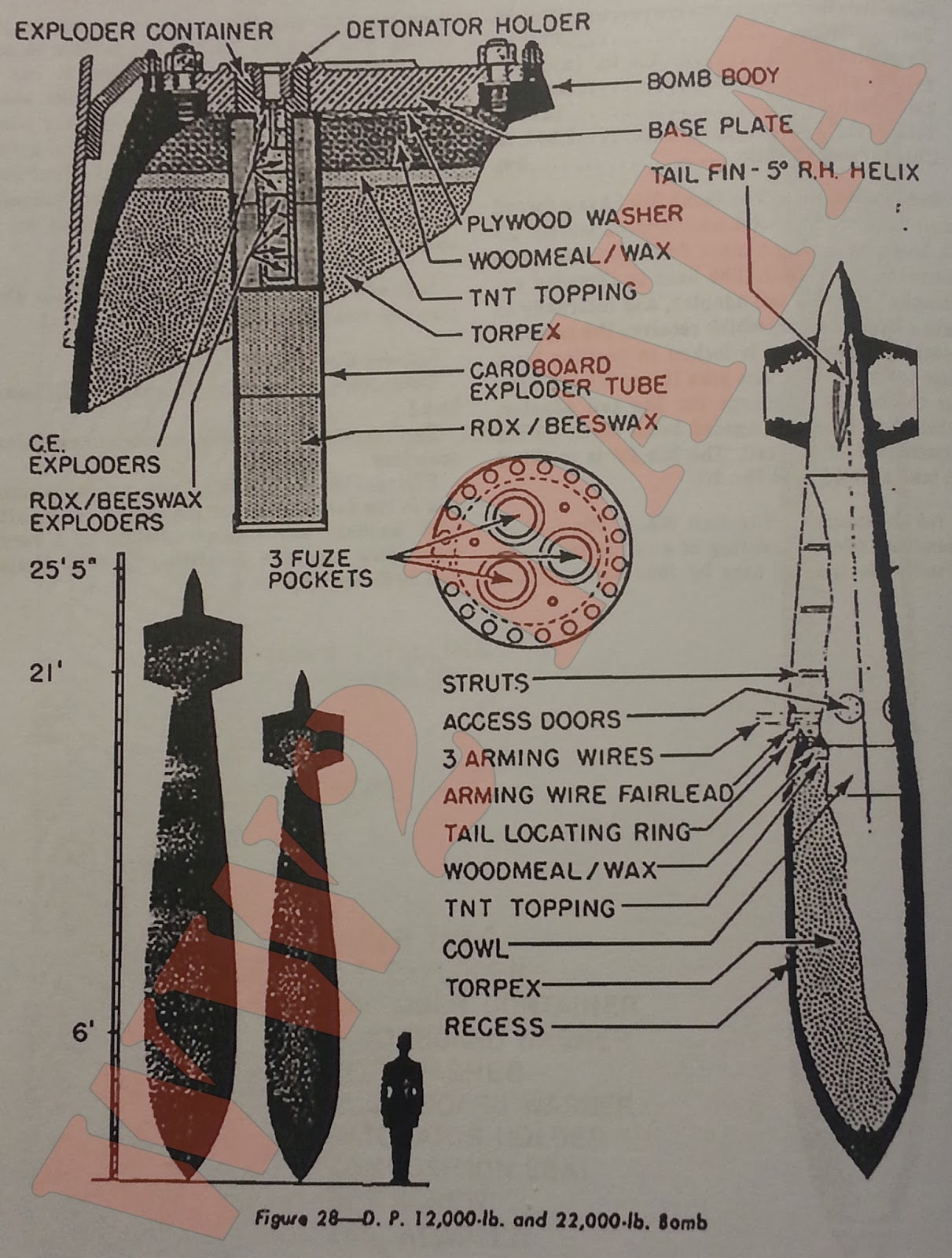


DP 22,000lb Mk I, "Grand Slam" (Service)

Overall length: 25 feet, 6 inches
Body length: 12 feet, 6 inches
Body diameter: 3 feet, 10 inches
Wall thickness:
-Near tail: 1.75 inches
-Near nose: 7.75 inches

Tail length: 13 feet, 4 inches

Tail width: 4 feet, 4 inches (across fins)
Total weight: 22,400 pounds
Charge/Weight ratio: 42% (approx.)

Fuzing: Mk III - Three Tail Pistols No.58 Mk I

Tail No: No.82 Mk I
  

Color and markings: Green overall, Red band near nose


Body Construction: The bomb body is manufactured of cast steel, with a solid nose plug and with three exploders fitted 120 degrees apart in the base plate.  The bomb bodies are issued with exploders inserted, and the exploder tubes are sealed with shipping plugs.

The tail is attached to the after end of the bomb body by 12 studs.  A cylindrical metal cowling, placed between the bomb body and the tail cone, enhances the streamlining of the bomb.

The bomb contains an explosive filling of Torpex, with a one-inch layer of TNT topping added to the after end.  Four inches of woodmeal/wax composition is then added, and the filling sealed with a 1/2 inch plyboard washer.  The three exploders pass through holes in this washer and are held in place by a heavy base plate, which is secured by bolts to the bomb body.


Tail Construction: The special tail unit, No.82 Mk I, is constructed of light alloy and consists of a cone to which are attached four fins of streamlined cross-section.  The fins are set at an angle of 5 degrees to the axis of the tail cone, giving a right-hand spin to the bomb as it falls.  The tail fits over twelve 7/16 inch studs fitted into the bomb body, and is securely fastened to the studs by Simmonds nuts.  Three hand-holes in the tail cone give ready access to the three tail pistols.
 
Suspension: The bomb is suspended in the plane by twin suspension links.  Each link is coupled beneath the bomb by a special Vickers release clip, capable of either electrical or manual operation.

In addition to the suspension links, the bomb is positioned in the plane by a standard crutching system.
  

Explosive Components:
Exploders:
-Primary: 2 ring and 2 solid CE pellets; 4 solid RDX/Beeswax pellets
-Secondary: 2 ring and 2 solid large RDX/Beeswax pellets (placed in a special exploder tube into which the standard exploder container fits)

Main Filling: Approximately 9,200 pounds Torpex surmounted by a 1-inch topping of TNT.


Remarks: This bomb is designed for special operation uses, and its employment will be restricted to certain specified bomb commands.  The initials "DP" signify its deep penetration characteristics, although the bomb is not designed for armor or concrete piercing.  Rather, it is intended to produce heavy shock waves as a result of the explosion of its heavy main charge deep within the earth.

The bomb is carried on specially adapted Lancaster aircraft.  The striking velocity of the bomb, when released at an altitude of 16000 feet, and an air speed of 200 mph, is stated at 1,097 ft/sec at which speed it has developed a rotational velocity of 60 rpm.

The general arrangement of this bomb is identical to that of the 12000 pound DP Bomb "Tallboy".  The two bombs are identical in all respects, the 22000 DP being merely an enlarged version of the 12000 DP Bomb.

Grand Slam bombs made in the US differ somewhat in body construction from those made in Britain.  The body is built up of five sections welded together.  The solid nose and the base sections are made of forged steel, while the three center sections are made of rolled plate, longitudinally welded, taper-bored internally, and then set in a die to form the external contours.


Next Time:  Anti-Submarine and Buoyancy Bombs, and Aircraft Depth Charges

Sunday, 11 December 2016

British Explosive Ordnance - Medium and High Capacity Bombs


British Explosive Ordnance


Medium Capacity Bombs Introduction


These bombs are designed for general operational use as alternatives to the corresponding GO bombs.  They are comparable to the US GP series, with a loading factor of approximately 50%, parallel sides, and ogival noses.

They may be fuzed at the nose and tail, or at the nose or tail only, if so desired.  When shipped, they are plugged at the nose and fitted with a Tail Pistol No.28 or No.30 (without detonators), the pistol acting as a tail transit plug.

These bombs are painted dark green overall, with a red band around the bomb body near the nose denoting that the bomb has been filled, and a light green band around the nose end indicating its HE nature.  The type of filling is stencilled around the bomb body, as is the monogram of the filling station, date of filling, etc.  These bombs are supplied fitted with transit bases, and the larger bombs have transit rings in addition to the bases.


MC 250lb, Mks I and II (Service)

  
Overall length: 55.5 inches
Body length: 27.5 inches
Body diameter: 10 inches
Wall thickness: 0.3 inches
Tail length: 27 inches (approx.)
Tail width: 10 inches
Total weight: 225 pounds (approx)
Charge/Weight ratio: 50% (approx)


Fuzing: Nose Pistol No.27, 42, 44; Tail Pistol No.28, 30, or 37

Tail No: No.2 Mks I or II

Color and markings:  Dark green overall
1/2 inch red band around nose,
1 inch light green band around base of ogive

  
Body Construction: The bomb has a solid drawn or rolled steel body.  The exploder containers screw into the nose and male base plates.  This bomb has parallel sides, with an ogival nose and a slight rear taper, similar to the construction of US General Purpose Bombs.


Tail Construction: The tail consists of a cylindrical tail strut secured to the tail cone by four fins.  The tail assembly is secured to the bomb body by four spring clips, which engage slots in the tail end of the body.  A reach rod through the tail cone, having arming vanes attached to the after end, engages the arming fork in the tail pistol.


Suspension: The Bomb Mk I has a single suspension lug welded to the bomb body.  The Bomb Mk II has dual lugs welded to its case for suspension from US aircraft, in addition to a single lug.

Explosive Components:
Exploders: CE pellets
Filling: Amatol or Pentolite


Remarks: This bomb is supplied with a Tail Pistol No.28 or 30, and may or may not be fuzed in the nose.

The Anti-Disturbance Fuze No.845, formerly incorporated in the nose of bombs fuzed with the Tail Pistol No.37, is obsolete.

Tail fins are usually painted red when a time pistol is used.


MC 500lb Mks I-V (Obsolescent), and Mks VI-XII (Service)
   

Overall length (w/ long tail): 70.6 inches
Overall length (w/ short tail): 57.8 inches
Body length: 41 inches
Body diameter: 12.9 inches
Wall thickness:
Mks I, II, VI, VII: 0.3 inches
Mks III, IV, V, VIIII-XII: 0.42 inches

Tail length:
No.25 Mks I, II: 28 inches
No.28 Mks I, II: 14 inches

Tail width: 12.9 inches
Total weight: 499lb Amatol filled (Mk VIII with short tail)
Charge/Weight ratio: 50%


Fuzing: Nose Pistol No.27, 42, 44; Tail Pistol No.28, 30, or 37

Tail No: No.2 Mk I; No.25 Mks I or II; No.26 Mk I; or No.28 Mk I

Color and markings:  Dark green overall
1/2 inch red band around nose,
1 inch light green band around base of ogive

  
Body Construction: The bomb has parallel sides, with an ogival nose and a slight rear taper, similar in construction to US General Purpose bombs.

With the exceptions as given below, exploder containers screw into the nose and base plate.

Mk I: Fabricated, rolled steel sheet, welded, with nose and tail welded on.

Mk II: Drawn tube, nose formed by "bottling" process, tail welded on.

Mk III: Cast

Mk IV: Cast to 500lb GP dimensions

Mk V: Same as Mk III but center of gravity was off so all were declared obsolescent immediately.  Only used with long tail unit.

Mks VI, VII, VIII, and IX are the same as Mks I, II, III, IV, respectively, with American dual suspension lugs added.

Mk X: Forged body, solid nose, fuzed only in tail.

Mk XI: Mk VII with a solid nose.

Mk XII: Mk VII with improved welds at the after end, and fuzed both nose and tail.


Tail Construction: The Tails No.25 and No.28 are similar in construction, each consisting of a cylindrical strut attached to a tail cone by four fins.  The tail assembly is secured to the body by four spring clips which engage slots in the tail end of the body.  Turnbuckle fittings are provided for two of the springs as a locking device.  A reach rod running through the tail cone engages the arming fork of the pistol, and carries the arming vanes at its after end.  The arming vanes protrude beyond the cylindrical strut and the fins on the short-type Tail Unit No.28.


Suspension: Mks I-V of this bomb have a single suspension lug welded to the body, while Mks VI-XII have dual lugs for suspension from US aircraft welded on in addition to a single lug.
  

Explosive Components:
Exploders: CE pellets
Filling: (Mk VIII) 210lb Amatol 50/50 or 60/40; 226lb Amatex 51/40/9; 222lb RDX/TNT 60/40; or 232lb Torpex 2.


Remarks: These bombs are supplied with a Tail Pistol No.28 or No.30, and may or may not be fuzed at the nose.

The short-type tail unit, such as the No.28 Mk I, is used when the bombs are dropped from fighter-bomber aircraft.

The Anti-Disturbance Fuze No.845, formerly incorporated in the nose of bombs fuzed with the Tail Pistol No.37, is now obsolete.

Tail fins are usually painted red when a time pistol is used.


MC 1000lb Mks I and II (Service)
   

Overall length: 72.5 inches
Body length: 52.5 inches
Body diameter: 17.75 inches
 Wall thickness: 0.48 inches
 Tail length: 20 inches
 Tail width: 17.5 inches
Total weight: 1021lb Amatol filled
Charge/Weight ratio: 47%


Fuzing: Nose Pistol No.27, 42, 44; Tail Pistol No.28, 30, or 37

Tail No: No.38 Mk I

Color and markings:  Dark green overall
Red band around nose,
Light green band around base of ogive

  
Body Construction: The bomb body is a hollow steel casting having parallel sides, an ogival nose, and a slight taper at the after end.  The exploder containers thread into the nose and male base plate.  This bomb is similar in appearance to US General Purpose Bombs.


Tail Construction: The tail assembly consists of a cylindrical strut attached to the tail cone by four sheet-metal fins.  A reach rod with arming vanes on the after end extends through the tail cone and engages an arming fork in the tail pistol.  The tail is secured to the body by four wing bolts and retained in the tail ring by split pins.  The arming vanes protrude beyond the cylindrical strut.


Suspension: The Bomb Mk I has a single suspension lug at the center of gravity attached to two stop plates, and dual "U" bolt suspension lugs, 180 degrees removed from the single lug, for carrying in US bomb racks.  Both sets of lugs are welded onto the body.  The Bomb Mk II has a strengthened form of US lug for dive bombers.
  

Explosive Components:
Exploders: CE pellets
Filling: 475lb Amatol 50/50 or 60/40, or Amatex 9; 500lb of RDX/TNT; or 525lb Torpex 2.


Remarks: This bomb is supplied with a Tail Pistol No.28 or No.30 in position, and may or may not be fuzed in the nose.

The Anti-Disturbance Fuze No.845, formerly incorporated in the nose of bombs fuzed with the Tail Pistol No.37, is now obsolete.

Tail fins are usually painted red when a time pistol is used.


MC 4000lb Mks I and II (Service)
   

Overall length: 109.5 inches
Body length: 74.5 inches
Body diameter: 30 inches
 Wall thickness: 0.75 inches
 Tail length: 33 inches
 Tail width: 30 inches
Total weight: 3764lb Amatol filled
Charge/Weight ratio: 58%


Fuzing: Nose Pistol No.27, 42, 44; Tail Pistol No.28, 30, or 37

Tail No: No.38 Mk I

Color and markings:  Dark green overall
Red band around nose,
Light green band around base of ogive

  
Body Construction: In the Bomb Mk I the exploder containers screw into the nose and make base plate.  The body has parallel sides, an ogival nose, and a slight taper at the body base.  It is similar in appearance to US General Purpose Bombs.  The Bomb Mk II has a strengthened after end due to better welding.


Tail Construction: The bomb employs a short-type tail unit, consisting of cylindrical strut attached to a tail cone by four fins.  A reach rod, having arming vanes at its rear, extends through the tail cone and engages the arming fork of the tail pistol.


Suspension: The bomb has a single lug 44 inches from the nose fuze tip, for regular suspension, and dual lugs 30 inches apart diametrically opposite the single lug for suspension from US aircraft.
  

Explosive Components:
Exploders: CE pellets
Filling: 2166lb Amatol 60/40; 2195lb Amatex 9; or 2265lb RDX/TNT 60/40.


Remarks: The Anti-Disturbance Fuze No.845, formerly incorporated in the nose of bombs fuzed with the Tail Pistol No.37, is now obsolete.

Tail fins are usually painted red when a time pistol is used.


High Capacity Bombs Introduction


These bombs are thin-walled and have a high charge/weight ratio.  They are used for general bombardment purposes on operations where maximum blast damage is required.  At the present time this series includes bombs of 2000, 4000, 8000, and 12000 pounds.

The earlier marks of these bombs are provided with side fuzing positions, which are used for special operations; the bombs normally being fuzed in the nose only.  The later marks of the 2000, and 4000 pound bombs, and all of the 8000 and 12000 pound bombs of the series, have three nose-fuze pockets, all of which generally are used.

Central exploder tubes are at present fitted in all types of HC bombs, and where side fuzing positions or nose fuzing positions offset from the longitudinal axis of the bomb are used, auxiliary exploder tubes connect the fuzing positions to the central tube.
 
These bombs are characterized by dome-shaped noses and parallel sides, and may be fitted with nose attachments to retard the bomb in flight.  Drum-type tails are generally used, although the 2000 pound bomb may be fitted with a parachute attachment, and the 12000 pound bombs sometimes incorporate the normal GP type tail assembly, ie tail cone, cylindrical strut, and four fins.

The body is usually welded together and the tail bolted on.  The 8000 and 12000 pound bombs consist of two and three body sections, respectively, bolted together.

HC bombs are supplied uncrated, and are fitted with transit rings.  All fuzing positions are plugged with transit plugs.  Tails, nose attachments, and parachute attachments are supplied in separate packages.


HC 2,000lb Mks II and III (Service)


Overall length: 131 inches
Body length: 89 inches
Body diameter: 18.5 inches 
Wall thickness: 0.19 inches

Tail length: 40 inches

Tail width: 17.9 inches
Total weight: 1,723 pounds, Amatol-filled
Charge/Weight ratio: 71%

Fuzing: Mk III - Three nose pistols, No.27,42, or 44
Mk II - Three nose fuze cavities present but only the center one can be used, with one of the above fuzes.

Tail No: No.39 Mk I
  

Color and markings:  Dark Green overall
1/2 inch red band 6 inches from front cylindrical shell,
2 inch light green band 16 inches from edge

Body Construction: The body is a steel fabricated cylinder with a dome-shaped nose and parallel sides, and is closed by a flat plate bolted to a flange within the after end.  The base flange is fitted with locating pins for the tail, and the holes to receive the tail securing bolts are drilled through it.

A central tube is cemented to the stem of the central exploder container in the nose, and extends through the body almost to the closing plate.  All three nose fuzing positions house exploder containers, the two side ones extending radially inward toward the central tube.


Tail Construction: The tail is a metal cylinder, having an angle ring secured at each end.  Hand holes in the tail cylinder give access to the tail securing bolts, which thread through tapped bosses on the forward angle ring.  Other holes in the cylinder provide stability in flight.
 
Suspension: The bomb uses a single suspension lug 46 inches from the nose dome secured by eight screws.
  

Explosive Components:
Exploders:  CE exploder in pistol exploder containers, and CE pellets in central tube.

Main Filling: 1230lb Amatol 60/40 or 50/50; 1285lb RDX/TNT 60/40; or 1360lb Torpex 2.


Remarks: The bomb may have a nose attachment consisting of a light-gauge metal cylinder extending from the body shell forward around the dome-shaped nose, to retard it in flight.


HC 4,000lb Mk I (Obsolescent)


Overall length: 115 inches
Body length: 88.5 inches
Body diameter: 30 inches 
Wall thickness: 0.31 inches
Tail length: 27 inches
Tail width: 29.3 inches
Total weight: 3,920
Charge/Weight ratio: 73%

Fuzing: Nose Pistol No.27, 42, or 44; Two side fuze pockets not used

Tail No: No.24 Mk I
  

Color and markings:  Dark Green overall
1/2 inch red band 1 inch from front edge of cylindrical shell,
2 inch light green band 16 inches from edge

Body Construction: The body is a cylindrical shell which has a hollow, conical nose piece welded to it, parallel sides, and a closing plate bolted to an angle ring.  The angle ring is welded in position a short distance inside the after end.  The shell is strengthened by a T-section beam welded to its inner surface.  Steel blocks, constituting pads for suspension lug and hoisting brackets, are welded in the angles of the beam,  The central tube is fitted over, and cemented to, the stem of the exploder container, extending almost to the closing plate.  Two exploder containers are fitted near the rear of the bomb at 45 degree angles to the strengthening beam.


Tail Construction: The tail is a cylinder of light-gauge plate, closed at rear by a diaphragm plate which is welded in position.  Tail securing screws thread into corresponding holes near the rear edge of the body shell.  The forward portion of the cylinder has saw-cuts between adjacent screw clearance holes, so that the tail can be sprung into the rear of the bomb body.
 
Suspension: A single suspension lug at the center of gravity is bolted to the body and internal strengthening beam.
  

Explosive Components:
Exploders:  Exploder containers house one solid and two perforate CE pellets.  The central tube is filled with 36 pellets of pressed TNT.

Main Filling: 2882 pounds of Amatol 60/40.


Remarks: This bomb may be fitted with a nose attachment to retard it in flight, consisting of a light-gauge plate around the forward end of the shell, which projects beyond it around the conical nosepiece.  Side fuze pockets are usually not used, but might contain a Time Pistol No.47.


HC 4,000lb Mks II and III (Obsolescent), and Mks IV, V, and VI (Service)


Overall length: 110 inches
Body length: 62 inches
Body diameter: 30 inches 
Wall thickness: 0.31 inches
Tail length: 27 inches
Tail width: 29 inches
Total weight: 3,930 pounds, Amatol filled
Charge/Weight ratio: 75%


Fuzing: Three nose pistols, Nos.27, 42, or 44; side fuze pockets on Mk II not used

Tail No: No.24 Mk I
  

Color and markings:  Dark Green overall
1/2 inch red band 8 inches from nose,
2 inch light green band 2 inches from nose

Body Construction: The body consists of a fabricated steel, cylindrical shell with a domed plate welded to the nose end, parallel sides, and a closing plate bolted to the angle ring, which is welded in position a short distance inside the after end.  The closing plate has a central adapter for a screw-ion plug and two drop handles.  The nose dome houses three exploder containers, the center one of which is extended through the body by a central tube.  The Mk II has two side fuze pockets near the rear of the body.  Mks II and III have strengthening beams running fore and aft, welded to the inner surface of the body, and acting as a pad for the suspension lug and hoisting brackets.  The Mk IV has steel blocks to support the suspension lug and hoisting brackets, and has no beam.


Tail Construction: The tail is a cylinder of light-gauge plate, closed at the rear by a diaphragm plate which is welded in position.  Tail securing screws thread into corresponding holes near the rear edge of the body shell.  The forward portion of the cylinder has saw-cuts between adjacent screw clearance holes, so that the tail can be sprung into the rear of the bomb body.
 
Suspension: A single suspension lug 43 inches from the nose dome is bolted to the bomb body and the steel support block.
  

Explosive Components:
Exploders:  CE pellets in exploder containers and central tube.


Main Filling:
-Mk II: 2954 pounds Amatol 60/40
-Mk III and IV: 2960 pounds Amatol 50/50 or 60/40, 3070 pounds RDX/TNT 60/40, 3088 pounds Minol 2, or 3294 pounds Torpex 2.


Remarks: These bombs may be fitted with a  nose attachment to retard them in flight, consisting of light-gauge plate around the forward end of the body shell which projects beyond it around the nose piece.  The side fuze pockets on the Mk  II are usually not used but might contain a Time Pistol No.47.

The Mk V is the same as Bomb Mk IV, but was made and filled in the US.   The Bomb Mk VI was made in US, and has a metal box for lugs and other fittings welded to the rear of the bomb body.


HC 8,000lb, Sectional, Mks I and II (Obsolescent)


Overall length: 133.6 inches

Body length:
-Front Section: 3 feet, 11.15 inches
-Rear Section: 3 feet, 11.75 inches
Body diameter: 38 inches
Wall thickness: 0.5 inches

Tail length:
-No.33 Mk I: 36.5 inches
-No.52 Mk I: 64 inches


Tail width: 37.8 inches
Total weight: 7,860 pounds, Amatol 9 filled
Charge/Weight ratio: 68%


Fuzing: Three nose pistols, Nos.27, 42, or 44

Tail No: No.33 Mk I, or No.52 Mk I
  

Color and markings:  Dark Green overall
1 inch bright red band,
2 inch light green band around each of the bomb body sections

Body Construction: The bomb consists of two cylindrical sections, each approximately 45 feet long and 3 feet, 2 inches in diameter, connected together by bolts.  The front section has a domed nose plate welded to the body, and houses three exploder containers.  A flat closing plate at the rear is bolted to an end ring, which is fitted with assembly bolts for connecting the two sections.  An additional exploder container is fitted into a central bush in the rear closing plate.  The rear section is closed at each end by plates.  The forward plate is welded to a channel ring having holes circumferentially located to receive the assembly bolts of the forward section.  The exploder container fits into the forward closing plate of the rear section.  Central exploder tubes extend through both sections.  Joining rings are cast in the Mk I and fabricated by welding in the Bomb Mk II.


Tail Construction: The Tail No.33 Mk I consists of a hollow steel-plate cylinder open at the after end, with an angle ring welded or riveted in its forward end.  The angle ring is drilled to take the assembly bolts of the rear body section for attaching the tail.  Hand clearance holes give access to the assembly bolts during assembling of the tail to the bomb.

The Tail No.52 Mk I has a cone with hand holes for access to the securing bolts, and a cylindrical strut attached tot he cone by six fins which are welded to both the strut and the cone.
 
Suspension: The bomb is suspended by a single suspension lug, secured by four bolts to steel block pads on the channel ring and immediately abaft the ring on the rear body section, 50 inches from the bomb nose.  This point represents the center of gravity.
  

Explosive Components:
Exploders:  All exploder containers and exploders in the central tube of both sections are filled with CE pellets.

Main Filling: 5361 pounds Amatex 9, or 5850 pounds Torpex 2.


Remarks: This bomb can be fitted with a cylindrical nose attachment, place around the nose of the forward section and protruding around the domed nose, to retard bomb in flight.  This bomb is not composed of two regular 4000 pound HC bombs, but of sections weighing approximately 4000 pounds, designed especially for it.


HC 12,000lb Mk II (Service)


Overall length: 196 inches
Body length: Each of three sections approx. 4 feet long
Body diameter: 38 inches 
Wall thickness: 0.5 inches


Tail length:
-No.33 Mk I: 36.5 inches
-No.52 Mk I: 64 inches


Tail width: 38 inches
Total weight: 11,936 pounds, Amatex 9 filled
Charge/Weight ratio: 70% (approx.)


Fuzing: Three nose pistols, Nos.27, 42, or 44

Tail No: No.33 Mk I, or No.52 Mk I
  

Color and markings:  Dark Green overall
1 inch bright red band,
2 inch light green band around each of the bomb sections


Body Construction: The bombs consist of three sections bolted together.  It is identical to the 8000 pound HC bomb, with an additional rear body section.  Joining rings are fabricated by welding, not cast as in Mk I section used in 8000 pound HC bomb.


Tail Construction: The Tail No.33 Mk I is a hollow-steel plate cylinder open at the after end, with an angle ring welded or riveted onto the forward end and drilled to take the assembly bolts of the rear body section for attaching tail.  Hand clearance holes give access to the assembly bolts.

The No.52 Mk I has a tail cone with hand holes for access to the securing bolts and a cylindrical strut, attached to the cone by six fins which are welded to the strut and cone.
 
Suspension: The bomb is suspended by dual suspension lugs, each secured by four bolts to the two channel rings connecting the three body sections.
  

Explosive Components:
Exploders:  CE pellets

Main Filling: 8040 pounds Amatex 9, or 8760 pounds Torpex 2


Next Time:  Semi-Armor Piercing, Armor Piercing, and Deep Penetration Bombs

Monday, 5 December 2016

British Explosive Ordnance - General Purpose Bombs


British Explosive Ordnance


Introduction


General Purpose bombs are heavy-cased bombs ranging in weight from 40 pounds to 4000 pounds.  The smaller bombs are used mainly as anti-personnel bombs, while the larger ones are used for general bombardment purposes.

The earlier marks of these bombs are fitted with central tubes to take the exploding components, but later marks are fitted with exploder containers at the nose end, or at the nose and tail ends.  Bombs with central tubes or with exploder containers at each end may be fuzed at both ends, or at either end, depending on the operational requirements.  Bombs fuzed at the nose only are fitted with instantaneous detonators, while bombs fuzed at the tail are usually fitted with delay detonators.  If bombs are fuzed at both the nose and the tail with instantaneous detonators, the nose assembly will function first, on account of the direct action of the nose pistol.  The general practice is to ship GP bombs with a tail pistol in place, but without detonators, altering the fuzing as may be desired prior to loading the bombs on the plane.

GP bombs are generally streamlined in shape, cast in one piece, and have a male base plate.  To facilitate handling in storage and shipment, the bombs have a transit base of the same diameter as the maximum diameter of the bomb.  Before using, bombs under 1,000 pounds are equipped with a tail unit that clips in place.  Bombs of 1,000 pounds and over employ a tail unit which is secured by wing bolts.

TNT, Amatol, and RDX/TNT are the explosives commonly employed as main fillings to give a charge/weight ratio of approximately thirty percent.

GP bombs are painted dark green overall and have a 1/2 inch red band at the nose, and a 1 inch light green band on which the type of filling is stencilled.


GP 40lb, Stabilized, Mks I, II, III (Service), and Mk IV (Obsolete)

  
Overall length: 27.25 inches
Body length: 15.9 inches
Body diameter:
-Mk I: 5.01 inches
-Mk II and III: 5.05 inches
Wall thickness: 0.47 inches
Tail length: 11.4 inches
Tail width: 4.88 inches
Total weight: 38.5 pounds (Mk III)
Charge/Weight ratio: 17% (approximately)

Fuzing: Nose Pistol No.29, 34, 38, or 45.  Nose Fuze No. 873

Color and markings:  Dark green overall
1/2 inch red band 1 inch from nose,
1 inch light green band 5 and 1/2 inches from nose

  
Body Construction: The bomb body is made of cast steel.  The open nose end is threaded internally to receive an exploder container, which is screwed and cemented in position and locked by a set screw.  The read end of the bomb is closed and reduced in diameter to form a spigot.

A boss on the spigot is drilled and tapped to receive the forward threaded end of a tail rod.  The exploder container is in the form of a tube closed at one end, the open end of which is threaded internally to take the pistol.


Tail Construction: A cylindrical strut is attached to a tall cone by four fins.  The tail unit is secured to the body by a tail rod which extends axially through the tail cone.  The forward end of the rod, which screws into the central boss on the spigot at the rear of the bomb body, is locked by a spring washer and a lock nut.  The rear end of tail cone is fitted with an internally threaded flanged adapter, which screws on the threaded rear end of tail rod, correctly location the tail cone on the bomb body.  The tail is locked in position by a spring washer and lock nut screwed against the adapter.

Suspension:
-Mk I: Normally carried 6 in the 250lb Small Bomb Container, although a limited number have a single suspension lug.

-Mk II: Normally carried 6 in the 250lb Small Bomb Container; may be fitted with a suspension band.

-Mk III: Has a suspension lug, and may be carried 6 in the 250lb Small Bomb Container, or on Light Series bomb carriers.
  

Explosive Components:
Exploders: TNT (1 oz, 7 dr) and CE (4 oz, 6 dr) retained by a waxed felt washer.

Main Filling:
Mk I: 6.3lb Amatol 80/20
Mk II: 6.5lb TNT, or 6.7lb RDX/TNT 60/40
Mk III: 6.5lb Amatol 60/40, or 6.7lb of RDX/TNT 60.40


Remarks: This bomb is usually used as a fragmentation bomb, being almost identical to the 20lb fragmentation bomb except for size.

The exploder system of the Bomb Mk IV was changed to use only CE pellets, and a special retarder tail was incorporated.


GP 40lb, Parachute, Mks I, II, and III (Service)


Same as previous entry except as follows:
Fuzing: Nose Pistol No.33 Mk I

Body Construction: This bomb is of cast-steel body, the nose end of which is fitted with an exploder container screwed and cemented in position, and locked by a locking screw.  The exploder container is threaded to take the pistol.  The rear end of the bomb body is closed and reduced in diameter to form a spigot with a central boss, which is drilled and tapped to receive an eyebolt.  The parachute tail unit is secured to the body by means of the eyebolt.


Tail Construction: The parachute tail unit consists of a cylindrical strut attached to the rear end of a tail tube by four fins.  The parachute is packed in a fabric cylinder, which is closed at its rear end and fits inside the tail tube.  The rear end of the fabric cylinder is connected by pilot lanyards to a flanged cover which fits loosely in the cylindrical strut and is retained in position to close the rear end of the tube by means of a wire transit clip.


GP 250lb Mks I, II, and III (Service)


Overall length: 54.2 inches
Body length: 28 inches
 Body diameter: 10.8 inches 
Wall thickness: 0.6 inches
Tail width: 10.2 inches
Total weight: 247 pounds (TNT)
Charge/Weight ratio: 27%

Fuzing: Nose Pistol No.19; Tail Pistol No. 22 or No. 17

Tail No: No. 1 Mk I (Mk III Only)
  

Color and markings:  Yellow overall
1/2 inch red band around nose,
1 inch light green band around body;
longitudinal green bar on body and tail indicates explodering(?) scheme

  
Body Construction: This bomb body consists of a streamlined steel casting or forging threaded at the nose to take a nose adapter, which holds the central exploder tube.  At the other end of the casting is a threaded base plug through which the exploder tube passes.  Welded to the end of the casting is a streamlined section of thin metal, containing no explosive, but tapered to take the tail ring.  The exploder also passes through this section.


Tail Construction: Four mild steel fins are fastened to a truncated cone, and are reinforced by a cylindrical strut.  The cone fits over the rear section of the bomb body and is held to it by a lock nut over the exploder tube.

Suspension: A single suspension lug is secured to the body by four screws.
  

Explosive Components:
Exploders: TNT and CE pellets

Main Filling: 68lb TNT, or 63lb Amatol 80/20


Remarks: Tail fins are usually painted red when a time pistol is used.  This bomb, previously declared "Obsolete", has recently been returned to service use by the RAF.


GP 250lb Mks IV, V, and VI (Service)


Overall length: 66 inches
Body length:
-Mk IV: 25.6 inches
-Mk V: 27.6 inches

 Body diameter: 10.2 inches 
Wall thickness: 0.52 inches
Tail length: 27.7 inches
Tail width: 10.2 inches
Total weight: 230 pounds
Charge/Weight ratio: 29%

Fuzing:
-Mk IV: Nose Pistol No.27, 42, or 44; Tail Pistol No.28, 30, or 37
-Mk V: Tail Pistol No.17 (Long Delay) only
-Mk VI: See Remarks

Tail No: No.2 Mk II (early Mk IV uses No.2 Mk I)
  

Color and markings:  Dark Green overall
1/4 inch red band 1 inch from nose,
1 inch light green band 6 inches from nose body;
1 inch by 1/4 inch white line on the body base indicates that bomb has been filled.

  
Body Construction:

-Mk IV: The body consists of a hollow steel casting open at each end.  The nose end is internally threaded to house the exploder container, which is locked in position by a locking screw.  The tail end is shaped to take the tail cone, and is provided with four equally spaced supports, which locate the spring clips on the tail.  A male base plate threads into the after end of the body and has two threaded holes to receive the transit base plate.

-Mk V: The Mk V Bomb is the same externally as the Mk IV, but is fitted with a central exploder tube instead of the exploder containers at the nose and tail.  This bomb does not take a nose pistol, but uses only the No. 17 Long Delay Pistol.  The nose opening is filled by a nose plug.


Tail Construction: The No. 2 Mk I Sheet-Metal Tail is attached to the body by four spring clips.  The tail consists of a tail cone with a cylindrical tail strut attached to it by four fins.  The spring clips are fitted to the base of the cone, which is slotted to engage the locating pin on the bomb body.  At the apex of the tail cone is fitted a bush, locating one end of the arming spindle, which is supported at the opposite end by a diaphragm at the base of the tail cone.  The inner end of the arming spindle has an arming fork attached to it which engages the arming fork of the tail pistol of the bomb.

Suspension: The bomb has a single suspension lug secured to it by four countersunk screws.
  

Explosive Components:
Exploders: TNT and CE

Main Filling: 67.75lb TNT or 67lb Amatol 60/40


Remarks: The Bomb Mk V was manufactured to use up existing stocks of the Pistol No. 17 (long delay), which is too long to fit in the Bomb Mk IV.

The No. 845 Anti-Disturbance Fuze, formerly incorporated in the nose when the Tail Pistol No.37 was used, is now obsolete.

The Bomb Mk VI is made in the US and uses fuzes manufactured there to British designs: Nose Fuze Mk VII, M3, and Tail Fuze Mk V, M1.


GP 500lb Mks IV, V, and VI (Service)


Overall length (w/ No.2 Tail): 70.6 inches
Overall length (w/ No.26 Tail): 55.6 inches

Body length:
-Mk IV: 37.2 inches
-Mk V: 36.4 inches

 Body diameter: 12.9 inches 
Wall thickness: 0.72 inches

Tail length:
-No.2 Mk I: 33.4 inches
-No.26 Mk I: 20.4 inches

Tail width: 12.9 inches
Total weight: 470 pounds (with No.2 Tail)
Charge/Weight ratio: 31% (approx.)

Fuzing:
-Mk IV: Nose Pistol No.27, 42, or 44; Tail Pistol No.28, 30, or 37
-Mk V: Tail Pistol No.17 (long delay) only
-Mk VI: See Remarks

Tail No: No.2 Mk I, or No.26 Mk I or II
  

Color and markings:  Dark Green overall
1/2 inch red band 1 inch from nose,
1 inch light green band 8 inches from nose;
1 inch by 1/5 inch white line on the body base indicates that bomb has been filled.

  
Body Construction:

-Mk IV: The body consists of a hollow steel casting open at each end.  The nose end is internally threaded to house the exploder container, which is locked in position by a locking screw.  The tail end is shaped to take the tail cone, and is provided with four equally spaced slots to locate the spring clips on the tail.  A male base plate threads into the after end of the body and has two threaded holes to receive the transit base plate.

-Mk V: This bomb is externally the same as the Mk IV, but has a central exploder tube instead of the exploder pockets at either end.  The fuzing is in the tail only, and the nose is closed by a nose plug which has a cross cut in the end, instead of a ring as in the Bomb Mk IV.


Tail Construction: The 500lb Tail No.2 Mk I differs from the 250lb Tail No.2 Mk I only in the weight and dimensions.  The tail assembly consist of a tail cone with a cylindrical tail strut attached to it by four fins.  It is attached to the bomb body by four spring clips.

The 500lb Tail Assembly No. 26 Mk I is similar to the 500lb Tail No. 2 Mk I, differing mainly in weight and dimensions.  It is used on the 500lb GP Bombs Mk IV or Mk V when carried externally on high-speed fighter aircraft, or internally on fighter bombers of the Mosquito type.  The tail and fins are shorter and it has a two-bladed arming vane instead of the four-bladed arming vane used on the Tail No.2 Mk I.

Suspension: The bomb has a single suspension lug slightly aft of center of gravity, and secured to it by four countersunk screws.
  

Explosive Components:
Exploders:
-Mk IV: TNT and CE
-Mk V: CE pellets and TNT in central exploder tube rather than exploder pocket at each end

Main Filling: 144.5lb of TNT or 143lb Amatol 60/40


Remarks: The Bomb Mk V was manufactured to use up existing stocks of the Pistol No. 17 (long delay), which are too long to fit in the Bomb Mk IV.

The No. 845 Anti-Disturbance Fuze, formerly incorporated in the nose when the Tail Pistol No.37 was used, is now obsolete.

Tail fins are usually painted red when a time pistol is used.

The Bomb Mk VI is made in the US and uses fuzes manufactured there to British designs: Nose Fuze Mk VII, M3, and Tail Fuze Mk V, M1.


GP 1,000lb Mks I - IV (Service)


Overall length (w/ No.13 Mk I Tail): 86.5 inches
Overall length (w/ No.29 Mk I Tail): 71 inches
Body length: 52.5 inches
Body diameter: 16.15 inches 
Wall thickness: 0.77 inches

Tail length:
-No.13 Mk I: 35.5 inches
-No.29 Mk I: 20 inches

Tail width: 16 inches
Total weight: 1,072 pounds (with short tail and Amatol-filled)
Charge/Weight ratio: 33%

Fuzing:
-Mks I and II: Nose Pistol No.27, 42, or 44; Tail Pistol No.28, 30, 37
-Mks III and Mk IV: Tail Pistol No.28, 30, 37

Tail No: No.13 Mk I, or No.29 Mk I
  

Color and markings:  Dark Green overall
1/4 inch red band 2 inches from nose,
2 inch light green band 9 and 1/2 inches from nose

Body Construction:

-Mk I: The bomb consists of a hollow steel casting open at each end, with the nose end internally threaded to house a nose bush, which is screwed and cemented in position.  The bush is bored and threaded for part of its length to take an exploder container which is screwed and cemented in position.  The exploder container is threaded internally in the open end to house a detonator holder, which is also cemented in position and locked with a locking screw.  The detonator holder is threaded internally in the open end to take a pistol or a transit plug.  The after end of the bomb body is shaped externally to take a tail, and is provided with a locating pin to locate the tail when in position on the bomb.  A male base plate screws into the tail end of the body and is cemented in position.  The filling plug is bored and threaded internally to receive an exploder container, which houses the detonator holder and is inserted and locked in the same manner as the one used in the nose of the bomb.

-Mk II: Similar to the Mk I, except that the spigot on the tail end of the bomb body for locating the transit base and the seating on the bomb body for the suspension lug, are omitted.

-Mk III: Similar to Mk I, except that the exploder container and detonator holder are not fitted; the nose being plugged with a special adapter and transit plug which are welded in position.

-Mk IV: Similar to Mk II body, except that the nose is permanently plugged in a manner similar to the Mk III.


Tail Construction: The No.2 13 Mk I tail assembly consists of a tail cone, a cylindrical strut attached to the cone by four corrugate fins, and an arming mechanism for arming the tail pistol.  A tail ring near the base of the tail cone is drilled to house four wing bolts used for attaching the tail to the bomb body.  The arming mechanism consists of an arming spindle, one end of which is attached to the fork that engages the arming fork of the tail pistol.


-No.29 Mk I: Similar to the No. 13 Mk I, differing only in dimensions by having a shorter tail strut and fins.  The fins are not corrugated.  Arming vanes protrude beyond the cylindrical strut.
 
Suspension: The bomb has a single suspension lug 30 inches from nose plug tip, consisting of a rectangular stop plate to which is welded a lug.  The plate is secured to the bomb body by two screws.
  

Explosive Components:
Exploders:  TNT and CE, with a wax-filled washer between the CE and the detonator holder.

Main Filling: 357lb Amatol 60/40 or 368lb RDX/TNT 60.40.  Each end of the bomb has the same sealing arrangement as the 1,900lb GP Bomb.


Remarks: The Mks I and II may be fuzed nose or tail, or both.  Mks III and IV are fuzed in the tail only.  The Anti-Disturbance Fuze No. 845 formerly incorporated in the nose when the Tail Pistol No.37 was used, is now obsolete.

The tail fins are usually painted red when a time pistol is used.


GP 1,900lb Mks I and II (Service)


Overall length: 98 inches
Body length: 63.2 inches
Body diameter: 18.7 inches 
Wall thickness: 1.15 inches
Tail length: 35.3 inches
Tail width: 18.7 inches
Total weight: 1,785
Charge/Weight ratio: 26%

Fuzing: Nose Pistol No.27, 42, or 44; Tail Pistol No.28, 30, 37

Tail No: No.14 Mk I
  

Color and markings:  Dark Green overall
1/4 inch red band 2 inches from nose,
2 inch light green band 11 and 1/4 inches from nose

Body Construction:

-Mk I: The body consists of a hollow steel casting open at each end, with the nose end threaded internally to house a nose bush, which is screwed and cemented in position.  The bus is bored centrally and threaded for part of its length to take an exploder container.  The exploder container is locked to the nose bush by a locking screw, and is threaded internally at the open end to house a detonator holder, which takes a pistol or transit plug.  The after end of the bomb body is shaped externally to take the tail, and provided with a locating pin to locate the tail when in position on the bomb.  A male base plate screws into the base of the body and is cemented in position.  It is bored and threaded internally to receive an exploder container, which houses a detonator holder in the same manner as that at the nose.  A flat seating at the center of gravity is drilled and tapped to take four screws which secure a suspension lug.

-Mk II: Similar to Mk I, except that the spigot on the tail end of the body for locating the transit base, and the seating on the bomb body for the suspension lug, are omitted.


Tail Construction: The No.14 Mk I tail assembly consists of a tail cone, a cylindrical strut attached to the cone by four fins, and an arming mechanism for arming the tail pistol.  The tail cone is secured to the body by a tail ring, which houses four wing bolts used to attach the tail to the body.  Attached to the tail cone at the rear of the tail ring, is a spider in the form of a cross that support the forked end of the arming mechanism.  The rear of the tail cone is closed by a bush, which supports the arming vane end of the arming mechanism.  The arming spindle has a fork in the tail pistol, and an arming vane on the other end which is secured by a nut and washer.  The arming vane and spindle are prevented from rotating during transit by a safety clip.
 
Suspension: The bomb uses single suspension in the form of a stop plate with an integral lug.  The plate has four holes for the securing screws in attaching to the bomb body.
  

Explosive Components:
Exploders:  TNT and CE

Main Filling: 470lb Amatol 60/40, sealed at the nose and with a pad of approved composition, and a 1/4 inch layer of TNT into which is pressed a felt washer.  The t ail end is sealed with a 3/16 inch layer of TNT, a pad, and a glazeboard washer.  The exploder containers are protected from the filling by paper tubes.


Remarks: The Anti-Disturbance Fuze No.845, formerly incorporated in the nose when the Tail Pistol No.37 was used, is now obsolete.

The tail fins are usually painted red when a time pistol is used.


GP 4,000lb Mks I and II (Service)


Overall length: 106.5 inches
Body length: 79.3 inches
Body diameter: 24.5 inches 
Wall thickness: 1.35 inches
Tail length: 23.5 inches
Total weight: 3,587
Charge/Weight ratio: 30%


Fuzing: Nose Pistol No.27, 42, or 44; Tail Pistol No.28, 30, 37

Tail No: No.34 Mk I
  

Color and markings:  Dark Green overall
1/2 inch red band around nose,
2 inch light green band around maximum diameter

Body Construction:

-Mk I: Similar to the Mk II, with the exception of two side fuze pockets near the rear end of body, afforded by two adapters welded into the body and fitted with exploder containers which extend inward at a 45 degree angle to the axis of the bomb.

-Mk II:  The body consists of a hollow steel casting open at each end, with six strengthening beams welded inside the nose end.  The nose bush is screwed and welded into the nose , and a male base plate is screwed into the base.  Exploder containers are threaded into the nose bush and the base plate, and arte secured in place by locking screws.  The rear end of the body is shaped to receive the tail assembly.  The rear face of the body has two sets of four threaded holes for the wing bolts of the tail assembly, or the transit base.


Tail Construction: The tail assembly consists of a cylindrical strut supported by four fins from the tail cone, and an arming mechanism for the tail pistol.  The forward end of the arming spindle has a fork which engages another fork of the tail pistol.  The rear end is fitted with a four-bladed arming vane.  The arming vanes protrude beyond the cylindrical strut.
 
Suspension: The bomb body has three sets of tapped holes for the securing screws of a central suspension lug, and the fore and aft hoisting brackets.  The suspension lug is secured by four bolts at the center of gravity.
  

Explosive Components:
Exploders:  TNT and CE

Main Filling: 1,070lb Amatol 60/40 or 1,018lb of Amatex 51/40/9.  The filling is sealed nose and tail with an approved composition.


Remarks: The Anti-Disturbance Fuze No.845, formerly incorporated in the nose when the Tail Pistol No. 37 was used, is now obsolete.

Tail fins are usually painted red when time pistol is used.


Next Time:  Medium and High Capacity Bombs