Showing posts with label M17. Show all posts

Monday, 28 May 2018

American Projectiles and Explosives - Rifle Grenades (Part 2)


American Projectiles and Explosives


Rifle Grenades (Listing)


Anti-Tank M9 and M9A1


Length: 11.24 inches
Diameter: 2.25 inches
Color: Olive drab
Weight: 1.23 pounds
TNT filling: 4 ounces


Description: Anti-Tank Grenade M9A1 consists of a body, a stabilizer assembly, and a fin.  The body is cylindrical, the two pieces joined in the middle with rounded ends.  The stabilizer is a hollow tube which screws into the base of the body and fits over the launcher; it also carries a shroud fin assembly which aids in stabilizing the flight of the grenade.  The body is made of cast steel.

The impact fuze, which consists of a striker held away from a detonator by a creep spring and a safety pin, is assembled integrally with the stabilizer assembly.  The safety pin projects through the fuze body and clamps around the stabilizer tube.  When the pin is withdrawn, a drop of two feet, nose-first, to a hard surface will cause the fuze to function.

This grenade is designed primarily for use against tanks and other armoured or resistant targets.  It must strike within 20 degrees or normal to be sure to function.  However, the velocity of the grenade itself is not a critical factor, as it incorporates the hollow-charge principle.  The danger radius to the rear of the explosion is 50 yards.


Operation: The grenade is fired from a rifle by means of a special launcher attachment.  A special cartridge is used for propulsion.  The grenade must be placed on the launcher before the safety pin is withdrawn.  The safety pin is removed before firing.  When the grenade is fired, set-back holds the striker away from the detonator.  On impact, the striker overcomes the creep spring and hits the detonator.


Remarks: The M9 is an earlier model.  It has the same tail assembly, but the head is acorn-shaped and is equipped with a point detonating fuze.  It is slightly less sensitive than the M9A1.  The safety pin of the M9 is located in the base of the grenade body instead of in the stabilizer tube.  Its pull ring is secured to the body with adhesive tape.


Fragmentation M17


Length: 9.775 inches
Diameter: 2.25 inches
Color: Olive drab
Weight: 1.47 pounds
E.C. powder filling: 0.77 ounces


Description: This grenade consists of a fragmentation-type body similar to the Hand Grenade Mk IIA1 assembled to a fuze and stabilizer assembly similar to that for the anti-tank and practice rifle grenades.  The stabilizer and fuze assembly threads into the grenade body.

The fuze is a simple impact type.  The striker is held away from the detonator by a safety pin and a creep spring.  The safety pin projects through the fuze body and clamps around the stabilizer tube.  When the pin is withdrawn, a drop of two feet, nose-first, to a hard surface will cause the fuze to explode the grenade.  Detonation will not occur upon impact with water, mud, or soft sand.  This grenade is designed primarily for use against personnel.


Operation: The grenade must be placed on the launcher before the safety pin is withdrawn.  The safety pin is removed before firing.  When the grenade is fired, set-back holds the striker away from the detonator.  On impact, the striker overcomes the creep spring and hits the detonator.


Remarks: The Fragmentation Grenade M17 is no longer in production; however, large quantities were issued.


Smoke M19, M19A1, M20, and T6E1


Length: 10.72 inches
Diameter: 2 inches
Color: Blue grey
Filling: Smoke mixture


Description: In outward appearance, this grenade is similar to the Anti-Tank Grenade M9A1, except that the body is in one piece and does not have the joining rib.  The body is cylindrical, with rounded ends.  The stabilizer is a hollow tube which screws into the base of the body and fits over the launcher.

The impact fuze of the Anti-Tank Grenade M9A1 has been modified so that a long detonator which extends into the body of the grenade acts as a burster when the fuze operates.  The fuze is an impact type, with the striker held off the detonator pin by a safety pin and a creep spring.  The safety pin projects through the fuze body and clamps around the stabilizer tube.

The explosion of the burster tube breaks the grenade and scatters burning white phosphorus over an area of 25 square yards.  The burning phosphorous gives off a dense white smoke.  The particles are of incendiary nature and make an excellent anti-personnel weapon.


Remarks: The M20 adn T6E1 are rifle smoke grenades with a filling that emits white smoke.  The T6E1 is 1/4 inch longer than the M20.  Both are identical in construction and operation to the M19A1.  The M10 is filled with 10.8 ounces of H.C. smoke mixture and is used exclusively for screening purposes.  The fuze functions on impact and ignites the smoke mixture.  The smoke mixture burns for approximately one minute, giving off a dense white non-toxic smoke through the emission holes in the base of the grenade body.


Smoke M22


Length: 10.72 inches
Diameter: 2 inches
Color: Blue grey
Filling: Smoke mixture


Description: This grenade is similar to the Smoke Grenades M20 and T6E1.  In outward appearance, it is similar to the Anti-Tank Grenade M9A1, except that it does not have the joining rib.  The nose of the body has a small circular opening which is closed with a light metal cover.  The stabilizer contains the Fuze M9A1 Type.

The body is filled through the nose.  After filling, a tool is inserted longitudinally through this nose opening, and the filling is packed against the sides of the body, leaving a central channel.  Then, this channel is coated with an igniting composition.  The smoke-emission holes are through the base shoulder of the grenade body.

Four colors are issued: red, green, violent, and yellow.

The primary use of the grenade is for signaling.


Operation: The igniter ignites the igniting mixture, which initiates the burning of the smoke mixture.  Smoke is emitted through the emission holes for one to one and one-half minutes.


Practice M11A2 and M11A3


Length: 11.18 inches
Diameter: 2.25 inches
Color: Black


Description: This grenade simulates the Anti-Tank Grenade M9A1.  The grenade is so constructed that the fin and the ogive assemblies, which are most liable to damage in use, may be replaced and the grenade used repeatedly.  It is for training in marksmanship.


Ground Signals

There are a number of smoke and flare pyrotechnic signals in containers launched from rifle-grenade launchers.  They are used in signaling and for simulation of air bursts of artillery, etc.


Projection Adapters


M1A1

Description: This adapter consists of a stabilizer and fin assembly to which are attached three spring-steel fingers.  It is designed to project the standard fragmentation hand grenade by means of the rifle or carbine.  The Hand Grenade Mk II is assembled to the adapter with the fingers engaging the grooves in the grenade body.  When the grenade is assembled to the adapter, the safety lever of the grenade is inserted in the arming clip.  The safety lever is held in place by the arming clip until the grenade is fired.  On set-back, the clip lags and so is removed from over the safety lever, which is then thrown off by the rotating striker.  The striker hits the primer, igniting the 4.5 second delay, after which the grenade explodes.

When the grenade is assembled to the adapter and the safety pin removed, the lever bends outward, on account of pressure from the striker.  If the lever is struck on its outer surfaces, near the striker, while in this condition, it is possible that the lever may spring loose from the fuze and release the striker, allowing the fuze to function.  Care should be exercised, once the safety pin is removed, to prevent the lever from being struck.


M2

Description: This adapter consists of a stabilizer and fin assembly and a metal set-back band.  To the stabilizer are attached four short spring-steel clips.  It is designed to project the following grenades: CN-DM-M6; CN-M7; H.C., AN-M8; AN-M14; M16; and M18.

The grenades are assembled to the adapter with the clips holding over the ridge at the base of the grenade.  The set-back band contains a short spring and fits around the grenade, over the safety lever.  It holds the safety lever in a safe position after removal of the fuze safety pin.  When the grenade is fired, set-back causes the band to slide off the safety lever toward the base of the grenade.  This permits the safety lever to spring outward and the striker to ignite the fuze.  The fuze ignites the grenade in approximately one to one and a half seconds.


Next Time: Tree Suspension Device and Anti-Tank Mines (Part 1)

Monday, 2 April 2018

American Projectiles and Explosives - Smoke Streamer and Photoflash Bombs, and Ground Pyrotechnics (Part 1)


American Projectiles and Explosives


Aircraft Pyrotechnics


Smoke Streamer


T29


Overall length: 47.5 inches
Body length: 40.5 inches
Body diameter: 8 inches
Wall thickness: 0.06 inches
Tail length: 11.5 inches
Tail width: 10.75 inches

Filling: 8 Modified Smoke Grenades M18
Total weight: 100 pounds


Fuzing: The Fuze M143 consists of a fuze body support mounting four bouchon grenade-type fuzes and an arming washer, and is threaded to fit the fuze adapter of the tube train.  The arming washer is 2.5 inches in diameter and has four arms 0.75 inches wide and one inch long.  The arming wire holds the arming washer over the bouchon levers until it is withdrawn.


Construction: The bomb body consists of a sheet-steel case with a filling plug in the base.  The four tail vanes are welded to the truncated cone with box-type interior struts.  The complete body assembly consists of this Practice-Bomb Case M38A2, a train tube, a grenade train, a closing plug, and a fuze.  The train tube is a seamless steel tubing three inches in diameter and 40 inches long, with a fuze adapter brazed to the after end.  Eight modified Grenades M18 filled with fast-burning mixture are inserted into the tube to form the grenade train.  Each grenade is modified by cutting a center hole in its base, and the bouchon fuze is omitted. 
 
The top of each grenade is coated with a starter compound which acts as the igniter for the adjacent grenade.  Four strands of quick match are knotted and inserted in the center hole of the top grenade in such a manner as to leave the knot and loose ends at the top to receive the fuze flash.  The eight grenades are held apart by spring steel separators.  A threaded closing plug seals the tube and protects the grenade train from moisture.  This plus must be removed just prior to use.  the bomb is brought up to the weight of approximately 98 pounds by filling the balance of the internal space with sand.

Operation: When the arming wire is pulled, the bouchon springs throw off the arming washer and handles, allowing the bouchons to fire.  This action ignites the quick match in the center hole of the top grenade, which in turn is ignited, and the flash is simultaneously transmitted to all the grenades.


Remarks: The colored streamer smoke bomb is used as a visual signal to be dropped by the lead plane of a bomber formation when the target has been determined.  Smoke emission begins approximately one second after release from the plane and continues for approximately 7,000 to 10,000 feet.


Photoflash Bombs


M23A1


Overall length: 25.4 inches
Diameter: 4.25 inches
Weight: 10.6 pounds
Weight of flash powder: 7.75 pounds

Fixed delay: 15 seconds
Duration of flash: 0.2 seconds
Intensity of flash: 150,000,000 candlepower
Release altitude: 4,000 to 7,000 feet


Use: This bomb is used to provide light of high intensity and short duration for night photography from low altitudes.


Description: The bomb case is made of cardboard closed with metal ends, one of which is marked "Front" to insure proper loading in the rack.  This end contains the hang-wire assembly just before the Fuze Assembly M23A1.  The fuze assembly is made up of the friction wires attached to the hang wire, match composition, quick match, delay element, upper and lower rings, and base ignition charge immediately adjacent to the flashlight powder charge.  The hang wire is attached to the arming-wire retainer.


Operation: When the bomb is released, the hang wire remains attached to the arming-wire retainer.  As the bomb drops, the hang wire pulls the friction wires through the match composition of the fuze.  The hang wire also pulls out the hang-wire container, allowing both the hang wire container and the bomb to fall free.  The flame from the match composition ignites a piece of quick match, which in turn ignites a delay element.  After 15 seconds, the delay element ignites the base charge of the fuze, which sets off the flashlight powder charge.  The flash lasts a fifth of a second.


AN-M46


Overall length: 48.4 inches
Diameter: 8 inches
Weight: 51.9 pounds
Weight of flash powder: 25 pounds

Burning time: 0.2 seconds
Peak intensity: 500,000,000 candlepower

Fuzing: M111A2, AN-M146

Use: The Photoflash Bomb An-M46 was developed so that planes engaged in night photography reconnaissance need not be limited to low altitudes.
Description: In appearance it resembles a conventional light-case bomb.  Uses a Fuze M111A2 in the nose, but it is issued unfuzed.  It also has two suspension bands for rack and shackle suspension.


Operation: When the bomb is dropped, the arming wire is pulled, starting the mechanical time fuze.  When the time set on the fuze has elapsed, the flashlight powder is ignited by the fuze booster.


Remarks: Because of the brilliance of the flash, it is detrimental to the vision to watch the explosion of photoflash bombs.  Extreme care should be exercised in handling these bombs, because the charge is very sensitive to friction, shock, and temperature.  These bombs should not be jettisoned over friendly territory, as they may function on impact.


Ground Pyrotechnics


One-inch Salute Mk 1 Mod 0


Length: 1.75 inches
Diameter: 0.75 inches


Use: This salute is used by the Marine construction battalions and amphibious training commands to simulate battle sounds of loud report and bright flash.


Description: Essentially a commercial-type firecracker, this salute is a spirally-wound paper tube closed at both ends with paper cups.  It uses the regular firecracker filling and fuse.


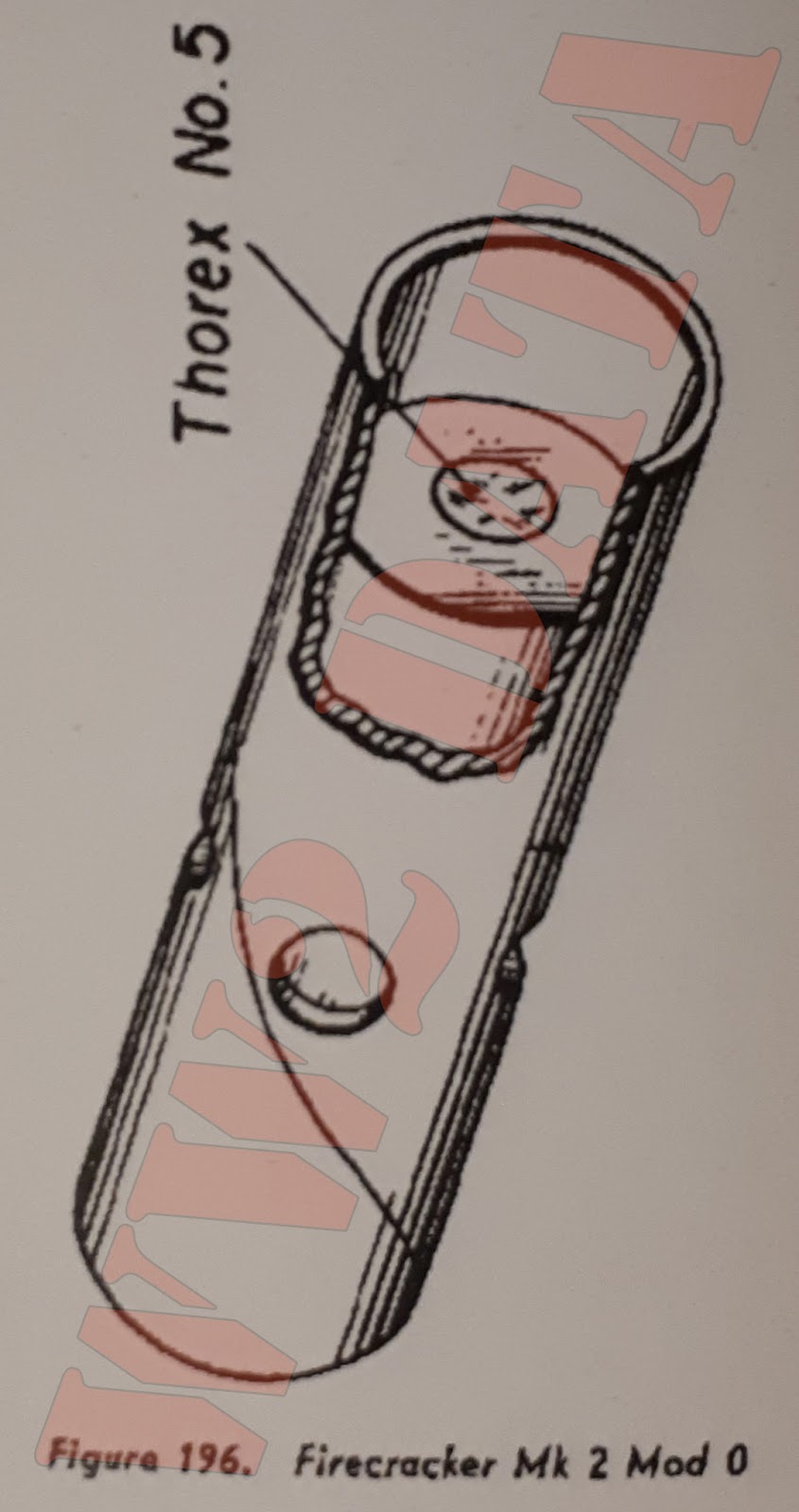
Firecracker Mk 2 Mod 0


General: This firecracker is used as a practice charge for booby traps and firing devices.  It produces a loud report, bright flash, and smoke.  It is designed to reduce the hazard of flying particles attendant upon use of a standard potassium perchlorate firecracker.  It is classified as fireworks, since it contains no high explosive.  Although coated with a waterproofing material, it should be stored in a dry place.


Installation: The coupling base of any standard firing device is pushed through the wax-filled hole in the hollowed end of the firecracker and rotated clockwise until at least two threads of the coupling base are inside the hollowed end.


Signal Light Mk 2


Red
Burning time: 7
Candlepower: 300

White
Burning time: 6
Candlepower: 250

Green
Burning time: 5
Candlepower: 600


Use: Signal Light Mk 2 is used primarily as a distress signal.


Description: The cartridge, sometimes called the Very signal, is similar in appearance to a 10-gauge shotgun shell.  The star charge is a tightly-packed cylinder of pyrotechnic material reinforced with wire and wrapped with quick match.  The propelling charge is composed of about 25 grains of black powder separated from the star charge by a hard felt pad.


Identification of the three types

Red Star: Paper wrapping is red; closing wad is corrugated

White Star: Paper wrapping is white; closing wad has a small cone in the center.

Green Star: Paper wrapping is green; closing wad is smooth.


Operation: The Signal Pistol Mk 5 may be used, as well as the Hand Projector Mk 3 or Mk 4.

The primer ignites the propelling charge, expelling the star out of the projector and igniting the quick match, which ignites the star as it leaves the barrel and burns as it rises to a height of about 200 feet.


Projector Type M17 - M22 Series (Obsolete)


Length w/o tail: 6 inches
Diameter: 1.6 inches
Delay: 6 seconds
Height of trajectory: 600 feet


Description: The signal is assembled in a cylindrical case, and equipped with a finned tail assembly for stabilization purposes.  The primer is located int he head of the signal, and the propelling charge is contained in a small cavity under the head.  The end opposite the primer is closed by a press-fit cap to which the tail assembly is attached.  The signal has a solid tail stem and an X-shaped fin.  Embossed letters on the fin indicate the color and type of star(s).


Operation: The signal is inserted nose-first into Ground Projector M3 or M4.  The projector is struck smartly on the ground, causing the primer to strike the projector firing pin.  The primer ignites the propelling charge, which projects the signal tail-first for approximately 100 feet.  The signal then reverses itself and reaches an altitude of approximately 600 feet.


High-Bursting Range Signal M27

No picture available

The Range Signal M27 is similar to the projector-type signals, except that it has no tail assembly.  It is fired only from the Ground Signal Projector M1A1.  The signal explodes at the top of its rise, producing a flash and a puff of smoke.


Next Time:  Ground Pyrotechnics (Part 2)