Showing posts with label 82mm. Show all posts

Monday, 22 February 2021

Soviet Satellite Country Ammunition - Czechoslovakia (Part 5)


Examination of Czechoslovakian Ammunition Production/Inventory


Mortar Ammunition


The Skoda establishment of Czechoslovakia has produced two original post-World War II mortars: the 82mm mortar Model 1948 and the 120mm mortar Model 1948.  Both mortars are separable into pack units and are used for mountain infantry support.  They are used by the Ethiopian Army and the 82mm M1948 is used in the Czechoslovak Army, but whether or not the 120mm M1948 is also in service with the Czech Army is unknown.

Formerly, the Skoda concern produced the Czech 50mm light mortar; mortars of this caliber, however, are no longer standard.  Czechoslovakia has also produced German mortars and ammunition from 1938 to 1945.

The USSR has provided the Czech Army with cerain Soviet mortars in some quantity.  The Soviet 82mm battalion mortar M1941, 106mm mountain-pack regimental mortar M1938, and 120mm regimental mortar M1938 are considered standard in the Czech Army.  The Soviet 160mm mortar M1943 has also been reported as being used by the Czechs, but the extent of use has not been ascertained.  Ammunition of Soviet origin for these weapons will doubtless be found in the Czech Army, although Czech-made Soviet shells may be more common.

The German 81mm mortar M1934 and the 120mm mortar M1942 (a copy of the Soviet 120mm mortar) are still used by the Czech Army.  British 2-inch and 3-inch mortars are reportedly held in a reserve status.  Whether ammunition for these weapons (except the German 120mm, which can fire Soviet shells) is restricted to stockpiles dating from World War II, or whether it is currently being produced in limited quantities, is unknown.  The German 81mm has been modified to fire 82mm ammunition.  In addition, the Czech 82mm M1948 is in use in the Army.

The Czech mortar ammunition described in the following comprises the rounds for the Czech-manufactured 82mm mortars which are used by the Ethiopian and Czech armies and the 120mm used by the Ethiopian Army.  The ammunition is of conventional design and presents no outstanding features.  The colors of the ammunition components and the packing box have not been reported.  The stenciled markings are in French.  If these items were used by another country, in all probability the language used would change accordingly.


82mm Mortar Shell, HE
(Czechoslovak Nomenclature Unknown)


 This steel, eight-finned, high-explosive projectile is fired from the Czech-made (Skoda) 82mm Model 1948.  The weapon is in use by Ethiopian and Czechoslovak armies.

The round is of conventional teardrop shape, but incorporates no gas check bands on the bourrelet.  It uses a point detonating impact fuze and a shotgun-shell-type ignition cartridge.  The ignition cartridge body is made of cardboard and contains 7.5 grams of powder.  The propellent increments come in plastic (celluloid) cases and contain 7.8 grams of powder each.  The ignition cartridge alone produces an initial velocity of 220 feet per second; the ignition cartridge plus six increments produces an initial velocity of 722 feet per second.

Stenciled markings on the shell indicate its caliber and type, the type of explosive filler, the date of manufacture, the arsenal symbol, the weight classification, and the fuze model used.  The cap of the fuze is stenciled to indicate the caliber and type of shell and the fuze model (Mp 36).

If the shell is also used by countries other than Ethiopia, the identification markings would probably vary with the using country.  The markings shown are the export version sold to Ethiopia by Czechoslovakia.


Characteristics
Caliber: 82mm (3.23 in)
Weight of complete round: 3.35kg (7.39 lb)
Weight of propellent: 54.3g (1.91 oz)
Type of filler: TNT
Weight of filler: ? kg (? lb)
Maximum number of increments: 6


Packaging


Three of these shells complete with fuzes, ignition cartridge, and propellent increments are packed in a  wooden carrying case.  The case has a handle at the front end and a metal eye at the rear end for hand carrying or animal transport.  The top of the box has two hinges in the rear and is secured by two snap locks in front.  The dimensions and weight shown above are approximated measurements.  The French markings given above are found on packaging in use by Ethiopia, the only country besides Czechoslovakia definitely known to use this ammunition. 


120mm Mortar Shell, HE
(Czechoslovakian Nomenclature Unknown)

 
This steel, twelve-finned, high-explosive projectile is of conventional teardrop design.  It is fired from the Czech-designed and made (Skoda) 120mm mountain pack mortar M1948, which is intended for mountain infantry support.  At present this weapon is used by the Ethiopian Army; whether it is used by the Czech Army is unknown.  

The shell uses a 31-gram shotgun-shell-type ignition cartridge, bagged propellent increment charges, and a point detonating impact fuze Model Mp Z 36.  The shell has an average wall thickness of 0.6 inch.  The protective cap on the fuze must be removed prior to firing.  The fuze may be set for either instantaneous or 0.08-second delay action by positioning the nose of the fuze to align an arrow with an index.  The propellent increment bags are secured to the fin shaft by a loop of string (fastened to one end of the bag) which is placed over a ball formed by the opposite end of the bag.  Charge 1 includes the ignition cartridge and 100 grams of propellant in a red bag.  Charges 2, 3, and 4 include Charge 1 plus one, two, or three green-bagged increments of 135 grams each.  At a normal rate of six rounds per minute, performance of the shell varies from a range of 450 meters and an initial velocity of 115 meters per second with Charge 1, to a range of 5,000 meters and an initial velocity of 255 meters per second with Charge 4.

Stenciled markings on the shell indicate its caliber and type, the type of explosive filler, the date of manufacture, the arsenal symbol, the weight classification, and the fuze model used.  The fuze is stencil marked to indicate the caliber and type of shell and the fuze model (Mp Z 36).  The base and walls of the ignition cartridge are reportedly marked to indicate the cartridge and powder types.  If the shell is also used by countries other than Ethiopia, the identification markings would probably vary with the using country.


Characteristics
Caliber: 120mm (4.72 in)
Weight of complete round: 16.2kg (35.71 lb)
Weight of propellent: 536g (18.9 oz)
Type of filler: Cast TNT
Weight of filler: 2.35 kg (5.18 lb)
Maximum number of increments: 4


Packaging


This shell is packed two complete rounds to a wooden box.  The box weighs 15.87 pounds empty, has a metal carrying handle at each end, metal hinges, and is secured in front by two metal catches.  It has two metal rings by means of which it can be tied to a pack animal.  Two boxes form one pack load.  The interior surface of the box is coated with grease, and the exterior surface is painted olive drab.  The shell are packed fuzed.  The ignition cartridges and propellent increments are packed in cylindrical metal cans.  The dimensions and weight shown above are approximate measurements.  The only markings on this box so far reported have been in French as shown above.   The only country definitely known to use this ammunition is Ethiopia.


Next Time: Soviet Satellite Country Ammunition - Czechoslovakia (Part 6)

Source: Original US-supplied Canadian Manual on Soviet & Soviet Satellite Explosives (No. 30-14-2)

Monday, 1 February 2016

Soviet Satellite Country Ammunition - Communist China (Part 2)


Examination of Communist Chinese Ammunition Production/Inventory


B. Mortar Ammunition
 
 
The great preponderance of mortars and mortar ammunition in the Chinese Communist Army comprises foreign makes.  The most used foreign mortars have been the United States 60mm, 81mm, and 4.2inch, the Soviet 82mm and 120mm, and the Japanese 81mm and 90mm types.  The Chinese Communists have also captured and produced considerable numbers of the Nationalist 60mm mortar Type 31 (1942), 82mm Type 20 (1931), 120mm Type 33 (1944), and 150mm mortar Type 29 (1940).  The weapons and ammunition manufactured by Communist China are generally imitations of those of foreign countries.
 
The only types of mortar shells produced by Communist China have been the conventional teardrop-shaped high-explosive shell; propaganda shells; and a cylindrical 60mm high-explosive shell to which a threaded 120mm warhead may be attached in the field, and which may be fired as a mortar shell or used as a demolition charge.  These shells are made primarily of cast iron and secondarily of forged steel.  The most used high-explosive filler is TNT.  The shells may have 6, 8, or 12 fins on the fin shaft, and 3, 4, or 5 gas check bands on the bourrelet.
 
The fin assemblies are designed to receive either the shotgun shell press-fit or the screw-in type of ignition cartridge, and bagged propellent increments.  The propellent increments are attached to the fin assemblies by cloth ties, coiled springs, or spring clips, or are wedged in slots of the fins.  The Chinese Communists produce a multitude of brass point detonating mortar fuzes of instantaneous or slight delay action.
 
For shipment the shells, equipped with felt or plastic nose plugs, are packed in wooden boxes.  Boxes of different dimensions are made to hold six, eight, or ten 60mm mortar shells; two, three, or four 82mm mortar shells; and one or two 120mm mortar shells.  In the wooden box is one or more small metal or wooden containers which hold propellent increments bags, ignition cartridges, and fuzes in sufficient number to make each shell into a normal complete round.  On occasion extra ignition cartridges may be found, but rarely are the maximum number of propellent increments a shell can use packed with the shells.
 
An instruction sheet is normally found in each box of mortar shells.
 
The ammunition marking system used by the Chinese Communist Forces is quite confusing, and does not appear to be subhect to any set standard.  Boxes are seldom marked in the same manner.  English and Oriental letters, words, and numbers are used almost without discrimination; markings do not always appear on the box in the same location; and the extent of the markings varies greatly.  It would seem that the only attempt at uniformity lies with each producing arsenal.  The markings which appear on the box in varying degrees indicate the caliber and type of the shell and weapon; the manufacturing arsenal; the year, month, and day of manufacture; the gross weight, volume, and dimensions of the box; the lot number of the contents; and handling instructions.  A sample of Chinese Communist mortar shell packaging with its markings is illustrated below.


The small container which protects the propellent increments, ignition cartridges, and fuzes may be painted black or left unpainted.  Some of these containers are stenciled with a list of the contents; some have a label glued to the top, which presents essentially the same information; and some are void of markings.
  
Some Chinese Communist 82mm mortar rounds are found in hermetically sealed, cylindrical, metal containers, packed three to a wooden box.  Each of the metal containers holds a shell, with fuze and ignition cartridge assembled, and six propellent increments.  The markings on the metal container are the same as those on the shell.  As with the packing boxes, there is no sound system to the manner of identifying the components of complete mortar rounds.  The high-explosive shells are of different colors, and the method of marking the components is inconsistent, varying with the producing arsenals.
 
The bodies of Chinese Communist high-explosive mortar shells have been found painted black, gray, blue, or olive drab, with stenciled markings in white, yellow, or red.  The stenciled markings appear on the shell body in varying degrees of completeness.  When given in full, they indicate the caliber and type of the shell, the manufacturing arsenal, the explosive filler, the date of manufacture, and the weight classification.
 
For the most part, the many different mortar fuzes produced by the Chinese Communists bear no identification markings.  Some fuzes, however, bear stamped markings that give the date of manufacture, the manufacturing arsenal, the Chinese type number, and the type of action, ie: "O" for instantaneous action or "U" for delay action.
 
Stenciled markings have been found on some ignition cartridges and propellent increment bags produced by the Chinese Communists.  These markings are believed to indicate the type of charge, the weight, the lot number, the arsenal, and the date of manufacture.  More commonly, these components will be found unmarked.  The many colors of the silk propellent increment bags have not been significant as a means of identification.


60mm Mortar Shell, HE

 
 This high-explosive mortar shell is fired from the 60mm mortar Type 31.  The complete round consists of five components: A point detonating fuze (designation unknown), a cast iron shell body, a fin assembly, an ignition cartridge, and propellent increments which can be adjusted for zone firing.
 
The shell body, which is made from low-strength cast iron, is of the convential teardrop design for HE mortar shells.  Because of its low strength and brittleness, cast iron is considered to be an excellent choice of material for the shell body.  The shell body is usually filled with TNT.  The fin assembly, which stabilizes the shell in flight, consists of a steel cartridge container (drilled out to hold an ignition cartridge of the shotgun shell type) and four pairs of vanes which are spot welded at equal intervals around the container.  Between the rows of fins is a total of 16 flash holes, each approximately 0.17 inch in diameter.  The forward end of the cartridge container is a threaded plug, for attachment to the base of the shell.  Within the cavity of the cartridge container is a 360* groove located approximately 0.26 inch from the open end.  This groove serves to permit the metal base of the ignition cartridge to expand when fired, thus keeping the cartridge in position during flight. 
 
The shell is painted blue, with the arsenal mark in white, and a double dash (- -), presumably the weight classification, in yellow.  The fuze is of brass, and the increments bags are respectively green, white, and brown.  A known variant of this projectile differs significantly only in markings and in having a threaded primer which retains the ignition cartridge in the fin assembly.
 
The Chinese Communist 60mm mortar ammunition is interchangeable with United States 60mm mortar ammunition.
 
Note.  The dimensions given above for the ignition cartridge have not been verified.


Characteristics
Caliber: 60mm (2.36 in)
Weight of complete round w/o increments and ignition cartridges: 1.5kg (3.25 lb)
Weight of propellant: 24gm (0.85 oz)
Type of filler: TNT
Weight of filler: 0.12kg (0.26 lb)
Maximum number of increments: 4
 
 
Packaging
 
 
The packing box for this round has a capacity of ten shells.  The box is of sturdy construction, usually of soft pine wood.  It contains two layers of mortar projectiles, separated by suitable wooden spacers, and a hermetically sealed can holding the propellent increments and igniters.  The box has outside cleats on the top, bottom, and sides.  Markings on the box vary greatly, but usually include the symbols shown above, which identify the contents loosely by caliber.


60mm Mortar Shell, HE, Long, High Capacity With Supplementary 120mm Warheads
  

This high-explosive mortar shell is fired from the Chinese 60mm mortar Type 31.  The one-piece shell body is a machined, thin-walled, steel tube.  Both ends of the tubular body are threaded; the forward end receives the cast iron head, which mounts a brass fuze, and the rear end receives the tail assembly.  An aluminum centering ring is fastened near the middle of the body by means of a set screw.  The steel tail assembly consists of the bourrelet, a fin shaft, and eight fins.  Four equidistant circumferential grooves are cut into the bourrelet, to form the gas check bands.  The fins are spot welded to the fin shaft.  The ignition cavity is not threaded.  The brass point detonating fuze is similar to the fuze used in the Chinese 87mm HEAT rockets.
 
The shell possesses an unusual configuration, and is apparently extremely cheap to manufacture.  It is believed that the ballistic characteristics of the round would be poor.
 
The complete round is painted dark green, with yellow stenciled markings, except that the fuze, bourrelet, and centering ring are unpainted.
 
The round illustrated above is not limited to used with a 60mm warhead, but also may be found with either of two different types of 120mm warhead.  One is fabricated of three rolled steel plates welded to form a container approximately 11.5 inches long, with a cylindrical center section and conical ends.  One end is threaded to screw on to the shell body of the 60mm long mortar round, and the other end is threaded to receive the fuze.  The other 120mm warhead is of one-piece construction, made of steel, has a rounded nose, and is approximately 9.62 inches long.
 
Note.  Drawings of the ignition cartridge and propellent increments have not been derived from actual specimens, but are based on analysis of rounds from which these components were missing.

 
Characteristics
Caliber: 60mm (2.36 in)
Weight of complete round, w/o ignition cartridge, w/o 120mm warhead: 3.62kg (8 lb)
Weight of propellent: ?gm (? oz)
Type of filler: RDX
Weight of filler: 0.06kg (0.16 lb)
Maximum number of increments: ?
Type of filler in 120mm warhead: TNT
Weight of filled in 120mm warhead: 3kg (6.6 lb)(approx)
Weight of filled 120mm warhead: 4.61kg (10.25 lb)

 
Packaging

 
The 60mm long rounds are packed four to a tin-covered box, which also contains four Type 137 instantaneous impact mortar fuzes and several extra increment charges.  Two 120mm warheads are packed in a separate wooden box that also contains two hermetically sealed tin cans, each holding a fuze and igniter.


82mm Mortar Shell, HE (6 Fins)
   
This conventional teardrop-shaped mortar shell is fired from the Chinese 82mm mortar Type 20 (1931).  It has six fins for stabilization and uses a screw-in type of primer with separate ignition cartridge.  Up to six propellent increments of flaked smokeless powder in silk bags may be secured between the fins by spring clips which are retained on the fin shaft or wedged in slots in the fin.  The explosive filler is cast TNT.
 
The cast iron shell body, which has a wall thickness averaging 0.45 inch, is painted black, and bears stenciled markings in white or yellow.  The stenciled marking indicate the caliber, the filler, the weight class, and the manufacturer of the shell.
 
The truncated brass instantaneous fuze used in the shell weighs 0.55 pound and is similar to the fuze found in the Chinese 60mm mortar shell and in Chinese copies of the Japanese 81mm mortar shell.  A copper shear wire passing through the nose of the fuze is the only safety in the fuze.  The fuze is unpainted and is stamped with the date of manufacture.  The silk propellent increment bags may vary in color of the material, but they are of equal weight (5.96g or 0.21 oz).  Some ignition cartridges and increment bags have been found with stenciled markings which presumably designate the arsenal, lot, and weight markings.
 
 
Characteristics
Caliber: 82mm (3.23 in)
Weight of complete round: 3.89kg (8.59 lb)
Weight of propellant: 35.76gm (1.26 oz)
Type of filler: Cast TNT
Weight of filler: 0.38kg (0.84 lb)
Maximum number of increments: 6

 
Packaging

 
These shells are packed in two-, three-, and four-round wooden boxes; the four-round box is the most common.  The shells, which are supported within the box by braces, may be transported fuzed, but generally have nose plugs and not fuzed until just before firing.  Regardless of the numer of shells in the box, there are always sufficient fuzes, ignition elements, and propellent increments in the box to make all rounds complete.  Occasionally extra ignition elements are found. 
 
Most often the fuzes, ignition elements, and propellent increments are found in a cylindrical or rectangular can, but they may also be found stowed in a wooden compartment of the box.  An instruction sheet is found within the box.  The box markings may indicate the caliber and type of shells, the arsenal, the date, and handling instructions.  These markings vary greatly, but usually include the symbols shown above which identify the contents loosely by caliber.


82mm Mortar Shell, HE (8 Fins)
  
 
This cast iron, teardrop-shaped mortar shell is fired from the Chinese 82mm mortar Type 20 (1931).  It differs from other Chinese mortar shells in the narrowness of the bourrelet and the shape of the eight fins.  The 0.55 pound bursting charge of this shell is cast TNT.  The body wall thickness averages 0.52 inch.  The ignition cartridge is a press-fit, 12-gauge, shotgun-shell type.  The eight white silk increment bags used with the shell are secured between the fins by a coiled spring which passes through holes in the fins.
 
The shell is painted gray, except that the bourrelet is unpainted.  Known markings on the shell indicate the manufacturing arsenal, the weight class, and the type of shell; these markings are stenciled in white or yellow.  The brass point detonating fuze used with the shell incorporates many features of the French Brandt mortar fuze.  The Chinese fuze does not contain a delay element.  Stamped markings on the fuze indicate the manufacturing arsenal, date, and fuze type.  The fuze weighs 0.44 pound.

 
Characteristics
Caliber: 82mm (3.23 in)
Weight of complete round w/o increments: 3.76kg (8.29 lb)
Weight of propellant: 44.88gm (1.6 oz)
Type of filler: Cast TNT
Weight of filler: 0.25kg (0.55 lb)
Maximum number of increments: 8

 
Packaging

 
Three shells each with a nose plug and a protective greased cloth strip around the bourrelet, are packed in a wooden box and supported by braces placed over their fin shafts.  At one end of the box, a compartment is available for the stowage of a small metal or wooden container holding the 3 fuzes, 3 ignition cartridges, and 24 propellent increments for the shells.
 
Stenciled markings on the large box may indicate the caliber and type of the shells, the number of ocomplete rounds, the loaded weight of the box, and the manufacturer's symbol.  An instruction sheet is usually placed inside the box.  There is considerable variation in box markings, but the symbols shown above usually appear somewhere on the box, and identify the contents broadly by caliber.


82mm Mortar Shell, Propaganda

  
This cylindrical-bodied, six-finned mortar shell can be fired from a standard 82mm mortar tuber such as the Chinese mortar Type 20 (1931) and the Soviet mortars M1937, M1941, and M1943.  The first Chinese-manufactured rounds of this type were recovered in Korea in 1952.  The shell is used to distribute propaganda leaflets over the battlefield.
 
The body of the shell, is steel, 0.125 inch thick, and the nose and tail assembly are cast iron.  This shell has no fuze, but instead is equipped with an internal ignition system to ignite the expelling charge.  The flash from the ignition cartridge passes through an orifice in the top of the fin shaft to ignite a delay element, which in turn ignites the black powder expelling charge. Pressure of the burning expelling charge acts against a conical wooden plug, forcing it against two liners which form a tube that contains the leaflets.  Pressure agaisnt the liner sections eventually causes the rupture of shear pins and separation of the shell's tail, nose, and body.
 
The shell is painted green and has yellow markings which indicate the caliber and type of shell and the date of manufacture.  A somewhat similar round has also been recovered; it is longer (19.75 in) and heavier (7.5 lb without leaflets), and has a setback-operated nose fuze.

 
Characteristics
Caliber: 82mm (3.23 in)
Weight of complete round, w/o leaflets: 2.6kg (5.75 lb)
Weight of propellant: ?gm (? oz)
Type of filler: Leaflets
Weight of filler: ?kg (? lb)
Maximum number of increments: 4

 
Packaging

 No picture available 
The method of packing this shell, although not definitely known, presumably is similar to the packing method used for other Chinese mortar shells.  It is believed that from 2 to 4 shells would be packed in a wooden box, along with a can containing the necessary number of ignition cartridges and propellent increments, and that box markings may normally indicate the caliber and type of the shells, the manufacturer's symbol, the date of manufacture, and perhaps the box weight, dimensions, and lot number.


120mm Mortar Shell, HE, Short
  
 
This high-explosive mortar shell is fired from the Chinese 120mm mortar Type 33 (1944).  The stubby, eight-finned shell has a body of gray cast iron.  The body is believed normally painted a dark olive drab, but has also been reported as gray.  The markings which should appear on the shell identify the manufacturing arsenal, filler, date (month and year) of manufacture, caliber, and type of shell.
 
The wall thickness of the shell averages 0.65 inch.  The white silk propellent increment bags are secured to the fin assembly by placement in the elongated holes in the fins or by tying them with string.  The shell uses a lacquered cardboard ignition cartridge, which is marked with the date of manufacture, and a threaded primer.
 
The mouth of the shell is reduced by a steel adapter, which is provided with threads for the brass point detonating fuze and the steel booster cup.  The fuze weighs 0.315 pound.  Chinese characters meaning "120" were found on one fuze of this type, and may or may not be indicative of the fuze model.  The markings "O", for instantaneous action, and "W", for delay action, also appear on the fuze.  Potassium nitrate/TNT 50/50 is one of the high-explosive fillers that may be found in the shell.

 
Characteristics
Caliber: 120mm (4.72 in)
Weight of complete round: 13.04kg (28.75 lb)
Weight of propellant: ?gm (? oz)
Type of filler: Potassium Nitrate and TNT  (50/50)
Weight of filler: 1.58kg (3.48 lb)
Maximum number of increments: 6

 
Packaging

 
These shells, fitted with nose plugs, are packed two to a wooden box.  They are held in place by two supports located at the ogive and fin shaft sections.  In a partitioned section of this large box is a small wooden box within which is an unpainted and unmarked, sealed sheet metal can; the can holds two fuzes, two ignition cartridges, two (sometimes three) primers, eight propellent increment charges, and an instruction sheet.
 
A label, presumably bearing information about the contents, may be pasted on the metal can.  Markings on the alrge wooden box may give the caliber and type of shell, the manufacturing arsenal, the date of manufacture, and handling instructions.  Although there is considerable variation in most of these markings, the caliber of the shell usually appears somewhere on the box, and seems to be consistently given in the Arabic or Chinese numerals shown above.


120mm Mortar Shell, HE, Long

   
This elongated teardrop-shaped mortar shell is fired from the Chinese 120mm mortar Type 33 (1944).  It is made from a steel forging, has twelve fins, an explosive charge of cast TNT, and a cast iron adapter in which the brass point detonating fuze and the steel booster cup are secured.  The fuze weighs 0.34 pound.  The wall thickness of the shell averages 0.30 inch.  The primer and ignition cartridge are not interchangeable with those of other shells. 
 
The shell is painted black, except for the unpainted bourrelet surface.  White stenciled markings on the shell body indicate the caliber and type of shell, the weight classification, and the manufacturing arsenal.  The propellent increment bags may vary in size and pattern of material, but are of the same weight.

 
Characteristics
Caliber: 120mm (4.72 in)
Weight of complete round: 13.65kg (27.88 lb)
Weight of propellant: ?gm (? oz)
Type of filler: Cast TNT
Weight of filler: 3.94kg (6.27 lb)
Maximum number of increments: 4

 
Packaging

 
This shell, fitted with a nose plug, is packed one round to a wooden box having a separate compartment at one end for a sheet metal can containing one fuze, four propellent increments, and one ignition cartridge.  The ammunition box may have rope handles.
 
Markings on the box may indicate the caliber and type of shell, the arsenal, the number of rounds contained, the weight and measurements of the loaded box, and the date of packing.  Although the markings differ greatly from box to box, the symbols shown above seem to appear consistently, and identify the contents by caliber.  Markings on the metal container indicate the quantity and type of its contents, and the date of packing.  An instruction sheet for firing the shell is within the packaging.


120mm Mortar Shell, HE, Extra Long
   

This cast iron mortar shell is fired from the Chinese 120mm mortar Type 33 (1944).  It has six fins, each with an 0.8 inch circular hole.  It uses a cardboard ignition cartridge and a threaded primer.  The wall thickness of the shell is 0.5 inch.
 
The shell has been reported as having an approximately 1/2 inch wide blue or blue-green band around the center of the body, and a 1/2 inch wide blue ring in the shape of an incomplete oval with a major axis of 4 inches and a minor axis of 3 inches, located just above the gas check rings.  The color of the shell also has been reported as being dark brown.
 
Shells of this type are said to contain TNT, black powder, or Japanese Type 88 explosive fillers.  The fuze, used with the shell in an adapter is a very simple point detonating impact fuze; it has a fixed firing ping and a sliding primer, which is immobilized in transit by a safety wire.  The fuze is armed immediately upon removal of the safety wire.  There are no markings on the fuze.  The ignition cartridge bears the date of manufacture and is lacquered for waterproofing.  The propellent increments are secured between the fins either by a length of string or by a coiled spring which passes through the holes in the fins

 
Characteristics
Caliber: 120mm (4.72 in)
Weight of complete round: 20.87kg (46 lb)
Weight of propellant: ?gm (? oz)
Type of filler: Cast TNT
Weight of filler: 3.23kg (7.13 lb)
Maximum number of increments: ?

 
Packaging
 
 
This shell is packed one complete round per box.  The primer and ignition cartridge may be either assembled to the shell or, like the fuze, packed separately in the same box.  The number of propellent increments shipped with the shell is unknown. 
 
Markings on the box may designate the caliber and type of shell, the manufacturing arsenal, and the lot number.  Although most of the markings differ greatly from box to box, the caliber of the shell is believed to be designated consistently by one or the other of the methods shown above, making possible a limited identification of the box contents.


Next Time: Communist Chinese Artillery Ammunition

Monday, 23 November 2015

Soviet Explosive Ordnance - Rockets


Soviet Explosive Ordnance


82mm Rocket, HE, Model RS-82
  
  
This high-explosive rocket originally was designed to be launched from aircraft; however, it was also used as a ground-to-air or ground-to-ground rocket.   The RO-82 aircraft launcher, or a 48-round truck-mounted ground launcher (designation unknown), may be used to fire this rocket.  High-explosive rocket fire is used against a variety of ground targets.
  
This rocket, 24.4 inches in length without the fuze, consists of a warhead, a motor body, and a tail unit with four stabilizing fins.  Studs threaded into each end of the motor body guide the rocket along the slotted launcher rail.  The warhead is a machined steel forging in which three circumferential grooves are cut to facilitate fragmentation.  The propeller-armed nose fuze is inserted into the threaded well of the warhead.  The AGDT-a fuze is used with this rocket for fire against aerial targets, and the AM-a fuze is used for ground fire.
  
The motor body, a machined cylinder, is closed at the forward end except for an internally threaded flange by means of which it is attached to the rear of the warhead.  A black powder igniter placed at each end of the propellent charge in the motor body is ignited by the PP-1 or PP-4 flash cartridges.  The rear end of the motor body is threaded internally to accommodate the single nozzle. 
  
Each of the four stabilizing fins is constructed of two pieces of sheet metal, which are welded together, slotted, and welded to the metal cone covering the nozzle.


Characteristics
Caliber: 82mm (3.23 in)
Total weight of rocket: 6.82kg (15 lbs)
Weight of warhead: 2.5kg (5.5 lbs)
Weight of propellant: 1.06kg (2.3 lbs)
Type of warhead filler: TNT
Weight of warhead filler: 0.4kg (0.88 lb)
Maximum velocity: 350 m/s (1,148 fps)
Maximum range: 6km (6,780 yards)
  
  
Packaging
  
(No Illustration Available) 
  
The Model RS-82 rocket is crated (without fuze) at the munitions plant.  Fuzes are packed seperately in small wooden boxes.  The fuze well in the warhead is filled with a wooden insert and sealed with a threaded plug for shipment, both of which are removed and replaced by the appropriate fuze, in order to arm the rocket.
  
The combustion chamber is armed with PP-1 or PP-4 flash cartridges at the factory.  The rockets are covered with grease as a protection from corrosion and rust.
  
Crates are marked with a tag identifying the lot number of the shipment, the year of manufacture, the manufacturing plant, and the number of rockets contained within the crate.


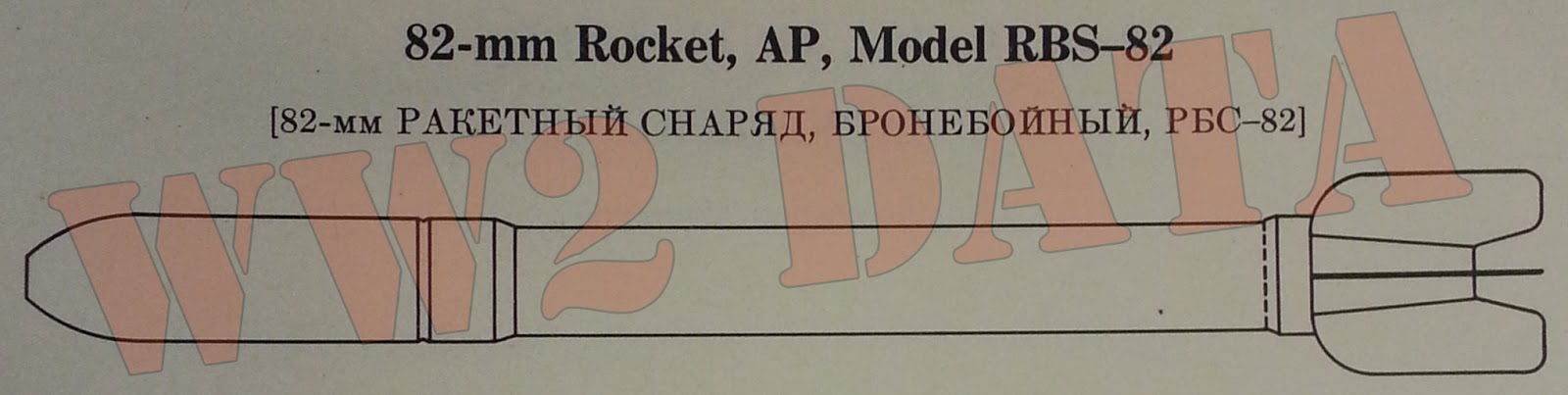
82mm Rocket, AP, Model RBS-82
  
   
This armor-piercing rocket originally was designed to be launched from the 82mm aircraft launcher RO-82; however, it is believed that it also may be fired from a 48-round truck-mounted ground launcher (designation unknown).  The RBS-82 armor-piercing rocket is designed for fire against armored targets.  It is designed to penetrate armor up to 50mm (2 inches) in thickness.  This rocket is reported to have been used successfully against German armor in World War II.
  
The RBS-82 rocket, 40.75 inches in length, consists of a warhead, a motor body, and a tail unit with stabilizing fins.  Studs are threaded into each end of the motor body to guide the rocket along the slotted launcher rail.  The warhead is filled with TNT, and is thicker-walled than that of the RS-82.
  
The forward end of the warhead is bluntly rounded and flat-nosed to reduce ricochet, but it is fitted with a metal or plastic ballistic cap.  The AV-96 impact fuze used with this rocket is seated in a threaded well in the base of the warhead.  The motor body is longer than that of the RS-82, and it contains three powder sticks and three igniters; it is threaded to the base plate of the warhead.  The propellant is ignited by means of PP-1 or PP-4 flash cartridges, which are inserted into flash cartridge holders in the rocket launcher.  The nozzle assembly is threaded into the rear of the motor body.
  
Each of the four stabilizing fins is constructed of two pieces of sheet metal welded together.  The fins are slotted and welded to the metal cone covering the nozzle.


Characteristics
Caliber: 82mm (3.23 in)
Total weight of rocket: 15kg (33 lbs)
Weight of warhead: 7.27kg (16 lbs)
Weight of propellant: 2.5kg (5.5 lbs)
Type of warhead filler: TNT
Weight of warhead filler: 0.48kg (1.06 lb)
Maximum velocity: 360 m/s (1,180 fps)
Maximum range: 6.4km (7,000 yards)
  
  
Packaging
  
 (No Illustration Available) 
  
The armor-piercing rocket RBS-82 is crated (with fuze) at the munitions plant.  PP-1 and PP-4 flash cartridges are shipped seperately.  The rocket is covered with grease as a protection from corrosion and rust.
  
Crates are marked with a tag identifying the lot number of the shipment, the year of manufacture, the manufacturing plant, and the number of rockets contained within the crate.


132mm Rocket, HE, Model RS-132
   
  
This high-explosive rocket originally was designed to be launched from aircraft; however, it also has been used as a ground-to-ground rocket.  The RO-132 aircraft launcher, or the M-13 (a 16-rocket truck-mounted ground launcher), is used to fire this rocket.  High-explosive rocket fire is used against a variety of ground targets.  The RS-132, an enlarged version of the RS-82, is one of the standard Soviet rockets.
   
This rocket, 36.8 inches long without the fuze, consists of a warhead, a motor body, and a tail unit with four stabilizing fins.  Studs threaded into each end of the motor body guide the rocket along the slotted launcher rail.  The warhead is a machined steel forging in which three circumferential grooves are cut to facilitate fragmentation.  The propeller-armed nose fuze is inserted into the threaded well of the warhead.  The AGDT-a fuze is used with this rocket when it is fired from aircraft, and the AM-a fuze is used for ground-to-ground fire.
  
The motor body is a machined cylinder containing the propellent charge, and it is closed at the forward end except for an internally threaded flange by means of which it is attached to the rear of the warhead.  The rear of the motor body is threaded internally to accommodate the single nozzle.  Each of the four stabilizing fins is constructed of two pieces of sheet metal, which are welded together, slotted, and welded to the metal cone covering the nozzle.
  
  
Characteristics
Caliber: 132mm (5.2 in)
Total weight of rocket: 23.1kg (50.8 lbs)
Weight of warhead: 9.12kg (20.06 lbs)
Weight of propellant: 3.78kg (8.32 lbs)
Type of warhead filler: TNT
Weight of warhead filler: 1.9kg (4.18 lb)
Maximum velocity: 350 m/s (1,148 fps)
Maximum range: 7.1km (7,763 yards)
  
  
Packaging
  
 (No Illustration Available) 
  
The Model RS-132 rocket is crated (without fuze) at the munitions plant.  Fuzes are packed seperately in small wooden boxes.  The fuze well in the warhead is filled with a wooden insert and sealed with a threaded plug for shipment.  The threaded plug and wooden insert must be removed and replaced by the appropriate fuze, in order to arm the rocket.  The combustion chamber is armed with PP-4 pyro cartridges at the factory.  Rockets are covered with grease as a protection from corrosion and rust.
  
Crates are marked with a tag identifying the lot number of the shipment, the year of manufacture, the manufacturing plant, and the number of rockets contained within the crate.


132mm Rocket, Frag-HE, Model ROFS-132
  
  
This fragmentation high-explosive rocket may be launched from the RO-132 aircraft launcher or from the M-13, a standard 16-rocket truck-mounted ground launcher.  The ROFS-132 rocket is used for blast and fragmentation effect.  The fragmentation effect is believed comparable to that of a 152mm artillery projectile.
  
The nomenclature of the rocket is somewhat confusing.  It is believed that the model manufactured prior to World War II was called the ROFS-132.  An improved model of the same rocket has been given the nomenclature TS-13.  The TS-13 is thought to be almost the same as the ROFS-132, but designed exclusively for ground launchers, whereas the ROFS-132 is launched from either aircraft or ground launchers. 
  
Another postwar improved model of the basic rocket, tentatively identified as the TS-53, is identical in construction with the TS-13, except that it has 12 subsidiary nozzles.  These auxiliary nozzles, each 3mm (0.12 in) in diameter, are arranged around the circumference of the motor body at equal intervals and are set transversely to the longitudinal axis of the rocket.  About 7 percent of the propellent gas passes through them, rotating the rocket at a rate of about 20 to 30 revolutions per second.
  
The ROFS-132, which measures 56.6 inches in length without the fuze, consists of a warhead, a motor body, and a tail unit.  The warhead is an elongated, thick-walled body with a threaded well at the nose for the insertion of the GVMZ fuze.  The AM-a fuze also may be used with this rocket, but it requires an adapter sleeve.  The motor body is a seamless, machined tube, identical in construction with the motor body of the RS-132 rocket, and it contains the propellent charge.
  
Each of the four fluted stabilizing fins of the ROFS-132 is constructed of two pieces of sheet metal which are welded together, slotted, and welded to the metal cone covering the nozzle.


Characteristics
Caliber: 132mm (5.2 in)
Total weight of rocket: 43kg (94.6 lbs)
Weight of warhead: 22kg (48.4 lbs)
Weight of propellant: 7.2kg (15.84 lbs)
Type of warhead filler: TNT
Weight of warhead filler: 4.6kg (10.12 lb)
Maximum velocity: 360 m/s (1,180 fps)
Maximum range: 6km (6,540 yards)
  
  
Packaging
  
(No Illustration Available)  
  
The Model ROFS-132 is crated (without fuze) at the munitions plant.  Fuzes are packed seperately in small wooden boxes.  The PP-4 flash cartridges are inserted in the combustion chambers of ROFS-132 rockets, and the rockets are shipped to arsenals and troop units in that form.  Rockets are covered with grease, as a protection from corrosion and rust.
  
Crates are marked with a tag identifying the lot number of the shipment, the year of manufacture, the manufacturing plant, and the number of rockets contained within the crate.


132mm Rocket, AP, Model RBS-132
  
  
This armor-piercing rocket was designed primarily to be launched from the RO-132 aircraft launcher; however, it also may be launched from the M-13, a 16-rocket truck-mounted ground launcher.  The RBS-132 armor-piercing rocket is designed for fire against armored targets.  It is designed to penetrate armor up to 75mm (3 inches) thick.  During World War II the Soviets used this rocket successfully against German armor.
  
This rocket, 59.4 inches in length, consists of a warhead, a motor body, and a tail unit with stabilizer fins.  Studs are threaded into each end of the motor body to guide the rocket along the slotted launcher rail.  The RBS-132 rocket differs from the RBS-82 in size, weight, and method of igniting the propellant charge; in other respects the two rockets are identical.  The TNT-filled warhead has a thick-walled, bluntly rounded ogive and a flat nose to prevent ricocheting.  The forward end of the warhead is fitted with a metal or plastic ballistic cap.  The AV-96 impact fuze used with this rocket is seated in a threaded well in the base of the warhead.
  
The motor body is filled with seven powder sticks and an igniter of black powder.  The PP-4 flash cartridges located in the forward end of the motor body activate the igniter, which in turn ignites the propellant charge.  The motor body is threaded into the base plate of the warhead.  The nozzle assembly is threaded into the rear of the motor body.  Each of the four stabilizing fins is constructed of two pieces of sheet metal, which are welded together, slotted, and welded to the metal cone covering the nozzle.


Characteristics
Caliber: 132mm (5.2 in)
Total weight of rocket: 51kg (112.2 lbs)
Weight of warhead: 30.5kg (67.2 lbs)
Weight of propellant: 7.2kg (15.84 lbs)
Type of warhead filler: TNT
Weight of warhead filler: 1.35kg (2.97 lb)
Maximum velocity: 320 m/s (1,050 fps)
Maximum range: 7km (7,700 yards)
  
  
Packaging
  
 (No Illustration Available) 
  
This armor-piercing rocket is crated (with fuze) at the munitions plant.  The combustion chambers are armed with PP-4 flash cartridges.  Accordingly, this rocket is shipped as a complete round.  The rocket is covered with grease as a protection from corrosion and rust.
  
Crates are marked with a tag identifying the lot number of the shipment, the year of manufacture, the manufacturing plant, and the number of rockets contained within the crate.


300mm Rocket, HE, Model TS-16
    
   
 This high-explosive rocket is one of the early types of heavy rockets designed by the Soviets.  It can be fired from its packing crate, which is placed on the four-round portable launcher, M-30, now obsolete.  The rocket is guided on the launcher rail by the longitudinal slats of the packing crate; therefore, no guide studs are necessary.  The TS-16 rocket is used for blast effect on ground targets at close range.

This rocket, 56 inches in length, consists of a nose-fuzed warhead, a motor body similar to that of the 132mm rockets, and a tail unit with eight stabilizing fins.  The warhead, 300mm in diameter, consists of two half-cylinders welded together to form the central portion which in turn is welded to the cup-shaped from and rear ends.  A steel collar and a nose cap are welded to the assembly.  The motor body, 125mm in diameter, contains the propellent charge.  

Details regarding the internal parts are not known.  It is presumed that ignition is effected by means of two connected igniters, one at each end of the charge.  The method by which the igniters are made to function is not known.  The tail unit consists of eight hollow fluted fins, formed of pressed steel sheet metal, which are welded to the cone covering the nozzle and banded with a steel strip.


Characteristics
Caliber: 300mm (11.8 in)
Total weight of rocket: 81kg (178 lbs)
Weight of warhead: ?kg (? lbs)
Weight of propellant: 6.8kg (15 lbs)
Type of warhead filler: TNT
Weight of warhead filler: 33.6kg (73.9 lb)
Maximum velocity: ? m/s (? fps)
Maximum range: 2.5km (2,750 yards)


Packaging

(No Illustration Available)

Model TS-16 rockets are individually crated and are launched directly from the packing crate.  Packing crate specifications, therefore, coincide with the requirements of the M-30 portable launcher.  Each rocket is covered with grease as a protection against corrosion and rush.

Crates are marked with a tag identifying the lot number of the shipment, the year of manufacture, the manufacturing plant, and the number of rockets contained within the crate.


300mm Rocket, HE, Model TS-20

  
 This high-explosive rocket is one of the early types of heavy rockets designed by the Soviets.  It can be fired from its packing crate, which is placed on the four-round portable launcher, M-30, now obsolete.  The rocket is guided on the launcher rail by the longitudinal slats of the packing crate; therefore, no guide studs are necessary.  The TS-20 rocket is used for blast effect on ground targets at close range.

This rocket consists of a warhead, a motor body, and tail unit.  The rocket is easily identified by tits blunt, rounded warhead, 300mm in diameter, to which a long, tapered nose fuze is fixed.  The warhead consists of two steel cups welded together, a threaded collar, and a nose cap which is welded onto the assembly.  The motor body, 125mm in diameter, is the same as that of the 132mm rockets, and it contains the propellent charge.  
  
This rocket has one nozzle.  The tail fin assembly is the same as that of the TS-16 (eight hollow fluted fins, formed of pressed steel sheet metal, which are welded to the cone covering the nozzle and banded with a steel strip.)


Characteristics
Caliber: 300mm (11.8 in)
Total weight of rocket: 76.7kg (169 lbs)
Weight of warhead: ?kg (? lbs)
Weight of propellant: 7kg (15.56 lbs)
Type of warhead filler: TNT
Weight of warhead filler: 32.3kg (71 lb)
Maximum velocity: ? m/s (? fps)
Maximum range: 2.8km (3,080 yards)


Packaging

(No Illustration Available)

Model TS-20 rockets are individually crated and are launched directly from the packing crate.  Packing crate specifications, therefore, coincide with the requirements of the M-30 portable launcher.  Each rocket is covered with grease as a protection against corrosion and rush.

Crates are marked with a tag identifying the lot number of the shipment, the year of manufacture, the manufacturing plant, and the number of rockets contained within the crate.


300mm Rocket, HE, Model TS-31


This high-explosive rocket is believed to be the latest Soviet development in the field of heavy, long-range rockets.  The 12-rocket truck-mounted M-31 field rocket launcher is used to fire the Model TS-31.

The TS-31 high-explosive rocket consists of a warhead, motor body, and tail unit.  The warhead and tail unit are similar in appearance to those of the Model TS-20, but the motor appears to be longer and of a slightly larger diameter.  This rocket uses a delay nose fuze.  The ignition system appears to employ an electric primer located in the tail end of the motor.  For firing, two wandering leads passing from the primer through the nozzle arc connected to terminals on the launcher.  The tail unit, as in the Model TS-20, has eight banded fins around a single nozzle.

The TS-52, another Soviet high-explosive rocket, is identical to the TS-31 in construction except that, in addition to the axial nozzle, it has four equidistant metal tubular inserts around the circumference of the motor tube which house subsidiary nozzles.  These nozzles, sealed with mastic, seem to be inclined at an angle to the axis of the projectile, since they have the effect of rotating the projectile at a rate of 15 to 20 revolutions a second.  The maximum range of the TS-52 is 4000m, which is slightly less than that of the TS-31.  Like the TS-31, the TS-52 is fired from the truck-mounted M-31 launcher.


Characteristics
Caliber: 300mm (11.8 in)
Total weight of rocket: 91.7kg (202 lbs)
Weight of warhead: 55.4kg (120 lbs)
Weight of propellant: ?kg (? lbs)
Type of warhead filler: TNT
Weight of warhead filler: 29.1kg (64 lb)
Maximum velocity: 244 m/s (800 fps)(estimated)
Maximum range: 4.325km (4,730 yards)


Packaging

(No Illustration Available)

No packaging data are available on the 300mm Model TS-31 rocket. 

It is assumed that it is individually crated, as are other large-caliber rockets.


Thursday, 20 August 2015

Soviet Explosive Ordnance - 14.5mm Projectiles and 82mm Mortar Rounds


14.5mm Ammunition


14.5mm Cartridge with Armor-Piercing Incendiary Bullet M1941 (with Special Core),
Type BS-41


This round is used interchangeably with the 14.5mm AP-I round B-32 cartridge, in the Soviet shoulder-fired antitank rifles PTRS-1941 (Simonov) and PTRD-1941 (Degtyarev).

This steel-jacketed bullet differs from the Type B-32 in that it has a flat base and a tungsten carbide core and in that it is considerably shorter.  The incendiary composition is placed in the nose of the jacket, forward of the core, as in the Type B-32.

This bullet was designed in 1941 in an effort to increase the combat effectiveness of the shoulder-fired antitank rifles.  Even with its slightly increased penetration capability, it has only limited use against modern armor.

The red bullet with black tip and the black primer are identifying color markings.


Characteristics
Caliber: 14.5mm (Cal. .57)
Weight of cartridge: 206.5g (3,187 gr)
Weight of case: 111.2g (1,715 gr)
Weight of bullet: 64.4g (994 gr)
Weight of propellant: 30.95g (478 gr)
Weight of tungsten carbide core: 38.5g (594 gr)
Length of cartridge: 115.7mm (6.13 in)* (4.55 in)
Length of case: 113.2mm (4.46 in)
Length of bullet: 49.02mm (1.93 in)

* The manual incorrectly states this measure


Packaging


Two hermetically sealed galvanized-metal containers are packed in a wooden box, as illustrated above.  Each metal container has 42 cartridges packed loosely in rows with strips of paper between each row and the cartridge heads alternately positioned in opposite directions.  The wooden packing box has a total of 84 cartridges.

Wooden packing boxes also have been reported to contain 80 cartridges of this type and caliber.  The wooden packing box for this cartridge is identified by the black-painted ends, black edges on the ends of the cover, two broken, black concentric circles, and the Russian symbol БС-41 (BS-41) immediately following the caliber size.

The metal container can be identified by the two broken, black concentric circles and by the Russian symbol БС-41 (BS-41) after the caliber size.


14.5mm Cartridge with Armor-Piercing Incendiary Bullet M1932, Type B-32


This round, with a rimless, bottlenecked cartridge case, is used in the Soviet 14.5mm antitank rifles PTRS-1941 (Simonov) and PTRD-1941 (Degtyarev), which were employed extensively by the Soviet Army against lightly armored vehicles, as well as against light and medium tanks, during World War II.

The brass cartridge case is secured to the bullet by a continuous rolled crimp at the mouth.  The streamlined steel-jacketed bullet has a hardened steel core and an incendiary composition in the nose.

The round was designed to combat light and medium tanks within a range of 500 meters (547 yards) and to ignite inflammable material behind the armor.  Its usefulness against modern armor is limited.l  At a range of 100 yards, this cartridge will penetrate 1.5 inches of homogeneous armor plate at normal.

The black tip and red band on the bullet are identifying color markings.


Characteristics
Caliber: 14.5mm (Cal. .57)
Weight of cartridge: 200.2g (3,089 gr)
Weight of case: 107.8g (1,664 gr)
Weight of bullet: 63.4g (979 gr)
Weight of propellant: 28.87g (445 gr)
Weight of steel core: 40.6g (626 gr)
Length of cartridge: 155.7mm (6.13 in)
Length of case: 113.2mm (4.46 in)
Length of bullet: 49.02mm (1.93 in)


Packaging


The packaging for this round is identical with that for rounds of 7.62mm and 12.7mm caliber.  A hermetically sealed metal container holds 40 cartridges packed loosely in rows, with strips of paper placed between each row, and with the heads alternately in opposite directions.  Two such containers are placed in a wooden box, making a total of 80 cartridges per box.  Wooden boxes of this type also have been reported to contain 84 cartridges, 42 in each of the 2 metal containers.

 Both the metal and the wooden for this cartridge bear the Russian symbol Б-32 (B-32) immedietaly following the caliber size, as well as a black and red stripe. 


I should take this moment to mention once again that the data these entries (Soviet Explosive Ordnance) are taken from a 1953 Technical Manual on the subject.  Therefore, it is possible that inaccuracies exist.  Any evidence that contradicts this information from a more recent source would be greatly appreciated, to help make these posts more accurate.


Mortar Ammunition


Soviet mortar ammunition is similar, in most respects, to the mortar ammunition of other nations.  The shells are teardrop-shaped, are stabilized in flight by metal fins, and use point-detonating fuzes.  This ammunition for smooth-bore weapons uses a propelling charge adjustable for desired ranges, consisting of ring-shaped or boat-shaped propellent increments and shot shell type of ignition cartridge.  The ring-shaped propellent increments are placed around the fin shaft; the boat-shaped propellent increments are inserted between the fin vanes, and the ignition cartridge is inserted into the fin shaft base.

Soviet mortar ammunition is cheap, easy to manufacture, and has an extremely high percentage of explosive content.  Types of mortar ammunition known to be in use are: fragmentation, high-explosive, fragmentation high-explosive, smoke, leaflet, incendiary, chemical, and illuminating.

Soviet mortar ammunition is manufactured in the following calibers: 82mm for the battalion mortar, 107 for the mountain-pack regimental mortar, 120mm for the regimental mortar, and 160mm for the divisional mortar.  The 160mm is the largest mortar used by any present-day (1953) army.  Within the Soviet Army, 107mm mortars and ammunition probably will be found only in moutnain units.  107 mortars and ammunition also are known to have been issued to several Satellite nations.  During World War II the Soviets used a 50mm mortar, but they are believed to have discontinued use of the weapon because of its short range, unsatisfactory fragmentation effect, and inaccuracy.

Indications are that lack of uniformity in Soviet propellants necessitates considerable preparation of ammunition before firing.  It is mandatory that the ammunition for each mortar be pre-selected and sorted by lots, weight marks, and matching charges.  Such a selection tends to reduce the dispersion caused by the varying lots of propellant.

The marking and packaging of Soviet mortar ammunition are very similar to those of their artillery ammunition, described previously.  82mm mortar rounds usually are packed in wooden boxes containing 10 complete rounds, or in 3-round metal "combat" boxes, which are easily transported by man-pack to the weapon site.  107mm and 120mm rounds are packed in two- and four-round wooden boxes.  The method of packing 160mm mortar rounds is not known, but owing to the weight of the round, single round containers probably are used.  Hermetically sealed containers are used for the storage of charges until just before their use.

Markings on the side of the brass base, or on the closing disc, of the ignition cartridges indicate the type of propellant, the lot number, the year of assembly, and the assembly plant for the cartridge.


82mm Mortar Shell, Frag, O-832

This fragmentation mortar shell, O-832, is fired from the various 82mm battalion mortars.  The complete round consists of five components: (1) A point detonating fuze, (2) a cast iron shell body, (3) a fin assembly, (4) an ignition cartridge, and (5) propellant increments which can be adjusted for zone firing.

The shell body may be filled with TNT, a mixture of amatol and TNT, or a mixture of Schneiderite and TNT.  The tail assembly stabilizes the shell in flight; it consists of a hollow shaft for the ignition cartridge, and six fins which are spot-welded to the shaft.  Slots in the fins hold the boat-shaped propellent increments in place.  Perforations or flash holes in the tail shaft, between the fins, permit the flash from the ignition cartridge to ignite the propellent increments. 

The number of increments used determines the charge number: "Charge 6" is the ignition cartridge and six increments; "Charge 0" is the ignition cartridge only.  In appearance, the ignition cartridge resembles a standard shotgun shell, except for a slight bulge in its case.  This bulge assures a forced fit and retains the ignition cartridge within the shaft of the fin assembly.

Point detonating fuzes M-1, M-2, M-3, M-4, M-5, MP-82, and MP-M are used with this round.
  

Characteristics
Caliber: 82mm (3.23 in)
Weight of complete round: 3.15kg (6.95 lbs)
Weight of propellant: 86.9g (3.04 oz)
Type of filled: Schneiderite/TNT
Weight of filler: 0.41kg (0.91 lb)
Maximum number of increments: 6
  

Packaging


The illustrated packing box has a capacity of 10 fuzed 82mm fragmentation mortar shells, O-832, with a sufficient number of ignition cartridges and propellent increments for all zones of fire.  The box is of sturdy construction, usually of a soft wood, with corners dove-tailed or reinforced by metal straps or angles.  Shells are held in place by contour blocking.  The O-832 mortar shell also may be packed in the three-round metal "combat" box. 

Markings shown in the above illustration will not be found on all boxes containing O-832 shells, but are typical of those which may be encountered.


82mm Mortar Shell, Frag, O-832D


This fragmentation mortar shell, O-832D, is fired from the various 82mm battalion mortars.  It differs from the O-832 fragmentation mortar shell in having a fin assembly with 10 fins instead of 6, and in using ring- or doughnut-shaped propellent increments rather than boat-shaped.

The ring-shaped increments are placed around the shaft of the fin assembly, directly over the flash holes, in order that they may receive the maximum flash from the ignition cartridge.  One ring-shaped propellent increment, as used on this shell, is equivalent to two boat-shaped increments, as used on the O-832; thus, three ring-shaped increments comprise the full charge.  The two types of increments are not interchangeable between these two shells.

Fuzes M-1, M-2, M-3, M-4, M-5, MP-82, and MP-M are used in this shell.


Characteristics
Caliber: 82mm (3.23 in)
Weight of complete round: 3.15kg (6.95 lbs)
Weight of propellant: 86.9g (3.04 oz)
Type of filled: Amatol 90/10
Weight of filler: 0.41kg (0.91 lb)
Maximum number of increments: 3


Packaging


The illustrated packing box has a capacity of 10 fuzed 82mm fragmentation mortar shells, O-832D, plus a sufficient number of ignition cartridges and propellent increments for all zones of fire.  The box is of sturdy construction, usually of a soft wood, with corners dove-tailed or reinforced by metal straps or angles.

The shells are held in place by contour blocking.  The rounds in this box have been renovated and repacked, as indicated by the Russian abbreviation "PEM" (REM).  The O-832D shells may also be found in the three-round "combat" box.


82mm Mortar Shell, Smoke, D-832


This smoke mortar shell, D-832, is fired from the various 82mm battalion mortars.  It can be distinguished from fragmentation shells by the "Д" (D) preceding the numerals in its code number, by a half-inch-wide black band just below the bourrelet, and by the adapter in the ogive.  (It appears that the fragmentation shell, O-832, was modified to take this adapter, which contains the fuze and bursting charge.)

In other respects, this shell closely resembles the fragmentation shell, O-832; the same type of propellent increments and fin assembly are used, and the outward appearance is similar.  The smoke shell is heavier than the fragmentation shell, however, and its range is slightly less.

The shell body contains a smoke-producing agent, usually yellow phosphorus, and a burster

The propellent increments "Z-832", and the ignition cartridges "Zh-832", are used to propel this shell.  

In addition to using this shell for screening purposes, the Soviets also use it in an anti-personnel role, as its fragmentation effect is only 35 to 40 percent less than that of fragmentation shells.  The shell is of additional tactical importance because of its incendiary effect against personnel and materiel.

Characteristics
Caliber: 82mm (3.23 in)
Weight of complete round: 3.66kg (8.07 lbs)
Weight of propellant: 50g (2 oz)
Type of filled: Phosphorus/Schneiderite/TNT
Weight of filler: 0.066kg (0.15 lb)
Maximum number of increments: 6

Packaging


The illustrated packing box has a capacity of three fuzed 82mm smoke mortar shells, D-832, with ignition cartridges, and with propellent increments attached to the fin assembly.  Additional increments may be carried in cylinders which are clipped to the lid.

The box is constructed of stamped sheet metal, has a hinged lid, finger-tip pressure catches, and carrying handles.  This container is known as the "combat" box because it is so easily transported to the weapon site by man-pack.  The box may or may not be marked.

The D-832 smoke mortar shell is also packed in 5- and 10-round wooden boxes.


82mm Mortar Shell, Propaganda, A-832


This propaganda leaflet mortar shell is fired from the various 82mm battalion mortars.  This mortar shell can be identified by its semi-conical nose, elongated body, and time fuze.  Soviet documents indicate that the nose and body of some propaganda leaflet mortar shells are painted red; however, some shells recovered have been unpainted.

The leaflets carried by this shell are enclosed in two metal half-cylinders in the shell body, and are expelled by a charge located between the time fuze and the leaflet containers.  When the expelling charge acts against the leaflet containers, the fine threads attaching the fin assembly to the body are sheared off, allowing the leaflets to escape and scatter.

A powder-train type, setback-armed time fuze similar in appearance to the Soviet 45-sec time fuze, is used in this shell.  Propellent increments and the ignition charge used with this shell are similar to those used for the O-832 and D-832 shells.


Characteristics
Caliber: 82mm (3.23 in)
Weight of complete round: 4.5kg (9.9 lbs)
Weight of propellant: 50g (2 oz)
Type of filled: Propaganda leaflets
Weight of filler: 0.01kg (0.02 lb)
Maximum number of increments: 6


Packaging


The illustrated packing box has a capacity of three fuzed 82mm propaganda shells, A-832, with ignition cartridges, and with propellent increments attached to the fin assembly. Additional increments may be carried in cylinders which are clipped to the lid.

The box is constructed of stamped sheet metal, has a hinged lid, finger-tip pressure catches, and carrying handles. This container is known as the "combat" box because it is so easily transported to the weapon site by man-pack. The box may or may not be marked.

The A-832 propaganda leaflet shell is also packed in 5- and 10-round wooden boxes.

 
Next time:  107mm and 160mm Mortar Shells