Showing posts with label 107mm. Show all posts

Monday, 21 September 2015

Soviet Explosive Ordnance - 107mm Projectiles


107mm Artillery Projectiles


107mm Complete Round, Seperate (Cartridge Case) Loading, HE, VF-423


This high-explosive round is fired from the 107mm corps guns M1910/30 and M1940 (M-60).  These weapons are obsolete in the Soviet Army, but they may be found in service with Satellite armies.  This projectile has a relatively thin-walled casing and large bursting charge.  It gives a greater blast effect than the VOF-423, but less fragmentation.
  
The RGM (with supplementary booster), UGT, and UGT-2 fuzes are used with the F-422L projectile in this round.  The VF-423 complete round also may be found with an F-422M projectile using an RGM fuze.
 
The following complete rounds are variants of the VF-423 round: VF-423D, with the F-420U projectile using the UGT-2 fuze; and VF-423K, with the F-422L projectile and the 3GT fuze.  They are basically the same as the VF-423 and are fired from the same weapons.
 
Note.  The dimensions for the cartridge case in the above illustration have not been verified.


Characteristics
Caliber: 106.7 (4.2 in)
Weight of complete round: 22.32kg (49.1 lbs)
Weight of projectile, as fired: 16.58kg (36.47 lbs)
Weight of propellant, w/o igniter: 2.35kg (5.16 lbs)
Type of projectile filler: TNT
Weight of projectile filler: 1.56kg (3.44 lbs)
 
 
Packaging
 
 
This ammunition may be packed in a two-round wooden box, as illustrated, or a four-round box may be used.  Projectiles and cartridge cases are also packed seperately, 3 projectiles to a box, and 20 cartridge cases to a box.


107mm Complete Round, Seperate (Cartridge Case) Loading, Frag-HE, VOF-423
 
   
This fragmentation high-explosive round is fired from the 107mm corps guns M1910/30 and M1940 (M-60).  These weapons are obsolete in the Soviet Army, but they may possibly be found in service with Satellite armies.  The illustrated round gives both fragmentation and blast effect.
 
The setting of the fuze determines whether the fragmentation or blast effect will be the greater in any given instance.  The projectile burst will produce from 300 to 400 lethal fragments.
 
The RGM and D-1 fuzes are used with the OF-420 projectile in this round.  The RGM fuze is used for impact fire or, with a delay setting, for ricochet fire.  The D-1 fuze is used exclusively for time fire.
 
The VOF-423U complete round, with an OF-420U projectile using a UGT-2 fuze, is a variant of the illustrated round.  It is basically the same as the VOF-423 and is fired from the same weapons.


Characteristics
Caliber: 106.7 (4.2 in)
Weight of complete round: 23.2kg (51 lbs)
Weight of projectile, as fired: 17.18kg (37.8 lbs)
Weight of propellant, w/o igniter: 2.79kg (6.14 lbs)
Type of projectile filler: TNT
Weight of projectile filler: 2.15kg (4.73 lbs)

Packaging
 
   
This ammunition may be packed in a two-round wooden box, as illustrated, or a four-round box may be used. Projectiles and cartridge cases are also packed seperately.
 
Note.  The dimensions on the above drawing have not been verified.


107mm Complete Round, Seperate (Cartridge Case) Loading, Incendiary, VZ-423
 
   
This incendiary round is fired from the 107mm corps guns M1910/30 and M1940 (M-60). These weapons are obsolete in the Soviet Army, but they may possibly be found in service with Satellite armies.
 
Incendiary rounds are used to start fires in and behind enemy lines, in order to destroy wooden structures, fuel dumps, and ammunition supplies.  The Z-420 projectile shown above is loaded with 16 segments of either thermite or "electron", and a small explosive bursting charge.
 
The T-6 and T-7 fuzes are used with the Z-420 projectile of this round.  Both of these fuzes are provided with a brass cap (not shown in the above drawing).


Characteristics
Caliber: 106.7 (4.2 in)
Weight of complete round: 23.23kg (51.1 lbs)
Weight of projectile, as fired: 17.24kg (37.93 lbs)
Weight of propellant, w/o igniter: 2.79kg (6.14 lbs)
Type of projectile filler: Thermite (16 segments) and explosive
Weight of projectile filler: 1.604kg (3.53 lbs)
 
  
Packaging
 
   
This ammunition may be packed in a two-round wooden packing box, as illustrated, or in a four-round box.  Projectiles are also packed seperately, three to a wooden box.  Box measurements in the above illustration have not been verified.


107mm Complete Round, Seperate (Cartridge Case) Loading, Smoke, VD-423
 
   
This smoke round is fired from the 107mm corps guns M1910/30 and M1940 (M-60).  These weapons are obsolete in the Soviet Army, but may be found in service with Satellite armies.  Smoke rounds are used by the Soviets for denying observation to enemy firing points and observation posts, for laying wide smoke screens over entire sectors, for target spotting, and for other purposes.
 
The common smoke compositions used in Soviet smoke rounds are phosphorus, sulfur trioxide, and chloride of tin.  Although the principal use of phosphorus is to produce smoke, it is an incendiary and casualty-producing agent as well.  It ignites spontaneously upon contact with the air and continues to burn even when embedded in the flesh. 
 
The D-422 projectile shown above contains a smoke composition and a black powder bursting charge.  The UGT-2 fze is used with the D-422 projectile in this round.  The D-422 projectile is a steel shell of an old model, and must be fired with a reduced charge.
 
The complete round VD-423U, with the D-422U projectile using the UGT-2 fuze, is a variant of the illustrated round.  It is basically the same as the VD-423 and is fired from the same weapons.
 
Note.  The dimensions given for the cartridge case in the above illustration have not been verified.
 
 
Characteristics
Caliber: 106.7 (4.2 in)
Weight of complete round: 22.31kg (49.1 lbs)
Weight of projectile, as fired: 16.77kg (36.89 lbs)
Weight of propellant, w/o igniter: 2.34kg (5.15 lbs)
Type of projectile filler: Phosphorus and black powder
Weight of projectile filler: 2.08kg (4.57 lbs)

Packaging

 
This ammunition may be packed in a two-round wooden box, as illustrated, or a four-round box.  Projectiles are also packed seperately, three to a wooden box.
 
Note.  The dimensions given for the box in the above illustration have not been verified.


107 Complete Round, Seperate (Cartridge Case) Loading, Shrapnel, VSh-423
 
   
This ball shrapnel round is fired from the 107mm corps guns M1910/30 and M1940 (M-60). These weapons are obsolete in the Soviet Army, but may be found in service with Satellite armies.  Shrapnel rounds are used primarily against exposed personnel.  The Sh-422 projectile contains shrapnel balls of a lead and antimony composition, and a small bursting charge.
 
The 45-sec time fuze is used with the Sh-422 projectile in this round.  A light metal cap is crimped onto the 45-sec fuze for shipping and must be removed before firing.  The model designation may or may not be stamped on the fuze.
 
The complete round VSh-423T, using a Sh-422T projectile with the T-6 fuze, is a variant of the illustrated round.  It is basically the same as the VSh-423and is fired from the same weapon.
 
 
Characteristics
Caliber: 106.7 (4.2 in)
Weight of complete round: 22.5kg (49.5 lbs)
Weight of projectile, as fired: 16.53kg (36.38 lbs)
Weight of propellant, w/o igniter: 2.35kg (5.16 lbs)
Type of projectile filler: Ball shrapnel and explosive
Weight of projectile filler: 0.196kg (0.432 lbs)
 
  
Packaging

 
This ammunition may be packed in a two-round wooden box, as illustrated, or a four-round box. Projectiles are also packed seperately, three to a box.
 
Note.  The dimensions on the above drawing have not been verified.
 
 
Next Time: 120mm Projectiles

Monday, 22 June 2015

Soviet Explosive Ordnance - 107mm and 160mm Mortar Rounds


107mm Mortar Rounds


The 107mm mortar rounds described in the manual are all for the mountain-pack regimental mortar of the same caliber, and should not be confused with the 120mm regimental mortars in the next update.
107mm Mortar Shell, Frag-HE, OF-841


This steel fragmentation high-explosive shell (light), OF-841, is fired from the 107mm mountain-pack regimental mortar M1938.  The complete round consists of five components: 
(1) A point detonating fuze,
(2) an explosive-filled thin-walled steel shell body,
(3) a fin assembly,
(4) an ignition cartridge, and
(5) propellent increments which may be adjusted for zone firing.

The OF-841 is supplied with propellent increments and ignition cartridges which are for use in the 107mm mountain-pack regimental mortar M1938 only; however, the OF-841A, OF-841T and D-841 are supplied with propellent increments and ignition cartridges designed for use with 120mm mortar rounds in the 120mm regimental mortar, as well as with the propellent increments and ignition cartridges for the 107mm mountain-pack regimental mortar.  Firing tables indicate that the OF-841 can be fired only with 107mm Charges 1 and 3.

The GVMZ and GVMZ-1 fuzes are used in this shell.


Characteristics
Caliber: 107mm (4.21 in)
Weight of complete round: 7.90kg (17.42 lbs)
Weight of propellant: 0.1kg (0.223 lb)
Type of filler: Schneiderite/TNT
Weight of filler: 2.1kg (4.63 lbs)
Maximum number of increments: 3


Packaging


The illustrated packing box has a capacity of four fuzed 107mm fragmentation high-explosive mortar shells, OF-841.  The box is of sturdy construction, usually of a soft wood, with corners dovetailed or reinforced by metal straps or angles.  The shells are held in place by contour blocking.

These rounds, as packed, need only be equipped with the propellent increments to be ready for firing.  The propellent increments are packed separately (in airtight metal cans or waxed cardboard cartons) within the wooden packing box that holds the rounds and must be affixed to the rounds prior to firing.


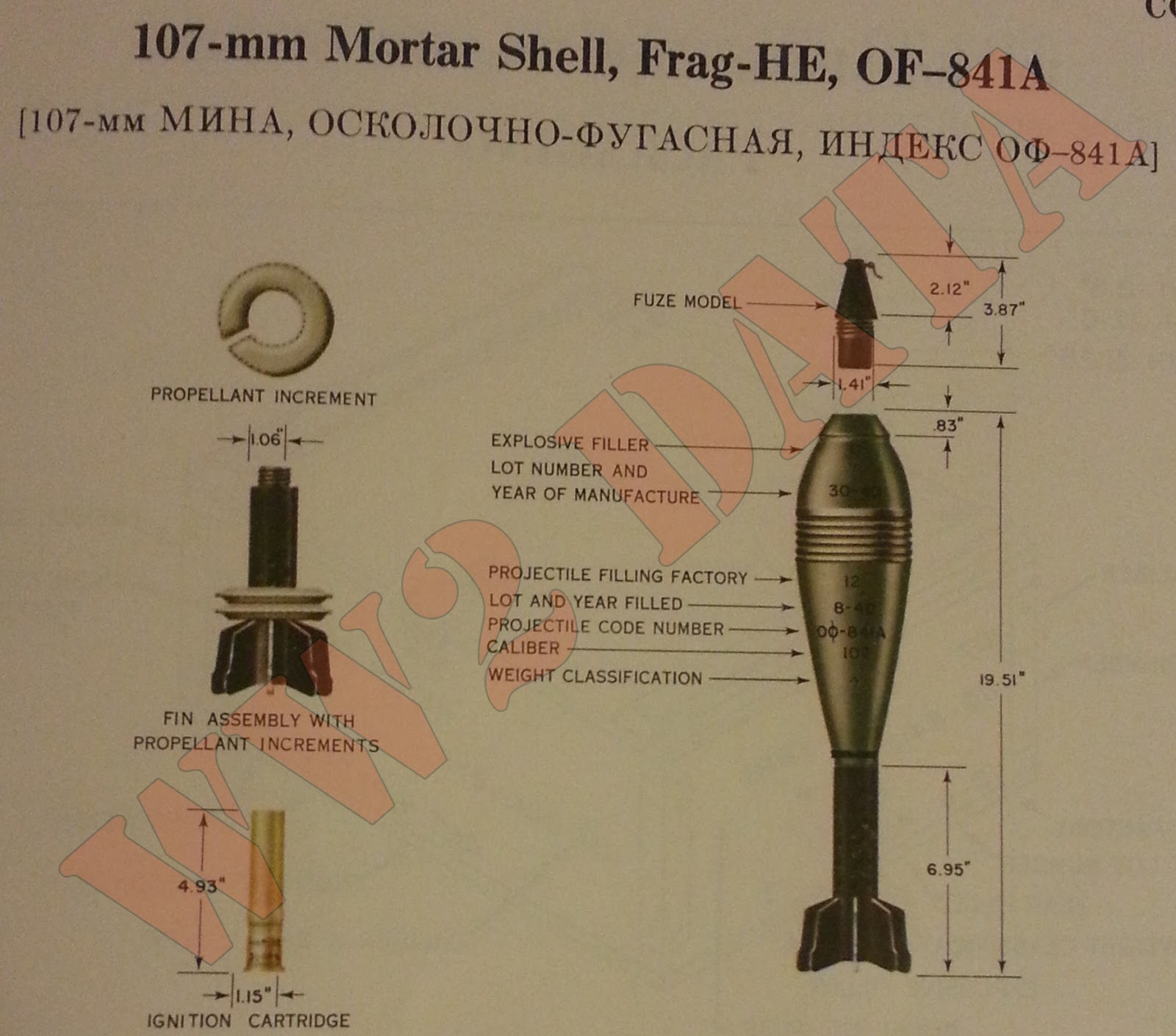
107mm Mortar Shell, Frag-HE, OF-841A


This cast iron (ЧУГУННАЯ) fragmentation high-explosive shell, OF-841A, is fired from the 107mm mountain-pack regimental mortar M1938.  It can be distinguished from the steel (СТАЛЬНАЯ) fragmentation high-explosive mortar shell, OF-841T, by the "A" at the end of the code number, and by a half-inch-wide black band just forward of the fin assembly.  The location of the black band also distinguishes this shell from the smoke shell, D-841.

In other respects, this round is similar to the OF-841T and the D-841.  Dimensions are approximately the same, and the same propellent increments, ignition cartridges, and fuzes (GVMZ and GVMZ-1) are used.


Characteristics
Caliber: 107mm (4.21 in)
Weight of complete round: 8.76kg (19.31 lbs)
Weight of propellant: ?kg (? lb)
Type of filler: TNT
Weight of filler: 1.15kg (2.54 lbs)
Maximum number of increments: 4


Packaging


The illustrated packing box holds four unfuzed 107mm mortar shells, OF-841A, and separately packed ignition cartridges and propellent increments.  This box is similar in construction to the box in which the OF-841T mortar shells are packed, and the rounds are packed in a similar manner.

Fuze wells in the OF-841A  are closed with plastic plugs; the fuzes are packed in separate boxes.


107mm Mortar Shell, Frag-HE, OF-841T


This steel fragmentation high-explosive shell (heavy), OF-841T, is fired from the 107mm mountain-pack regimental mortar M1938.  It is similar in appearance to the OF-841, but is longer and heavier.
The OF-841T, like the OF-841, has a powerful high-explosive filler.  Its blast is effective against field fortifications, buildings, materiel, and other objects, as well as personnel.

The OF-841T used the propellent increments and ignition cartridges designed for use with 120mm mortar shells in the 120mm regimental mortar, as well as the propellent increments and ignition cartridges for the 107mm mountain-pack regimental mortars.  A maximum of four 120mm increments (Charge 4) can be fired.

The GVMZ and GVMZ-1 fuzes are used with this round.


Characteristics
Caliber: 107mm (4.21 in)
Weight of complete round: 9kg (19.84 lbs)
Weight of propellant: ?kg (? lb)
Type of filler: TNT
Weight of filler: 1.98kg (4.37 lbs)
Maximum number of increments: 4


Packaging


The illustrated packing box has a capacity of four fuzed 107mm fragmentation high-explosive mortar shells, OF-841T.  The box is of sturdy construction, usually of a soft wood, with corners dovetailed or reinforced by metal straps or angles.  The shells are held in place by contour blocking.

The packed rounds are ready for firing except for propellent increments.  The propellent increments, which are packed in airtight metal cans or waxed cardboard cartons, are inclosed in the same wooden packing box with the shells.  They must be affixed to the round prior to firing.


107mm Mortar Shell, Smoke, D-841


This smoke mortar shell, D-841, is fired from the 107mm mountain-pack regimental mortar M1938.  It is similar in appearance to the OF-841T and OF-841A shells, but it can be distinguished from them by the "Д" (D) beginning the code number and by a 0.6 inch, wide black band located 0.6 inches below the gas check bands.

The steel shell body is filled with a smoke composition (usually yellow phosphorus) and with a burster charge which is designed to explode the shell body and scatter the smoke composition.  The phosphorus ignites and burns spontaneously upon contact with the air, and this fire is difficult to extinguish.  This round uses the same propellants, ignition cartridges, and fuzes (GVMZ and GVMZ-1) as the OF-841T.

The smoke mortar shell, D-841, is used primarily as a screening agent, but it is of further tactical importance against personnel and material because of its fragmentation and incendiary effect.

 
Characteristics
Caliber: 107mm (4.21 in)
Weight of complete round: 9.4kg (20.72 lbs)
Weight of propellant: ?kg (? lb)
Type of filler: Phosphorus and explosive
Weight of filler: 
-Bursting Charge: 0.207kg (0.46 lb)
-Smoke Composition: 1.82kg (4.01 lbs)
Maximum number of increments: 4


Packaging


The illustrated packing box has a capacity of four fuzed 107mm fragmentation high-explosive mortar shells, D-841, plus a sufficient number of ignition cartridges and propellent increments for all zones of fire.  The box is of sturdy construction, usually of a soft wood, with corners dovetailed or reinforced by metal straps or angles.  The shells are held in place by contour blocking.

Ignition cartridges and propellent increments are packed in airtight metal cans or cardboard cartons and inclosed in the wooden box, to be affixed to the shell prior to firing.  Fuze wells in the mortar shells are sealed with plastic plugs.  The fuzes are packed in separate boxes.


160mm Mortar Shell, HE, F-852


The shell illustrated is the high-explosive shell, F-852, which is fired from the 160mm divisional mortar M1943.  It is similar in appearance and construction to other Soviet large-caliber mortar shells, but it is approximately twice as heavy as the shells of the next largest caliber.  It is used primarily for demolition purposes.

This round consists of the usual five components: (1) A point detonating fuze, (2) a steel shell body filled with HE, (3) a fin assembly, (4) an ignition cartridge, and (5) propellent increments which can be adjusted for zone firing.

The fuze model for this round is not known, although there is some documentary evidence indicating the use of the M-1 fuze.

It is assumed that markings on this round would conform to the standard marking system for other Soviet mortar rounds and would include such data as the type of filler, filling factory, lot number and year filled, ccaliber, code number, and weight classification.


Characteristics
Caliber: 160mm (6.3 in)
Weight of complete round: 40.08kg (88.18 lbs)
Weight of propellant: ?kg (? lb)
Type of filler: ? (High-Explosive)
Weight of filler: ?kg (? lbs)
Maximum number of increments: ?


Packaging

No illustration available

There is no available packaging data on the 160mm mortar ammunition.  It is assumed that boxes for this ammunition are constructed in the same manner as other large-caliber mortar ammunition boxes; but, because the weight of the shell, the packing box probably contains only one round, one fuze, and one set of propellent charges.


Next time: 120mm Mortar shells