Monday, 26 October 2020

German Explosive Ordnance - German Mines and Grenades (Part 9)


German Explosives


Stielhandgranates 24 and 39


Model 24
Overall Length: 1 ft 2 inches
Diameter of body: 2 and 3/4 inches
Weight: 1/2 pound
Weight of Explosive Filler: 6 ounces
Explosive Filler: TNT


Model 39
Overall Length: 1 ft 4 inches
Diameter of body: 2 and 3/4 inches
Weight: 1 pound 6 ounces
Weight of Explosive Filler: 7 ounces
Explosive Radius: 16 yards


Color: Olive Drab


Description: These grenades are similar in all characteristics except size.  These grenades consist of a thin iron or steel casing, or head, containing the explosive filler, which is screwed onto a hollow wooden handle, through the center of which runs a double length of cord.  This cord is attached at one end to a lead ball which is part of the igniter, and at the other end to a porcelain ball.  The cavity in which the porcelain ball rests is closed by a metal cap that screws on.  Inside the cap is a spring-actuated metal disc that prevents movement of the porcelain ball.

These grenades use igniters B.Z. 24 consisting of a lead tube or sheath connected to a threaded brass fitting by a short steel tube.  The steel tube is threaded on both ends and contains the power delay pellet.  The lead tube contains the copper capsule which holds the friction composition.  The friction wire is cast in the friction composition and contained in the capsule which is coiled at the bottom to provide resistance to pulling and joined to the "pull" loop at its opposite end.  When the loop is pulled, it frees itself from the lead tube drawing the wire through the friction composition and the resulting flame ignites the delay pellet.


Operation: The metal cap is unscrewed from the handle and the porcelain ball is pulled.  This will pull a wire through the delay pellet.  The grenade is then thrown and after a 4- to 5-second delay the delay pellet will initiate the detonator.


Stielhandgranate 43


Overall Length: 1 ft 3 inches
Diameter of body: 2 and 3/4 inches
Weight: 1/2 pound
Weight of Explosive Filler: 6 ounces
Explosive Filler: TNT


Description: This grenade consists of a thin iron or steel casing, or head, containing the explosive filler.  This is secured to the wooden stick handle by four deep stabs.  The igniter screws into the top of this head and is of the standard pull friction type, had a blue head and a 4- to 5-second delay.

This grenade differs from the standard Model 24 stick grenade only in the position of the igniter and method of affixing the explosive head to the stick handle.  Usually this type is found with a fragmentation sleeve.


Eierhandgranate 39


Overall Length: 3 inches
Maximum Diameter: 2 inches
Weight: 12 ounces

Color: Black body with blue igniter head

Description: This is a small thin-case offensive type grenade with a high proportion of a low-grade explosive.  It is ignited by a friction type igniter and a 4- to 5-second delay pellet.  This grenade uses the B.Z.E. friction-type igniter.  The short body of this igniter is usually made of brass and contains a friction composition in which a friction wire is cast.  The lower end of the friction wire is coiled to provide resistance which serves to ignite the friction composition when the wire is drawn through it.  The upper end of the friction wire has a loop to which is fastened one end of a cord.  The free end of the cord is attached to a disk which is within the head.  The head screws on to the top of the body and a steel tube containing the delay pellet screws into the bottom of the body.


Operation: The igniter head is unscrewed and pulled, thus drawing the wire through the friction composition and igniting the delay pellet.  The grenade is then thrown and after a delay of 4 to 5 seconds the delay pellet will initiate the detonator thus setting off the explosive filler.


Remarks: There has been found a practice hand grenade of this type containing a spotting charge with the B.Z.E. igniter.  The German designation of this is the Eierhandgranate 39 (Ub).  A modified egg grenade has also been found with a ring attachment on the base.


Next Time: German Mines and Grenades (Part 10)


Source: German Explosive Ordnance Vol. 1: Bombs, Rockets, Grenades, Mines, Fuzes & Igniters 

Monday, 5 October 2020

German Explosive Ordnance - German Mines and Grenades (Part 8)


German Explosives


S-Mine 35 (A/P)


Diameter/Width: 4 inches
Depth (w/o fuze): 5 inches
Total Weight: 9 pounds

Explosive: TNT (or Amatol)
Explosive Weight: 6 and 1/2 pounds
Material: Steel
Pull or Pressure required: 9 to 13 pounds

Color: Normally brown with greenish tinge


Description: The S-Mine resembles a tin can in size and shape and was originally referred to as the "Fruit Tin" mine by the British.  It consists of an outer steel case and an inner canister which contains approximately 350 steel balls.  A central steel tube running axially through the mine receives the igniter at its upper end and acts as a flash channel.  A 4 and 1/2-second delay fitting is threaded into the bottom of this tube.  A gun powder ejection charge is located beneath the inner canister.  Three detonator tubes are space radially around the inner canister, 120 degrees apart.  A short delay element is fitted into the bottom of each of these detonator tubes.  The space between the detonator tubes is filled with explosive, either TNT or amatol.

There were various modifications in the early production models of the S-Mine, including detonator tubes made of compressed paper, minor technical differences, and use of irregular pieces of metal for shrapnel instead of steel balls.


Operation: The mine may be operated by pressure or by pull.  If it is to be operated by pressure, a standard pressure igniter, type S.Mi.Z. 35 is screwed into the top of the tube.  If the mines are to be operated by pull, a Y-connection is screwed into the top of the tube and two standard igniters of the Type Z.Z. 35 or Z.U.Z.Z. 35 are screwed into the branches of the Y.  Z.Z. 42 and electrical igniter E.S.Mi.Z. 40 also can be used.  In either case, when an igniter s fired, the flame produced ignites the 4 and 1/2-second delay powder of the tube which in turn ignites the powder charge.  The powder charge then explodes forcing the mine proper out of the canister and into the air.  At the same time the explosion of the powder charge ignites the delay powder tubes.  The delay in these tubes is long enough to permit the mine to rise 3 to 5 feet into the air before the detonators in the tubes are ignited.  The detonators then explode the charge and the steel balls are dispersed in all directions.  The effective range of these balls is between 150 and 200 yards.


Employment: When used as a pull-operated mine, it is laid in a cylindrical hole and held in place by four stakes.  Trip wires are attached to the igniters and stretched out in opposite directions.  The wires are run 4 inches above the ground and pass through eye screws fixed to the top of wooden stakes.  The recommended length for the trip wires is 21 yards with the supporting stakes at 7 yard intervals.


Remarks: Various anti-lifting devices are employed with the mine.


"Eismine" 42, Flascheneismine (Fl. Eis. Mi.) (A/P)


Length: 10.5 inches
Diameter/Width: 4 inches (maximum)
Total Weight: 5 pounds 10 ounces


Explosive: Gelatin-Donarit
Explosive Weight: 4 pounds
Material: Glass
Pull or Pressure required: Varies with igniter

Color: Clear

Description: The mine consists of a thick glass bottle resembling a quart milk bottle.  In some models there is a booster charge of penthrite wax in the neck.  There is a wooden plug with a conical recess and a central hole located at the top of the bottle neck.  The Fl. Es. Mi. Z. igniter, with detonator crimped on, fits into this hole with the detonator extending down into a hole in the booster.  An aluminum cap screws onto the top of the bottle over the igniter, with the igniter striker being just below the cap.  When in place the cap is waterproofed with a sealing compound and over this fits a rubber cap to assure complete waterproofing.


Operation: Sufficient pressure on the igniter causes detonation of the mine.


Employment: The original German theory for the use of these mines was that they should be suspended on 6-foot lengths of wire below the surface in ice-covered rivers. The mines were placed 16 feet apart and at intervals mines were set to be ignited by electric detonation.  The explosion of one mine would set up a sympathetic detonation which would explode those in the adjacent area.

The mines were later used for A/P ground mines, employing the Fl. Es. Mi. Z. igniter and adapted for use with other pressure type igniters.


Remarks: The mine is set in concrete to serve as an A/P land mine.


"Pot" Mine or "Mustard Pot" Mine - Beheles-Schutzen Mine (A/P)


Diameter/Width: 3 inches
Depth (w/ igniter): 3.5 inches
Total Weight: 12.5 pounds

Explosive: Powdered picric acid
Explosive Weight: 4 ounces
Material: Steel
Pull or Pressure required: 35 pounds

Color: Mustard brown


Description: The mine consists of a cylindrical body and a crush igniter, screwed into the top of the body by means of an adapter.  The body, which is of pressed steel, contains the explosive filling of approximately 4 ounces of powdered picric acid, and carries the top plate which is fixed by means of a rolled, overlapping flange 0.2 inch thick.

In the center, the top plate bears a screw thread into which is screwed an adapter which takes the igniter.  The adapters found in different specimens are of different materials, such as brass and plastic in various colors, suggesting local manufacture of not very high standard.


Operation: A moderate pressure on the top of the igniter crushes the metal drum and the glass ampoule inside it.  The acid pours into the white powder and a flash results from their chemical interaction, setting off the detonator, and in turn, the mine.


Remarks: This mine was manufactured for the Germans by the French.  There are other variations of this mine which embody minor manufacturing differences.


Next Time: German Mines and Grenades (Part 9)


Source: German Explosive Ordnance Vol. 1: Bombs, Rockets, Grenades, Mines, Fuzes & Igniters 

Monday, 28 September 2020

German Explosive Ordnance - German Mines and Grenades (Part 7)


German Explosives


Schumine 42 (A/P)


Length: 5.04 inches
Diameter/Width: 3.86 inches
Depth: 1.8 inches
Total Weight: 1.1 pounds

Explosive Weight: 1/2 pound
Material: Impregnated Plywood
Pull or Pressure required: 6 to 11 pounds

Color: Unpainted


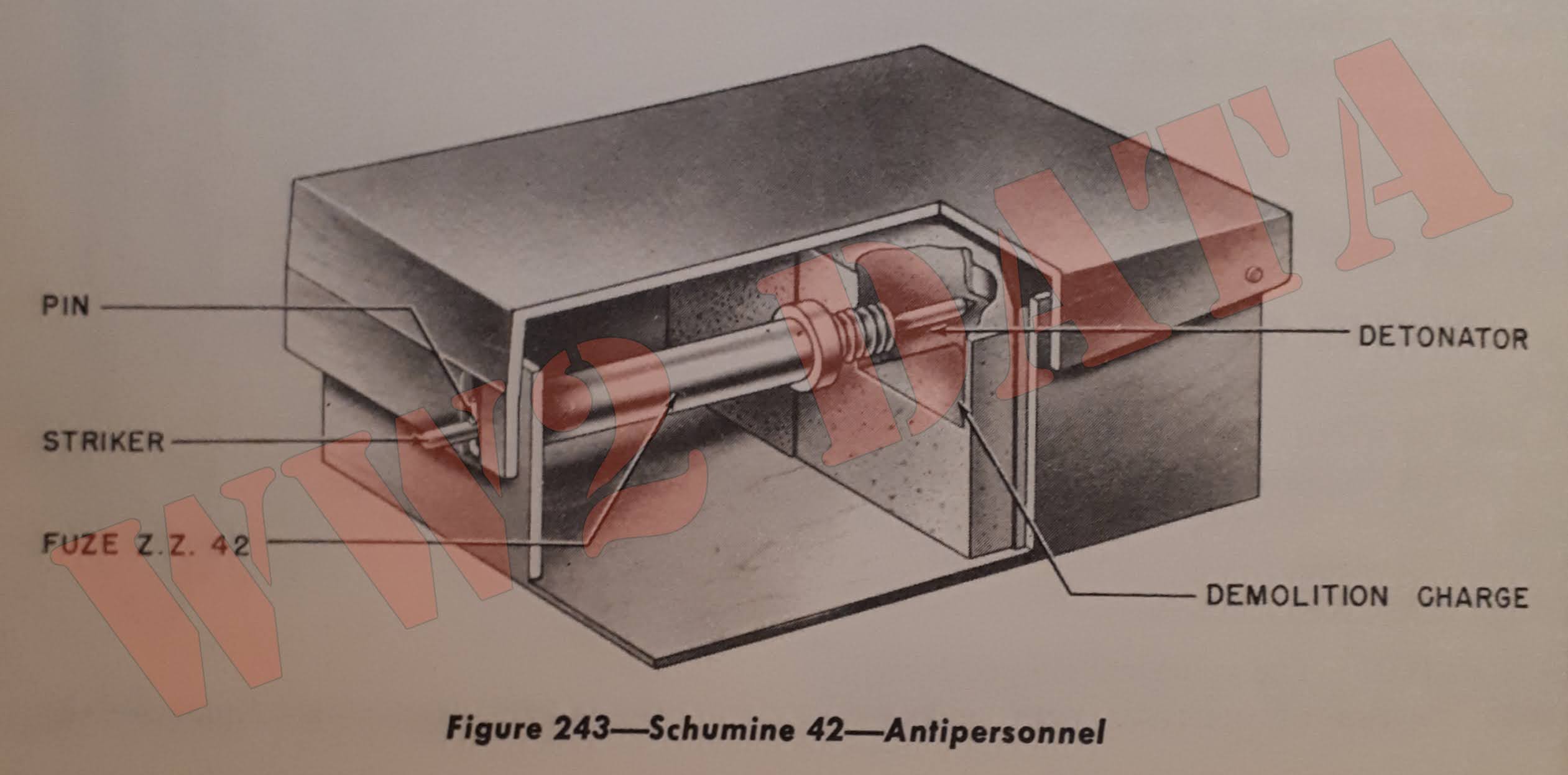
Description: The mine consists of a wooden box which contains a 1/2 pound demolition block fitted with a Z.Z. 42 igniter and detonator.  The box is covered with a hinged lid.


Operation: Pressure on the box lid pushes the pin out of the igniter, freeing the striker and causing detonation of the igniter cap, detonator and explosive charge.


Remarks: A modified Schumine with a special large lid and sloping front, designed to employ the Z.Z. 35 igniter, was also encountered.  The sloping front engages on an actuating pin pushed through the normal wire hole in the top of the igniter.  The modified mine has a hole in the lid so that a cord can be tied to the safety pin and the igniter armed from a safe distance.


Behelfsmine W-1 (A/P)


Length: 4.6 inches (w/ igniter)
Diameter/Width: 1.9 inches


Explosive: Picric Acid and granulated TNT
Explosive Weight: 4 ounces
Material: Steel
Pull or Pressure required: 35 pounds


Description: The W-1 is an antipersonnel mine improvised from a French 50mm mortar shell from which the nose fuze and tail fins have been removed.  A Buck chemical igniter is fitted by means of a plastic adapter.


Operation: When the Buck igniter is crushed by pressure, a chemical reaction is set up which causes the ignition of the detonator and then the mine.


S-Mine 44 (A/P)


Diameter/Width: 4 inches
Depth: 5 and 1/8 inches
Total Weight: 8.8 pounds

Material: Steel
Pull or Pressure required: 21 pounds pressure or 14 pounds tension

Color: Camouflage Yellow


Description: The main differences between the S-Mine 44 and the s-Mine 35 are in the use of a push-pull type igniter. (S.Mi.Z.44) and the fact that the mine detonates at a pre-determined height of approximately 36 inches.  For recognition purposes, it should be noted that the igniter tube is not located in the center of the mine as it is in the S-Mine 35.

The mine consists of an outer steel case containing an inner canister.  The canister holds the TNT explosive charge which is surrounded by small shot.  In the cover plate there are three screw-covered openings; one for pouring the charge, one for the igniter socket beneath which is the propellant (3 gm of burning gunpowder), and a 4.5-second delay pellet all in a celluloid case, and a third opening for a pull igniter and detonator.  The pull igniter is at the base of the center tube and immediately above it is a flash cap for initiating the detonator.  The pull igniter contains a spring-loaded striker, the sleeve of which is held beneath the internal shoulders of the igniter case by two balls which are prevented from moving inward by a pin in the base of the igniter.  The pin is attached to about 2 feet 10 inches of coiled wire to the base of the outer case.


Operation: After the detonator has been inserted and the igniter fitted and armed by withdrawal of a safety pin, the igniter can be operated either by pressure or pull on the trip wires.  Operation of the igniter initiates the 4.5-second delay pellet.  After the delay the propellant is fired, throwing the mine upwards.  When the coiled wire is fully extended it pulls the pin from the igniter, thus allowing the retaining balls to move inward and release the striker upwards to fire the cap, detonator, and bursting charge.


Employment: The mine is employed in the same manner as the S-Mine 35 for pressure or tension operation.


Remarks: This information is taken from a captured German document.


Next Time: German Mines and Grenades (Part 8)


Source: German Explosive Ordnance Vol. 1: Bombs, Rockets, Grenades, Mines, Fuzes & Igniters 

Monday, 21 September 2020

German Explosive Ordnance - German Mines and Grenades (Part 6)


German Explosives


B-Stabmine (Concealed Stickmine) (A/P)


Length: 10 inches
Diameter/Width: 6 inches
Depth: 3 and 1/2 inches


Material: Wood
Pull or Pressure required: 9 to 13 pounds

Color: Camouflage Brown


Description: The body of the mine consists of a wooden box containing the explosive charge.  The initiating stick is fixed in a wooden block which is wedged into a base raised on supports above the cover of the box.  In the base of the wooden block is a metal hook to which is attached a wire, the other end being secured to the eye of the pull igniter Z.Z. 35.  The pull igniter is held in a metal clamp in the cover of the box.


Operation: Movement of the stick pulls the wire and thereby fires the igniter and the charge.


Employment: Used in tall grass and on beaches.


Stockmine (A/P)


Length: 22 inches (Approx.) (Including picket)
Diameter/Width: 2.8 inches
Total Weight: 4.6 pounds (mine only)

Explosive: Borhpatrone 28
Explosive Weight: 100 grams
Material: Concrete (Shrapnel-filled) - wooden picket
Pull or Pressure required: 6 to 11 pounds


Description: The mine itself consists of a concrete cylinder which is made of weak cement and mortar.  This cement holds pieces of shrapnel.  Inside the concrete cylinder is the explosive charge.  In the mines found in North Africa, this charge was Bohrpatrone 28, an explosive which is designed for use in tropics.  However, this cavity may be filled with ordinary commercial cartridges.  An igniter, fitted with a detonator, fits into the recess in the top of the mine.  The mine is mounted on a wooden picket about 1 foot 4 inches long, driven into the ground.


Operation: Actuation of the igniter fires the detonator which in turn fires the explosive charge.  The firing of the mine causes a belt of shrapnel to be thrown out in all directions and the concrete is reduced to dust.  The effective radius is approximately 30 yards.


Employment: Stock mines usually are laid in depth on narrow tracks and in ravines and defiles.  They can also be laid in staggered rows to form mine belts.


Concrete Ball Mine (A/P)


Diameter/Width: 10 inches
Total Weight: 2.2 pounds
Material: Concrete

Color: Gray


Description: The spherical shaped body of the mine consists of concrete with embedded shrapnel used as an aggregate.  A central cavity is provided for insertion of the explosive charge which may be either two 500-gram charges and a 200-gram charge or only one 500-gram charge may be used with the 200-gram charge so that the igniter assembly is countersunk into the mine.


Operation: The igniter may be pulled by hand, initiating the safety which in turn, fires the detonator and charge.  In such a case, the mine may be rolled down a hill or cliff into enemy troops.  It is possible to peg the igniter to a stake below the bomb in such a way that, if an attempt is made to remove the mine, the igniter will be actuated.


Next Time: German Mines and Grenades (Part 7)


Source: German Explosive Ordnance Vol. 1: Bombs, Rockets, Grenades, Mines, Fuzes & Igniters

Monday, 14 September 2020

German Explosive Ordnance - German Mines and Grenades (Part 5)


German Explosives


Aluminum Mine (A/P or A/T)


Diameter/Width: 12 inches
Depth: 3 and 3/4 inches
Total Weight: 14 pounds

Explosive: Cheddite with Tolite boosters
Explosive Weight: 7 pounds
Material: Aluminum Alloy
Pull or Pressure required: 130 pounds on sides, 390 pounds in center.

Color: Tan


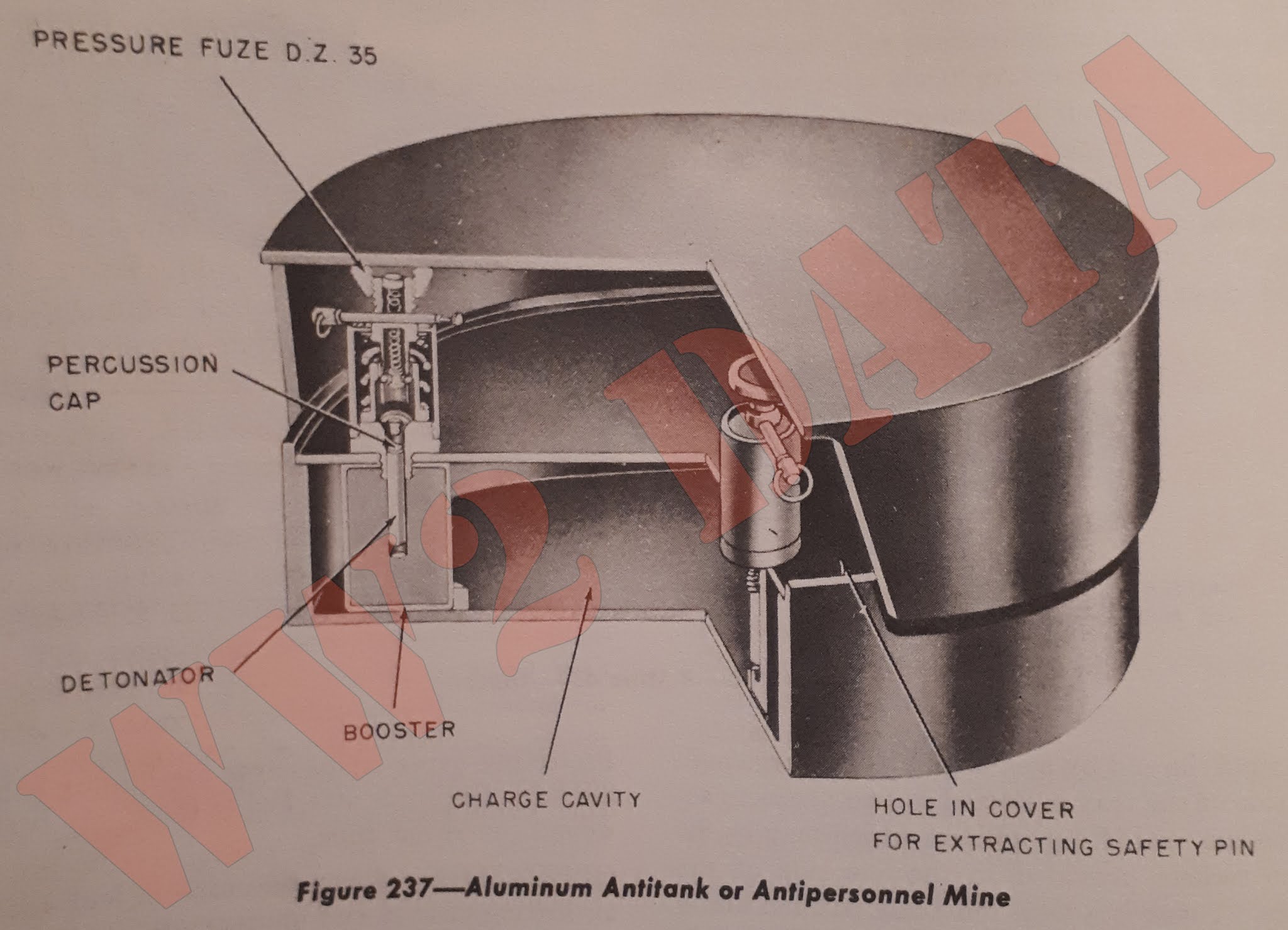
Description: The lower portion of the mine is a flattened cylindrical case which contains the explosive.  The explosive is covered by a flat aluminum disc.  Three igniter wells, located 120 degrees apart are positioned in the explosive.  Three D. Z. 35 igniters with No. 8 detonators are screwed into these wells.  An aluminum lid is placed over this assembly to act as a pressure plate.


Operation:

1. Pressure of 130 pounds on sides to 390 pounds in center depresses cover and sets off one or more of the three pressure fuzes, either German D.Z. 35 or T.Mi.Z.42.

2. Fuzes explode detonators, boosters, main charge.


L.P.Z. (Light A/T or A/P)


Diameter/Width: 10 and 1/2 inches
Depth: 5 inches
Total Weight: 9 pounds

Explosive: TNT
Explosive Weight: 5 pounds
Material: Sheet Metal

Color: Gray


Description: This is a light antitank mine, convertible to antipersonnel.  The explosive charge is contained in two saucer-shaped covers and an outer cover serves as a pressure plate.  Five igniters are built into the mine and spaced radially around it.  The igniter strikers, which face upwards toward the top of the mine, are held under spring tension and are cocked in position by locking balls.  A flame tube or flash chamber leads from each of the igniter caps to a central chamber over the main detonator.  The safety screw threads into this chamber and when it is screwed tightly clockwise, the white line marked "SICHER" on screw head is opposite white mark on mine.  The beveled end on the screw closes the flash hole leading to the detonator.  Three bolts, radially spaced, serve to secure the main charge to the pressure plate.


Operation: Pressure crushes the mine cover, and forces one or more igniter housings downward over their plungers.  This action compresses the outer spring, allowing the steel locking balls to be forced outward into upper recesses, releasing the striker.  The released striker, driven by the striker spring, explodes the percussion cap.  Flame from the cap travels through the flame tube and chamber, and ignites the detonator, booster, and main charge.


Remarks: If the mine is used against personnel, bottom fuze nuts are removed and the mine, resting on threaded end of plungers, is placed on a flat hard surface.  Light pressure on the mine cover depresses the entire mine and forces the plungers upward into the igniter housing.


Glassmine 43 (f) (A/P)


Length: 6 inches
Depth: 4 and 1/8 inches

Explosive: Sprengkorper 28
Explosive Weight: 7 ounces (approx.)
Material: Glass
Pull or Pressure required: 20 to 25 pounds

Color: Clear


Description: The mine consists of a glass "dish" which is covered by a thin glass shear plate.  The explosive charge is a standard sprengkorper 28 German demolition block.  Either the Buck chemical igniter or the "Schuko" igniter may be employed as shown above.  A metal safety fork fits into grooves in the pressure plate, providing a bridge to the outer edges of the mine, and supports the safety fork until such time as the mine is laid.

A grooved shoulder on the inside of the case, about 2 inches from the bottom, supports the igniter plate.  When the Schuko igniter is used the igniter plate consists of a thin sheet metal plate which has a central hole for the igniter.  When the Buck chemical igniter is used, however, an igniter plate having the same diameter and igniter hole but of stronger design is employed.  Four circular corrugations on the plate not only serve to strengthen it, but also to raise the igniter hole by 3/8 inch.

The mine is stated to be proof against sea, air, and sea water, and with each mine is supplied sufficient cement putty to ensure this.  The putty is used around the circumference of the igniter plate and around the edge of the glass shear plate.


Operation: When sufficient pressure is applied to the glass pressure plate, the shear plate is broken and crushes the top of the Buck igniter or trips the actuating lever of the Schuko igniter, depending on which is used.


Next Time: German Mines and Grenades (Part 6)


Source: German Explosive Ordnance Vol. 1: Bombs, Rockets, Grenades, Mines, Fuzes & Igniters
Monday, 31 August 2020

German Explosive Ordnance - German Mines and Grenades (Part 4)


German Explosives


T. Mi. 29 (T-5) (A/T)


Diameter/Width: 10 inches
Depth: 2.75 inches
Total Weight: 13.25 pounds

Explosive: Cast TNT
Explosive Weight: 10 pounds
Material: Zinc
Pull or Pressure required: 100 to 275 pounds

Color: Olive Green


Description: This is a light anti-tank mine.  The zinc casing is in two parts: the top, and the base.  The top slides into the base and is secured by eight tabs which pass through slots in the base, and are bent over and soft soldered.  The internal surfaces are painted with shellac.  The base is dished for strengthening with six rectangular troughs.  The top is slightly domed and has three adapters sweated into shallow recesses.  The adapters have sockets to take Z.D.Z. 29 igniters.

There are three additional sockets provided fitting anti-lifting igniters.  Two of these are in the side of the casing, diametrically opposite to one another and 4 inches to the right of center of each handle; the other is in the center of the base.  All of these igniter sockets are sweated into the casing, and in addition, have a locating device in the form of two brass pins, which fit into slots on either side of the hole in the mine casing.  Two steel carrying handles are held within loops of brass strip sweated to the casing.  The handles are shaped to fit close to the casing when folded.


Operation: Sufficient pressure on one or all of the igniters, fires the igniter, booster, and main charge.


Topf Mine A (A/T)


Diameter/Width: 12.5 inches
Depth: 5.5 inches
Total Weight: 20 pounds

Explosive Weight: 12.5 pounds
Material: Plastic
Pull or Pressure required: 330 pounds

Color: Black


Description: The main parts of the Topf are the mine body, the primer plug assembly and the igniter.


Mine Body: The mine body is a hollow cylindrical disk of plastic material filled with H.E.  Its top face is formed as a circular pressure plate surrounded by a shear groove.  The cylindrical recess in the center of the mine body accommodates the primer plug.  The carrying handle is fixed to the mine bottom by two glass screws.  Another glass screw in the mine bottom acts as a filler plug.


Primer Plug Assembly: The primer plug assembly consists of a glass screw cap and the cylindrical igniter seating, made of compressed bituminous cardboard material.  The top face of the igniter seating bears a deep pocket with an inside screw thread to accommodate the Topf mine igniter.  The remaining space between the glass screw cap and the igniter seating is filled with the primer charge.  In addition to the pocket for the Topf mine igniter, there is a subsidiary igniter socket leading into the primer charge from the bottom through a hole in the glass screw cap.  This subsidiary igniter socket has a standard igniter screw thread, and a thin bakelite detonator pocket to protect it against moisture.  A circular ridge, moulded on the side of the glass screw cap nearest to the mine body presses against a rubber washer when the primer plug assembly is fitted into the mine.


Igniter: The igniter is an entirely non-metallic pressure igniter without a safety device, and functions on chemical-mechanical action.  It is used, together with a non-metallic detonator, as the main igniter for the Topf mine.  The main parts of the igniter are a hollow cylindrical glass igniter body, and a hemispherical pressure head fitting into the igniter body.

Inside the igniter body there is a circular celluloid disk with two small spherical glass capsules, containing liquid chemicals, fixed on to it by means of an adhesive.  The lower part of the igniter body has two male screw threads, the larger one fitting into the igniter seating, while a protective detonator pocket of plastic material is held by the smaller screw thread.  A circular shear ridge halfway up on the pressure head rests on the top rim of the igniter body and so holds the head in position with its flat portion slightly projecting into the igniter body, just above the two glass capsules.


Operation: Under a load of at least 150 kg (330 pounds) the pressure plate of the Topf mine shears along its shear groove and thus comes to rest on the pressure head of the igniter.  This in turn gives way by the severing of its shear ridge and thus smashes the two small chemical glass capsules inside the igniter body.  The chemicals therein make contact with each other causing a flash which sets off the detonator, and so the mine.


R Mine 43 (A/T)


Length: 31.5 inches
Diameter/Width: 3.75 inches
Depth: 3.5 inches
Total Weight: 20.5 pounds

Explosive: TNT
Explosive Weight: 8.8 pounds
Material: Sheet Steel
Pull or Pressure required: 880 pounds at center; 440 pounds at ends.

Color: Light Khaki.  "R. Mi. 43" stenciled on lid.


Description: The mine consists of three main parts: a sheet steel tray, an encased charge of TNT contained in the tray, and a lid which fits over the tray and acts as a pressure plate.


Tray: The tray is of spot-welded sheet steel construction.  Shear wires are threaded through the tray 7/8-inch from the bottom, to support the charge.  Reinforcing strips are welded inside the  tray at the shear points.  Each end of the tray is folded over on top to form slotted pressure plates to actuate Z.Z. 42 igniters fitted to each end of the charge.  Reinforcing plates, welded to the sides of the tray in the corners, are bent over as supports to these pressure plates.  Swivel clips are provided to protest the igniters.  1 and 1/2 inches from each end are holes through which safety bars are threaded to keep the charge clear of the shear wires in the unarmed condition.  These bars are secured by safety pins attached by cord which may be wound around the mine.  Spring-loaded shutters are provided to block the holes on withdrawal of safety bars.  The shutters are in the form of a spring-loaded angle strip which swings on pivot pins.  These shutters can be manipulated from the bottom of the tray through holes 3/8-inch from the end by means of a bar or large nail.  One side of the tray is slotted in two places accommodate anti-lifting igniters which may be fitted to sockets provided in the one side of the charge.  There is a thin red band painted along the sides of the tray 1/2-inch from the bottom to indicate the correct position of the lid when the mine is armed.

Charge: The charge which has a metallic casing is provided with five igniter sockets.  Two are for the main igniters, type Z.Z. 42, one at each end; these are not visible from the outside when the mine is laid.  The other three are for anti-lifting igniters; one is in the center of the top of the charge; and the other two in one side 5 inches from the ends.  Two shear battens fixed to the bottom of the charge insure double shear action.  Two channels are also fixed to the bottom of the charge; these fit over the safety bars.

Lid: The lid is of spot-welded sheet steel construction.  It is fitted with a handle at one end.  Holes are positioned ot correspond with the sockets provided for anti-lifting igniters in the charge.  Two slots are provided for the shear wires; these may be bent over after the lid is fitted.  There are also two slots into which the safety bars slide, and with paint marks are found above these slots to correspond with similar marks on the tray.  Mines are transported singly in a wooden packing case with main igniters and safety bars in position.  Protecting paper strips cover the igniter holes in the lid.  The cords attached to the safety bars are wound round the mine.


Operation: After the mine is laid and the anti-lifting or trip wire igniters are fitted, the two safety bars are withdrawn.

The mine is fired by one of four ways:

1. Pressure on the lid sufficient to show one or both of the shear wires.

2. Functioning of the anti-lifting or trip wire igniters fitted into the sockets provided.

3. Electrically by remote control

4. Reverse of one main igniter, type Z.Z. 42, with its wings below the end pressure plate so that it will function if an attempt is made to lift the charge from the tray.  Only one igniter can be reversed to operate in this manner.


The mine also lends itself to the usual booby trap devices such as a trip wire attached to the handle of the lid.


Next Time: German Mines and Grenades (Part 5)


Source: German Explosive Ordnance Vol. 1: Bombs, Rockets, Grenades, Mines, Fuzes & Igniters

Monday, 24 August 2020

German Explosive Ordnance - German Mines and Grenades (Part 3)


German Explosives


Tellermine 35 (A/T)


Diameter/Width: 12 and 1/2 inches
Depth: 3 inches
Total Weight: 20 pounds

Explosive: TNT
Explosive Weight: 12 pounds
Material: Steel
Pull or Pressure required: 200 to 400 pounds

Color: Gray or Dark Green (European pattern); Tan (Desert pattern)


Description: The body of the mine is a circular metal box with a dome-shaped top surface containing 11 pounds of high grade pressed TNT.  A "floating" cover is held down by a heavy metal ring attached to the body and is supported in the center by a heavy spring.  A compressible rubber ring serves as a cushioned seat for the bottom of the igniter.  A threaded washer locks in the detonator and an adjusting collar serves to position the igniter.  The igniter is screwed into the mine cover until it bears firmly on the rubber washer.

There are two receptacles in the mine body, one in the side and one in the bottom, threaded to receive secondary firing devices.  Either pull friction igniter Z.Z. 35 or ZDSCHN. ANZ. 29 with a detonator is used for the secondary firing.

A rubber strip seals the junction between the cover and the body of the mine against the entry of water and dirt.


Operation: Pressure of 200 to 400 pounds on the cover depresses the cover and the igniter housing.  The igniter housing presses on top of the striker, shearing shear pin which holds the striker in the cocked position.  Driven by the striker spring, the striker spring sets off the percussion cap, detonator, booster, and main charge.


Remarks: The operation of the mine is affected by the position of the adjusting collar in the body.  If the collar is screwed beyond its correct position, a greater pressure on the mine cover is required to compress the spring sufficiently to cause the igniter to fire.  Conversely, if the collar is screwed in short of its correct position, less pressure is required on the mine cover and the mine is relatively more sensitive.


Tellermine 35 (Steel) (A/T)


Diameter/Width: 12 and 1/2 inches
Depth: 3 and 1/2 inches
Total Weight: 21 pounds

Explosive: TNT
Explosive Weight: 12 pounds
Material: Steel
Pull or Pressure required: 250 to 400 pounds

Color: Gray


Description: The Tellermine 35 (Steel) is a modification of the Tellermine 35.  The pressure plate is corrugated for extra strength and a booster charge has been added under the detonator and around the secondary igniter wells.

When either the T. Mi. Z. 42 or T. Mi. Z. 43 igniters is employed a screw plug in the top of the mine covers the igniter.


Operation: Operation of the mine, when fuzed with the T. Mi. Z. 35, is the same as that described for the Tellermine 35.

When either the T. Mi. Z. 42 or T. Mi. Z. 43 is used, sufficient pressure on the pressure plate causes the screw plug to bear on the top of the igniter, breaking the shear wire and causing it to fire.


Tellermine 42 (A/T)


Diameter/Width: 12 and 3/4 inches
Depth: 4 inches
Total Weight: 20 pounds

Explosive: TNT
Explosive Weight: 12 pounds
Material: Steel
Pull or Pressure required: 250 to 400 pounds

Color: Gray


Description: The Tellermine 42 is similar to the Tellermine 35 except that the pressure plate is much smaller and does not include the entire top surface.  The main igniter, the T. Mi. Z. 42, is placed in the receptacle in the center of the mine.  Then the pressure cap is screwed onto the pressure plate and comes to rest on the head of the striker.


Operation: Pressure of 250 to 400 pounds on the pressure plate forces the pressure cap down, since it is fuzed to the pressure plate, and compresses the heavy spring and detonates the mine.


Tellermine 43 (Pilz or Mushroom) (A/T)


Diameter/Width: 12.5 inches
Depth: 4 inches
Total Weight: 18 pounds

Explosive: TNT
Explosive Weight: 12 pounds
Material: Steel
Pull or Pressure required: 250 to 400 pounds

Color: Gray


Description: This mine is similar to the T. Mi. 42 except that the pressure plate is solid; i.e., there is no threaded hole for the insertion of the igniter and no screw cap.  The entire pressure plate will unscrew from the mine and reveal the T. Mi. Z. 42 or T. Mi. Z. 43 igniter.  The walls of the mushroom-shaped pressure plate are thin and there is no heavy spring under the pressure plate.


Operation: Downward pressure on the mushroom will crush the walls and force the head of the striker down, igniting the mine.


Next Time: German Mines and Grenades (Part 4)


Source: German Explosive Ordnance Vol. 1: Bombs, Rockets, Grenades, Mines, Fuzes & Igniters