Monday, 8 June 2015

Imperial Japanese Army Ammunition - 40mm, 47mm, and 57mm Projectiles


Japanese Explosive Ordnance: Army and Navy Ammunition


We're starting to finish up on the remaining aircraft and tank projectiles.

40mm Ho-301 High Explosive Projectile


Dimensions
Length of projectile (Fuzed): 129mm
Length of projectile (w/o fuze): 108mm
Distance base to rotating band (lower edge): 15mm
Width of rotating band: 8mm
Diameter of rotating band: 41mm
Diameter of body: 39mm
Diameter of bourrelet: 39.5mm
Width of bourrelet: 6mm
Distance base to bourrelet (lower edge): 91mm
Wall thickness (propellant chamber): 5mm
Wall thickness (H.E. chamber): 4mm

Weights
Complete round (Fuzed): 1lb 4.7oz
H.E. charge: 2oz
Propellant: 0.4oz
Primer: 0.1oz
Fuze (with gaine): 2.1oz
Gaine: 0.2oz

Primer Dimensions
Length: 9mm
Diameter (Thread): 12mm
T.P.I. (Thread Per Inch): 34 L.H. (Left-Handed)

Used in: Ho-301 40mm aircraft cannon. This is an unusual weapon similar in design to an Oerlikon blow-back operated cannon, but with the head of the bolt machined as a piston which closes the breech at the forward end of its stroke.

Filling: The filling consists of TNT with a forward pellet of picric acid or TNT.

Propellant:
The propellant consists of small, greenish-gray, square flakes of smokeless powder (approx. 1mm square) enclosed in a silk bag which is inserted in the after cavity of the projectile. A sealing cup of thin aluminium fits around the after end of the propellant bag and the charge and cup are held in by a perforated base plate which screws (LH) into the base of the cavity. The base plate has an outer ring of twelve 3/16-inch holes and a central hole threaded (LH) to receive the small flush primer. The aluminium sealing cup is perforated by a single hole in the center to permit the flash from the primer to reach the propellant. The force of the propellant gases blows through the aluminium cup to open the main series of holes.

Fuze:
This is a simple direct-acting nose fuze with a central axial striker held in the unarmed condition by a slotted safety block which in turn is held by two spring-loaded detents.

Remarks:
There is also a practice projectile which has the same dimensions and appearance as the H.E. projectile. It is painted black overall and has a nose plug instead of a fuze.


Type 1 47mm High Explosive Projectile


Weight of complete round: 2.44kg
Weight of projectile (without fuze): 1.15kg
Weight of filling: 0.087kg

Filling: Two preformed paper-wrapped blocks taped together and waxed. The forward block consists of two pellets of picric acid, a ring pellet around the gaine and a solid pellet beneath the gaine. The after block is one piece of cast TNT.

Diameter at bourrelet: 47mm
Length of projectile (without fuze): 140mm
Length of propellant case: 283mm
Length of assembled round (without fuze): 389mm
Diameter of base of case: 72mm

Fuzing: Type 88 instantaneous nose fuze (gun type), Type 88 short-delay nose fuze (gun type).

Used in: Type 1 Anti-tank gun, Type 1 Tank gun.

Weight of propellant: 0.398kg
Propellant: Single perforated cylindrical grains (7/16-inch long, 5/32-inch diameter) of a graphited double-base powder of the following composition:
-Nitrocellulose: 60%
-Nitroglycerine: 34.5%
-Ethyl centralite: 3%
-Diphenyl formamide: 2.5%


Type 1 47mm Armor Piercing Projectile


Weight of complete round: 2.75kg
Weight of projectile (Fuzed): 1.38kg
Weight of projectile (w/o Fuze): 1.27kg
Weight of filling: 0.018kg
Filling: 90% RDX, 10% Paraffin
Diameter at bourrelet: 47mm
Length of projectile (w/o fuze): 143mm
Length of propellant case: 283mm
Length of assembled round: 398mm
Diameter of base of case: 72mm
Width of rotating band: 12mm

Fuzing: Small Mk 2 base fuze (Short delay)

Used in: Type 1 Anti-tank gun, Type 1 Tank gun

Tracer: Yellow, 5 grams
Weight of propellant: .0398kg
Propellant: Single perforated cylindrical grains (7/16-inch long, 5/32-inch diameter) of a graphited double-base powder of the following composition
-Nitrocellulose: 60%
-Nitroglycerine: 34.5%
-Ethyl centralite: 3%
-Diphenyl formamide: 2.5%


Type 90 5.7cm (57mm) High Explosive Projectile


Weight of complete round: 2.91kg
Weight of projectile, filled (Fuzed): 2.36kg
Weight of filling: 0.25kg
Filling: TNT
Diameter at bourrelet: 57mm
Length of projectile (w/o fuze): 181mm
Lenght of propellant case: 121mm
Length of assembled round (without fuze and adapter): 280mm
Width of rotating band: 9.5mm

Fuzing: Type 88 short delay fuze

Propellant: Mk 1 square grain - 113g

Used in: Type 90 Tank gun, Type 97 Tank gun


Type 90 5.7cm (57mm) Substitute projectile


Weight of complete round: 3.04kg
Weight of projectile, filled: 2.23kg
Weight of filling: 0.07kg
Filling: Black Powder
Diameter at bourrelet: 57mm
Length of projectile (w/o Fuze): 183mm
Length of propellant case: 121mm
Length of assembled round (w/o Fuze): 272mm
Width of rotating band: 9.5mm

Fuzing: Type 88 short delay fuze

Propellant: Mk 1 square grain - 113g

Used in: Type 90 Tank gun, Type 97 Tank gun

Remarks:
This projectile is made of cast iron and has very thick walls.


Type 92 5.7cm (57mm) Armor Piercing Projectile


Weight of complete round: 3.13kg
Weight of projectile, filled and fuzed: 2.58kg
Weight of filling: 0.1kg
Filling: Two sections of explosive, individually wrapped in paper
-Upper section: pressed picric acid and wax
-Lower section: Cast TNT
Diameter at bourrelet: 57mm
Length of projectile (w/o fuze adapter): 181mm
Length of propellant case: 121mm
Length of assembled round: 280mm
Width of rotating band: 10mm

Fuzing: Type 92 small base fuze

Propellant: Mk 1 square grain - 113g

Used in: Type 90 Tank gun, Type 97 Tank gun


57mm Ho-401 High Explosive Projectile


Weight of complete round: 2.15kg
Weight of projectile, filled and fuzed: 2.58kg 1.47kg
Weight of filling: No Data
Filling: No Data
Diameter at bourrelet: 57mm
Length of projectile (w/o fuze): 163mm
Length of propellant case: 121mm
Length of assembled round: 270mm
Width of rotating band: 11m

Fuzing: No Data

Propellant: No Data

Used in: Ho-401 aircraft cannon

Note: I believe there is an error with this entry, in my book. The complete round weighs less than the projectile (filled and fuze) which is impossible. In pounds, it gives the round at 4.75 and the projectile at 3.25. Using a mass converter, 3.25lb is the equivalent of 1.47kg.


Next time: 70mm Projectiles, including Hollow Charge types!

Soviet Explosive Ordnance - 12.7mm Projectiles

12.7mm Ammunition

 
12.7mm Cartridge with High-Explosive Incendiary Bullet


This cartridge is used in Soviet 12.7mm Beresin (BS) aircraft machine guns and can be used in the 12.7mm DShK M1938 AA machine gun.  The bullet consists of a copper-clad steel envelope, a lead liner, and a steel inner container which carries a charge of explosive with an incendiary mixture in the rear,  This bullet has a brass, strikerless nose fuze.

The weight of the high-explosive filler (17.6 grains) and the incendiary filler (19.8 grains) indicates that this would probably be considered an incendiary or spotting bullet.

No color markings have been reported for this cartridge.


Characteristics
Caliber: 12.7mm (Cal. .50)
Weight of cartridge: 124.4g (1,920 gr) 
Weight of case: 65g (1,003 gr)
Weight of bullet: 42.7g (660 gr)
Weight of propellant: 16.61g (257 gr)
Length of cartridge: 146.3mm (5.76 in)
Length of case: 107.9mm (4.25 in)
Length of bullet: 59.9mm (2.24 in)

Packaging
  
No illustration available


There is no available information on the packaging of this cartridge.


12.7mm Cartridge with Explosive Bullet


This cartridge is used in Soviet 12.7mm Beresin (BS) aircraft machine guns and can be used in the 12.7mm DShK M1938 AA machine gun.


Information on the construction of this bullet is incomplete.  One source of information states that this bullet has a blunt nose which contains a metal disk held in place by a crimping, in a manner similar to that of a shotgun shell.


It is believed that the round is employed in the role of an incendiary ranging or spotting cartridge.

Characteristics
Caliber: 12.7mm (Cal. .50)
Weight of cartridge: N/A
Weight of case: 65g (1,003 gr)
Weight of bullet: N/A
Weight of propellant: N/A
Length of cartridge: 144.8mm (5.70 in)
Length of case: 107.9mm (4.25 in)
Length of bullet: N/A

Packaging

No illustration available

There is no available information on the packaging of this cartridge.  It is believed, however, that the packaging is similar to that for other Soviet 12.7mm cartridges.


12.7mm Cartridge with Armor-Piercing Bullet M1930, Type B-30


This 12.7mm cartridge very closely resembles the United States Cartridge, Ball, Cal. .50, M2, but has a slightly larger case.  It is fired in the Soviet 12.7mm DShK AA machine gun M1938 and in the 12.7mm Beresin (BS) aircraft machine gun.

The bullet consists of a tempered steel core, a lead enveloped, and a steel jacket clad with gilding metal.  This cartridge is employed for combatting lightly armored vehicles, machine gun positions, and aircraft; it is effective at ranges up to 2,400 meters (2,640 yards).

The black bullet tip is the identifying color marking, and it is identical with that used on the 7.62mm armor-piercing cartridge, Type B-30.

Characteristics
Caliber: 12.7mm (Cal. .50)
Weight of cartridge: 140g (2,160 gr)
Weight of case: 65g (1,003 gr)
Weight of bullet: 51.1g (788 gr)
Weight of propellant: 17.5g (271 gr)
Length of cartridge: 147mm (5.76 in)
Length of case: 107.9mm (4.25 in)
Length of bullet: 62.3mm (2.45 in)

Packaging


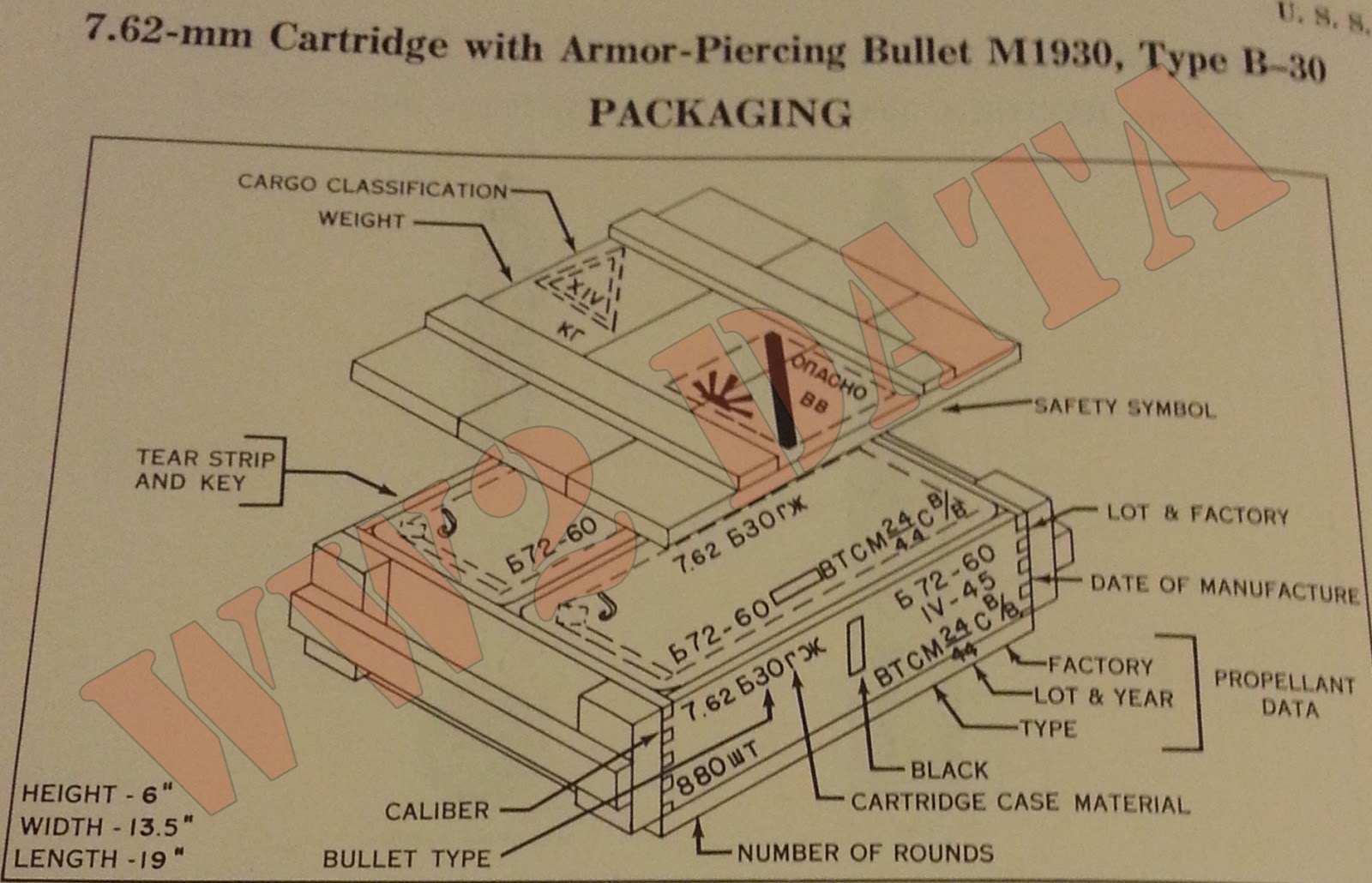
The hermetically sealed galvanized-metal container for this cartridge contains 85 cartridges packed loosely in rows, with the heads of the cartridges alternately in opposite directions, and with paper placed between each row.  Two such metal containers are packed in a wooden box, as illustrated, making a total of 170 cartridges.  Both metal and wooden box are marked with black stenciled letters giving information necessary to identify the cartridge.

This packaging can be identified by the Russian symbol Е-30* (B-30) immediately following the caliber size and by the black stripe.  These markings appear on both metal and wooden box.


*This translation appears to be incorrect, it should be Б-30


12.7mm Cartridge with Armor-Piercing Incendiary Bullet (with Special Core), Type BS-41


This 12.7mm cartridge is used in the Soviet 12.7mm DShK AA machine gun M1938 and in Soviet aircraft weapons of the same caliber.

The bullet of this cartridge is believed to be identical in construction with the bullet of the 7.62mm armor-piercing incendiary cartridge, Type BS-40.  It has a gilding-metal-clad steel jacket, a tungsten carbide core, and an incendiary composition.  The incendiary composition is located in the nose of the bullet, forward of the tungsten carbide core.

This cartridge was designed for use against armored targets and to ignite inflammable material.  Compared with the 12.7mm armor-piercing bullet, Type B-30 and the 12.7mm armor-piercing incendiary bullet, Type B-32, this bullet has slightly better penetration capabilities.
The cartridge is identified by the red bullet with black tip and black primer.

Characteristics
Caliber: 12.7mm (Cal. .50)
Weight of cartridge: N/A
Weight of case: 65g (1,003 gr)
Weight of bullet: N/A
Weight of propellant: N/A
Length of cartridge: 146.9mm (5.78 in)
Length of case: 107.7mm (4.25 in)
Length of bullet: N/A

Packaging


 Packaging for this cartridge is identical with that for other Soviet 12.7mm cartridges.  The galvanized-metal container has 85 cartridges packed loose in rows, with strips of paper between each row, and with the cartridge heads alternately in opposite directions.  As shown in the above illustration two such hermetically sealed metal containers are packed in a wooden box, making a total of 170 cartridges.

The wooden box is identified by the black paitned ends, the black edges of the ends of the cover, and two broken, black concentric circles on the side.  The Russian symbol БС-41 (BS-41) immediately follows the caliber size.  The metal box is similarly identified by two broken, black concentric circles and the symbol БС-41 (BS-41), located on the top.


12.7mm Cartridge with Armor-Piercing Incendiary Bullet


This Soviet cartridge is used in the 12.7mm DShK AA machine gun M1938 and in the Beresin (BS), aircraft machine gun.  The gilding-metal-plated steel-jacketed bullet has a tip of very thin brass.  At a point approximately 0.25 inch from its forward end, the thin brass tip is secured under the lead-lined bullet jacket.

The lead also extends forward of the steel armor-piercing core, filling the nose of the bullet.  To the rear of the core is a metal container with a charge of incendiary filling (yellow phosphorous).
The black tip and yellow band on the bullet nose are the identifying color markings for this cartridge.

Characteristics
Caliber: 12.7mm (Cal. .50)
Weight of cartridge: 134.2g (2,070 gr)
Weight of case: 65g (1,003 gr)
Weight of bullet: 46.98g (725 gr)
Weight of propellant: 17.4g (269 gr)
Weight of A.P. core: 17.49g (270 gr)
Length of cartridge: 146.9mm (5.78 in)
Length of case: 107.95mm (4.25 in)
Length of bullet: 63.5mm (2.50 in)

 
Packaging
No illustration available

There is no available information on packaging for this cartridge; however, the packaging is believed to be similar to, if not identical with the for other Soviet 12.7mm cartridges.

It is also believed that the box markings for this cartridge will be similar to those for the 12.7mm armor-piercing cartridge M1930, except for a different (at present unknown) Russian symbol after the caliber designation, and a different color stripe (probably black and yellow).


12.7mm Cartridge with Armor-Piercing Incendiary Bullet M1932, Type B-32


This cartridge is used in Soviet 12.7mm DShK AA machine gun M1938 and in 12.7mm aircraft machine guns.  The bullet has a gilding-metal-clad steel jacket and a hardened core surrounded by a lead liner.  The construction is identical with that of the 7.62mm armor-piercing incendiary bullet, Type B-32, from which the subject cartridge differs only in size and weight.

This cartridge was designed to penetrate lightly armored ground and aerial targets, and to ignite inflammable material behind the armor.  The armor-piercing characteristics of this bullet are comparable to those of the 12.7mm bullet, Type B-30.

The black tip and red band on the bullet nose are identifying color markings.

Characteristics
Caliber: 12.7mm (Cal. .50)
Weight of cartridge: 132.2g (2,040 gr)
Weight of case: 65g (1,003 gr)
Weight of bullet: 48.3g (745 gr)
Weight of propellant: 16.21g (250 gr)
Weight of steel core: 29.8g (460 gr)
Length of cartridge: 146.3mm (5.76 in)
Length of case: 107.7mm (4.25 in)
Length of bullet: 62.3mm (2.45 in)

Packaging


This cartridge is packed in boxes identical to those used for other Soviet 12.7mm cartridges.  Eighty-five cartridges, arranged with their heads alternately in opposite directions, are packed loosely in rows in a metal container, the strips of paper between each of the rows.  Two metal containers are packed in a wooden box, making a total of 170 cartridges.


The Russian symbol Б-32 (B-32), immediately following the caliber size, and a black and red stripe identify both the metal and the wooden box.


12.7mm Cartridge with Armor-Piercing Incendiary Tracer Bullet, Type BZT


This cartridge is used in the 12.7mm DShK AA machine gun M1938 and in Soviet aircraft weapons of the same caliber.

The bullet for this cartridge has a gilding-metal-clad steel jacket, a steel armor-piercing core, an incendiary composition forward of the core, and a tracer element to the rear of the core.  It is identical in construction with the bullet of the 7.62mm cartridge, Type BZT, except for a special steel container for the tracer element.

This cartridge is designed for use with other types of cartridges, such as the "B-30" and "B-32", to help ranging and fire correction.  It has considerably less armor-penetrating power, and less incendiary effect, than the "B-32" bullet of this caliber.


This cartridge is identified by the purple tip and red band on the bullet nose.

Characteristics
Caliber: 12.7mm (Cal. .50)
Weight of cartridge: 129.6g (2,000 gr)
Weight of case: 67.97g (1,049 gr)
Weight of bullet: 44.14g (681 gr)
Weight of propellant: 16.48g (254 gr)
Length of cartridge: 146.7mm (5.77 in)
Length of case: 107.85mm (4.25 in)
Length of bullet: 63.7mm (2.49 in)

Packaging


The packaging of this cartridge is identical to that of other Soviet 12.7mm ammunition.  The identifying marks for this packaging are the purple and red stripes and the Russian symbol БЗТ (BZT) immediately following the caliber size.

These markings are found on both metal and wooden boxes.


Next time: 14.5mm cartridges and Mortar rounds

Monday, 1 June 2015

Soviet Explosive Ordnance - 7.62mm Projectiles (Part 2)


7.62mm Ammunition - x54R (Continued)


Today we'll be taking a look at the rest of the 7.62x54R cartridges that were hinted at in the previous week's update.


7.62mm Cartridge with Heavy Bullet M1930, Type D


This round may be used in all Soviet 7.62mm rifles and carbines, but it is primarily designed to be used in Soviet machine guns of this caliber because of the greater range that it gives when compared to the M1908 ball round. 

The bullet of this cartridge was adopted in 1930, has a gilding-metal-clad steel jacket and a lead core, and is boat-tailed.  It is longer and heavier than the M1908 light bullet, and these features, together with a heavier powder charge, insure greater range.

The cartridge cases are constructed of either brass or steel, but steel cases seem to be more commonly used.  This cartridge is identified by the yellow-tipped bullet.


Characteristics
Caliber: 7.62mm (Cal. .30)
Weight of cartridge: 25.9g (400 gr) [Approximate]
Weight of case (Brass): 9.5g (147 gr)
Weight of case (Steel): 8.7g (134 gr)
Weight of bullet: 11.9g (185 gr)
Weight of propellant: 3.25g (50 gr)
Length of cartridge: 76.8mm (3.02 in)
Length of case: 53.7mm (2.11 in)
Length of bullet: 33.4mm (1.30 in)


Packaging


These 7.62mm rifle and machine gun cartridges are packed in 5-round clips, 3 clips to a paper package, 20 paper packages to a metal container, and 2 metal containers (a total of 600 cartridges) to a wooden box; or 20 cartridges to a paper package tied with a string, 22 such packages to a metal container, and 2 metal containers (a total of 880 cartridges) to each wooden box.

In either type of packaging, the Russian letter Д (D) will immediately follow the caliber size, and a yellow stripe will appear on both the metal container and the wooden box.  Wooden boxes with ammunition in clips will bear, in addition to the information shown in the above illustrations, the Russian term B ОБОЙМАХ (in clips)


7.62mm Cartridge with Incendiary Ranging Bullet, Type ZP


This round may be used in all Soviet 7.62mm machine guns, rifles ,and carbines.  The bullet of this cartridge was adopted in 1930, has a gilding-metal-clad steel jacket.  The nose section of the jacket is filled with a special incendiary mixture which is ignited by a high-explosive primer.  The latter is initiated by an inertia-operated striker.

The red-tipped bullet is the identifying feature of this cartridge.  The role of this round is to ignite unarmored fuel tanks of aircraft and vehicles.  In addition, the round is used in fire adjustment.  In very dry weather, the bullets will set fire to grass.  A bullet of this type, hitting personnel, has the same effect as an explosive bullet.

This bullet is not boresafe and is subject to muzzle bursts.


Characteristics
Caliber: 7.62mm (Cal. .30)
Weight of cartridge: 24.4g (377 gr) [Approximate]
Weight of case (Brass): 9.5g (147 gr)
Weight of case (Steel): 8.7g (134 gr)
Weight of bullet: 10.38g (160 gr)
Weight of propellant: 3.25g (50 gr)
Length of cartridge: 76.8mm (3.02 in)
Length of case: 53.7mm (2.11 in)
Length of bullet: 38.2mm (1.50 in)


Packaging


The galvanized metal container and wooden packaging illustrated above are identical to the packaging for other Soviet 7.62mm rifle and MG cartridges.

Both metal and wood box are marked with the cyrillic symbol ПЗ (PZ) immediately following the caliber size, and also with a red stripe, to identify this incendiary ranging cartridge.


7.62mm Cartridge with Armor-Piercing Bullet M1930, Type B-30


This armor-piercing cartridge is commonly used in all Soviet 7.62mm ground machine guns, rifles, and carbines for firing upon targets protected by light armor. such as armored cars and airplanes.  The bullet is effective against armor up to 10mm (0.39 in) thick, at a distance not greater than 800 meters (880 yards).

The bullet consists of a tempered steel core, surrounded by a lead envelope and a steel jacket clad with gilding metal.  The trajectory of this bullet and the tracer bullet M1930 coincide up to about 1,400 meters (1,540 yards).

This cartridge is identified by the black-tipped bullet.


Characteristics
Caliber: 7.62mm (Cal. .30)
Weight of cartridge: 25.2g (390 gr) [Approximate]
Weight of case (Brass): 9.5g (147 gr)
Weight of case (Steel): 8.7g (134 gr)
Weight of bullet: 11.9g (185 gr)
Weight of propellant: 3.25g (50 gr)
Length of cartridge: 76.8mm (3.02 in)
Length of case: 53.7mm (2.11 in)
Length of bullet: 33.4mm (1.30 in)


Packaging


This cartridge, like many of the other small-arms rounds, is wrapped in paper packages of 20.  Twenty-two such packages (a total of 440 cartridges) are placed in a galvanized-metal container.  Two of these hermetically sealed metal containers are packed in a wooden box, making a total of 880 cartridges.

The Russian marking Б-30 (B-30) immediately following the caliber size on both the metal container and the wooden box, and the presence of a black stripe on the top of the metal container and the side of the wooden box, identify this cartridge.


7.62mm Cartridge with Armor-Piercing Tracer Bullet


This cartridge is more commonly used in the 7.62mm Soviet ground machine guns than in rifles.  The bullet has a gilding-metal-clad steel jacket.
The role of this cartridge is to combat light armor and, at the same time, to serve as a tracer.  The purple-tipper bullet is the identifying feature of this round.


Characteristics
Caliber: 7.62mm (Cal. .30)
Weight of cartridge: 23.2g (358 gr) [Approximate]
Weight of case (Brass): 9.5g (147 gr)
Weight of case (Steel): 8.7g (134 gr)
Weight of bullet: 10.2g (157 gr)
Weight of propellant: 3.2g (49.4 gr)
Length of cartridge: 76.5mm (3.01 in)
Length of case: 53.7mm (2.11 in)
Length of bullet: 39.8mm (1.58 in)


Packaging

No illustration available


It is believed that packing boxes for this cartridge are identical to those for other Soviet 7.62mm machine gun cartridges, and that the rounds are probably wrapped in paper and packed 880 cartridges to each wooden box.

Exact markings are not available; however, it is believed that the general form of packing box markings will be the same as on other Soviet machine gun cartridge boxes.


7.62mm Cartridge with Armor-Piercing Incendiary Bullet M1940 (with Special Core),          Type BS-40


This cartridge is believed to be for use in shoulder weapons only.  The incendiary composition is placed in the nose of the gilding-metal-clad steel jacket, forward of the core.  The core is constructed of tungsten carbide to accomplish greater penetration.
The red-colored bullet with black tip and the black base of the cartridge case are the identifying features of this cartridge.
The bullet is able to penetrate thicker armor than the armor-piercing bullet M1932 or the armor-piercing incendiary bullet, Type BZT.  It is used to engage lightly armored targets and to ignite flammable material.


Characteristics
Caliber: 7.62mm (Cal. .30)
Weight of cartridge: 24.95g (385 gr) [Approximate]
Weight of case (Brass): 9.5g (147 gr)
Weight of case (Steel): 8.7g (134 gr)
Weight of bullet: 12.1g (187 gr)
Weight of propellant: 3.2g (49 gr)
Length of cartridge: 76.8mm (3.02 in)
Length of case: 53.7mm (2.11 in)
Length of bullet: 30.5mm (1.20 in)


Packaging


It is believed that packing boxes for this cartridge are identical to those for other Soviet 7.62mm machine gun cartridges, and that the rounds are probably wrapped in paper and packed 880 cartridges to each wooden box.

The packaging for this cartridge is identified by the Russian symbol БС-40 (BS-40), immediately following the caliber size.  The two broken, black concentric circles stenciled on both metal and wooden box, the black-painted ends of the wooden box, and the black edges of the ends of the cover signify that this cartridge contains a tungsten carbide-cored bullet.


7.62mm Cartridge with Armor-Piercing Incendiary Bullet M1932, Type B-32


This cartridge is used in all Soviet 7.62mm machine guns, and may also be used in rifles.  The bullet is identical in appearance to the armor-piercing bullet, Type B-30.  Its gilding-metal-clad steel jacket encloses the lead-encased steel core.  The incendiary composition is placed forward of the core in the nose.  When the jacket is flattened upon striking armor, the incendiary compound is ignited.

The role of this round is to pierce lightly armored vehicles and aircraft, and to ignite inflammable material.

The identifying feature of this cartridge is the black-and-red-tipped bullet.


Characteristics
Caliber: 7.62mm (Cal. .30)
Weight of cartridge: 24g (370 gr) [Approximate]
Weight of case (Brass): 9.5g (147 gr)
Weight of case (Steel): 8.7g (134 gr)
Weight of bullet: 10.08g (155 gr)
Weight of propellant: 3.2g (49 gr)
Length of cartridge: 76.8mm (3.02 in)
Length of case: 53.7mm (2.11 in)
Length of bullet: 37mm (1.48 in)


Packaging


This cartridge is wrapped in paper packages of 20, and tied with a string or tape.  Twenty-two of these packages are packed in a galvanized-metal container, making a total of 440 cartridges.  Two of these hermetically sealed metal containers are packed in a wooden box, making a total of 880 cartridges per box.

Markings illustrated, are placed on both the metal and the wooden box.  The Russian symbol Б-32 (B-32) immediately following the caliber size, and the black and red stripe on both the metal container and the side of the wooden box, identify the packaging for this cartridge.


7.62mm Cartridge with Armor-Piercing Incendiary Tracer Bullet, Type BZT


The 7.62mm BZT round is used in all the Soviet machine guns of this caliber, and may be used in rifles.  The bullet has a gilding-metal-clad steel jacket, a steel armor-piercing core, an incendiary composition in the nose section, and a tracer element in the base.  A small amount of incendiary composition is pressed over the tracer, as is also the case with the tracer bullet M1930.

This round is used against lightly armored targets and is intended to ignite inflammable material behind the armor.  It also serves as a tracer bullet.

It is identified by the purple tip and the red band on the bullet.


Characteristics
Caliber: 7.62mm (Cal. .30)
Weight of cartridge: 25.25g (390 gr) [Approximate]
Weight of case (Brass): 9.5g (147 gr)
Weight of case (Steel): 8.7g (134 gr)
Weight of bullet: 9.2g (142 gr)
Weight of propellant: 3.25g (49 gr)
Length of cartridge: 76.8mm (3.02 in)
Length of case: 53.7mm (2.11 in)
Length of bullet: 40.2mm (1.58 in)


Packaging


This cartridge is packed in the same manner as other Soviet 7.62mm machine gun cartridges.  The metal containers are packed with 440 cartridges and are hermetically sealed.  The wooden box, as shown in the above illustration, has two such metal containers, containing 880 rounds.

The Russian symbol БЗТ (BZT) immediately following the caliber size, and the purple and red stripes on both metal and wooden box, identify the packaging for this cartridge.


7.62mm Cartridge with Tracer Bullet M1930, Type T


This round is employed in all 7.62mm ground machine guns, rifles, and carbines.

The gilding-metal-clad steel-jacketed bullet has a lead-antimony core to give it sufficient weight.  A tracer element is in the base.  To the rear of the tracer element is a thin layer of incendiary composition.  The incendiary composition performs two functions: It ignited the tracer element, and it prevents daylight detection of the trace until the bullet is a certain distance from the muzzle.  At night, however, the burning of the incendiary composition is visible.  The tracer element burns out at about 2,000 meters (2,200 yards).

The case, primer, and type of powder are the same as for other Soviet 7.62mm machine gun and rifle cartridges.

The basic function of this cartridge is to facilitate adjustment for azimuth and for range upon moving targets.  The trajectory of this cartridge coincides with that of the light bullet M1908 up to a distance of about 1,000 meters (1,100 yards); with that of the heavy bullet M1930 up to about 1,200 meters (1,320 yards); and with that of the armor-piercing bullet M1930 up to about 1,400 meters (1,540 yards).

The round is identified by the green-tipped bullet.  A later 7.62mm tracer round, the T-46 (1946), is known to exist, but no details are available.


Characteristics
Caliber: 7.62mm (Cal. .30)
Weight of cartridge: 23.6g (366 gr) [Approximate]
Weight of case (Brass): 9.5g (147 gr)
Weight of case (Steel): 8.7g (134 gr)
Weight of bullet: 9.6g (148 gr)
Weight of propellant: 3.25g (50 gr)
Length of cartridge: 76.8mm (3.02 in)
Length of case: 53.7mm (2.11 in)
Length of bullet: 37.6mm (1.48 in)


Packaging


These tracer cartridges are usually wrapped in paper packages of 20 and tied with a string or tape.  Twenty-two such packages are placed in a galvanized metal container, making a total of 440 cartridges.  The metal container is hermetically sealed and is marked with a green stripe in addition to the other necessary cartridge information.

Two such containers are placed in a wooden box making a total of 880 cartridges.  This wooden box is also marked with a green stripe, in addition to the cartridge information.

The Russian letter T (T) following the caliber size, and the green stripe, identify the packaging for this cartridge.


7.62mm Silencer Cartridge


It is reported that, in World War II, Soviet Army snipers fired this round from the 7.62mm rifle M1891/30 equipped with a special silencer attached to the muzzle.

Very little is known about this cartridge.  It is believed that a reduced propelling charge and component of the 7.62mm cartridge with light bullet M1908, Type L, were used in the manufacture of the cartridge, to reduce the muzzle velocity below that of sound.

Prior to 1941 the bullet, case mouth, and base of the case were painted green.  Since 1941, only the bullet tip and primer are painted green.


Characteristics
Caliber: 7.62mm (Cal. .30)
Weight of cartridge: 19.55g (302 gr) [Approximate]
Weight of case (Brass): 9.5g (147 gr)
Weight of case (Steel): 8.7g (134 gr)
Weight of bullet: 9.5g (147 gr)
Weight of propellant: 0.5g (8 gr)
Length of cartridge: 76.8mm (3.02 in)
Length of case: 53.7mm (2.11 in)
Length of bullet: 28.6mm (1.12 in)


Packaging

No illustration available


There is no available information on the packaging of these cartridges.


Next Time: 12.7mm Cartridges

Imperial Japanese Army Ammunition - 37mm Projectiles

Japanese Explosive Ordnance: Army and Navy Ammunition


We start seeing more aircraft cannon rounds, specifically some of the larger calibers used on IJ aircraft. Since we're still in the Army portion, it's safe to assume that the guns mentioned are the ones used in the Ki-45 and Ki-46 (variant depending).

37mm High Explosive Incendiary Projectile


Overall length of projectile: 89mm (without fuze)
Length of complete round: 197mm (fuzed)
Diameter at bourrelet: 37mm
Width of rotating band: 10mm
Weight of projectile filled: 436.2g
Filling: Cyclonite and incendiary mixture

Used in: Ho-203 aircraft cannon

Case:
-Length: 111.5mm
-Diameter at base: 47mm
-Weight (Empty): 226.5g
-Remarks: The case is comparatively short, made of brass, and is slightly necked.

Propellant: Graphited smokeless powder in flat 4mm squares poured loosely into the case and sealed in with a cardboard disc. The weight of the propellant is 59.8g.
Color and Markings: Black body, red nose band, yellow body band.

Characters stenciled on body: (Ho 203)


Fuzing: Type 100 small instantaneous fuze.

Remarks:
This projectile is constructed in two pieces. It has a nearly straight-sided main body and an ogival-shaped nose piece which threads into the main body. The main charge is cyclonite and an incendiary mixture. The incendiary mixture is pressed into the base of the cavity, with the cyclonite filling the remained of the cavity and the nose piece. There is also an empty practice projectile similar in appearance to the H.E.I. but having the nose piece and dummy fuze constructed in one piece. The projectile is painted black overall.

Characters stenciled on practice shell body: (Ho 203)


and (Ma 438)


37mm High Explosive Incendiary Projectile


Overall length of projectile: 89mm (without fuze)
Length of complete round: 246mm
Diameter at bourrelet: 37mm
Width of rotating band: 10mm
Weight of projectile empty: 398.3g
Filling: Mixture of cyclonite and wax and incendiary composition

Used in: Ho 204 aircraft cannon

Case:
-Length: 144mm
-Diameter at base: 43.5mm
-Weight (empty): 381.2g
-Remarks: The case is of the rimless type and is lightly necked.

Propellant: Graphited smokeless powder in flat 4mm squares poured loosely into the case and sealed in with a cardboard disk. The weight of the propellant is 75.1g

Color and markings: Black body, red nose tip, yellow body band.

Characters stenciled on body: (Ho 204)


Fuzing: Type 4 super-detonating fuze.

Remarks:
The ammunition for the Ho 204 uses the same projectile as the Ho 203 ammunition but the case is longer. The projectile is constructed in two pieces: a straight sided main body and an ogival-shaped nose which screws into the main body. There is only one cavity into which both the incendiary and high-explosive filling are pressed.


37mm Practice Projectile


Overall length of projectile: 124mm
Length of case: 144mm
Length of complete round: 247mm
Diameter at bourrelet: 37mm
Width of rotating band: 8mm
Filling: Sawdust

Used in: Ho 204 aircraft cannon

Color and Markings: Black overall

Fuzing: None

Remarks:
This projectile has the appearance of an A.P. projectile. It is filled with sawdust and has a cavity closed by a base plug.


37mm Ammunition

While we have already gone over some examples of 37mm ammo, we finally start seeing the types used in anti-tank and anti-air guns. In fact, the 37mm rounds vary depending on which make and model of gun it was supposed to be used in, having some notable differences in case length.


There are eight 37mm anti-tank and tank guns, all sizes of which use the same projectiles but have different cartridge cases.


Propellant:
Type 11th year infantry gun: 1.85oz of graphited smokeless powder in the form of flakes poured into the case and sealed with a cardboard closing disc.
Type 94 tank gun: 2.7oz of graphited smokeless powder ub tge firn if rectangular flakes.
Type 94 AT gun, Type 98 Gun, and Type 100 Tank Gun: 4.3oz of graphited smokeless powder in the form of unitubular grains contained in a silk bag.
Type 97 AT gun: 5oz of graphited smokeless powder in the form of short, cylindrical grains contained in a silk bag.


Type 94 37mm High Explosive Projectile


Type 97 AT (97)
Type 94 AT (94AT)
Type 94 Tank Gun (94T)
Type 1 Anti-tank / Tank Gun (1AT/T)
Type 11th Year Infantry Gun (11th)


Overall length of projectile: 125mm (No fuze) for all types
Length of complete round (Fuzed): (97) 349mm (94AT) 266mm (94T) 223mm (1AT/T) 349mm (11th) 221mm
Diameter at bourrelet: 37mm for all types
Width of rotating band: 8mm for all types
Weight of projectile, filled: 595.1g
Filling: Picric Acid and TNT

Used in: All 37mm guns

Colors and Markings: Black body, red nose band, yellow body band (some rounds may have white body band added)

Fuzing: Type 93 small instantaneous fuze.

Remarks:
This steel projectile is filled with TNT and picric acid. The after two-thirds of the projectile cavity is filled with high grade cast TNT. The forward one-third of the projectile cavity is filled with picric acid. The entire bursting charge is enclosed in a heavy waxed paper casing with a double thickness between the TNT and picric acid charge.


Type 94 37mm Armor-Piercing High Explosive Projectile


Overall length of projectile: 114mm (No fuze) for all types
Length of complete round (Fuzed): (94AT) 262mm (94T) 228mm (97AT) 345mm (11th) 218mm
Diameter at bourrelet: 37mm for all types
Width of rotating band: 9.5mm for all types
Weight of projectile, filled: 1 pound 1/4 oz
Filling: Picric Acid

Used in: Type 11th Year Infantry Gun, Type 94 Tank Gun, Type 94 Anti-tank Gun, Type 97 Anti-tank Gun, Type 98 Tank Gun, Type 100 Tank Gun

Color and Markings: Black body, red nose tip, white body band

Fuzing: Type 94 small delay base fuze

Remarks:
This projectile is made of high grade steel. The main charge cavity contains a small wooden plug in the forward portion and a paper covered picric acid charge aft of the wooden nose plug. The Type 94 small delay base fuze screws into the base of the projectile, also acting as a base plug.


Type 1 37mm High Explosive Projectile


This round is used in the Type 94 Anti-tank gun and the Type 1 Anti-tank gun.

Overall length of projectile: 104mm (no fuze) for all types
Length of complete round, fuzed: (94AT) 250mm (1AT) 333mm
Diameter at bourelet: 37mm for all types
Width of rotating band: 11mm for all types
Weight of projectile: 1 lb 6 oz without explosive
Filling: Picric Acid

Used in: Type 1 Tank Gun, Type 1 Anti-tank Gun, Type 94 Anti-tank Gun

Color and Markings: Black body, red nose tip, white body band.

Remarks:
This projectile is constructed of high grade steel. It has no sharply defined bourrelet. It uses a small Mk 1 base fuze which also acts as a base plug.


Next Time: 40mm and 47mm IJA projectiles

Thursday, 28 May 2015

Imperial Japanese Army Ammunition - 20mm Projectiles (Final)

Japanese Explosive Ordnance: Army and Navy Ammunition

Today will be the last post about 20mm Army Projectiles. We start to get into post-1940 projectiles which were used in the Ho-5 cannon seen on many late-war Japanese fighters.

20mm High-Explosive Incendiary Tracer Projectile


Overall Length: 19.52cm
Length of projectile: 11.98cm
Length of case: 12.38cm
Filling: Cyclonite, incendiary composition, tracer composition

Fuzing: Type 100 small instantaneous fuze.

Color and Markings: Black body with red band just abaft bourrelet, green and yellow bands before rotating band. Characters (flexible or fixed machine cannon) stenciled on the body.


Used in: Ho-1 (Flexible) and Ho-3 (Fixed) aircraft cannon.

Remarks:
The projectile is made of steel and has two cavities, a main charge cavity and a tracer cavity, separated by a septum. The main charge cavity contains two pellets, the forward one, fitting around the fuze gaine, is cyclonite while the after one is an incendiary mixture.


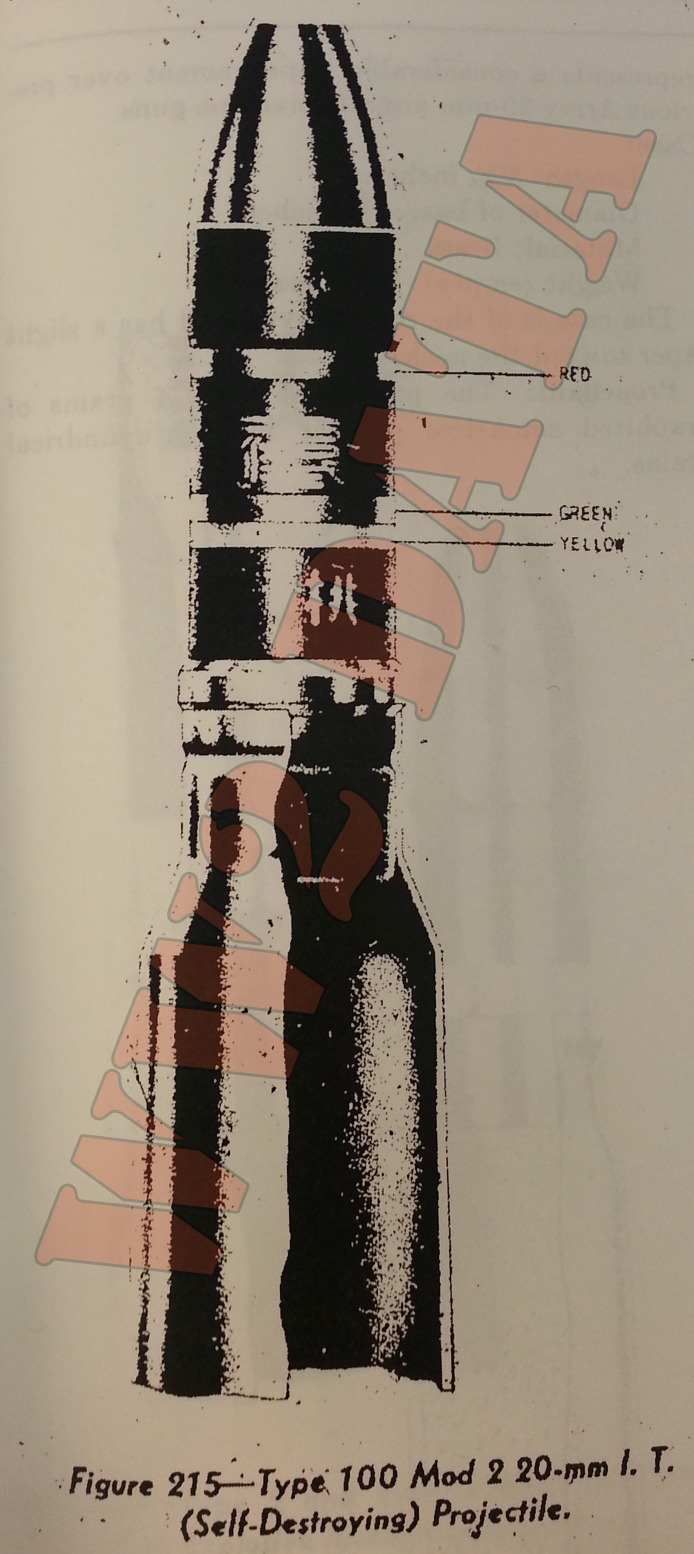
Type 100 Mod 2 20mm I.T. (Self-Destroying) Projectile


Overall Length: 20.93cm
Length of projectile: 8.32cm
Filling: Incendiary composition, tracer composition

Fuzing: Type 100 small instantaneous fuze

Color and Markings: Black body with red band just abaft bourrelet, green and yellow bands before rotating band. Characters (Type 100 Mod 2) are stenciled on the body.


Used in: Type 98 anti-aircraft / anti-tank gun

Remarks:
This is the same projectile as the type 100 and type 100 Mod 1 H.E.T. but there is no high explosive other than that used in the gaine.


20mm Armor-Piercing Tracer Projectile


This projectile came in 3 variations: Type 97 anti-tank gun, Ho-1 and Ho-3 aircraft cannons, and Type 98 anti-aircraft and anti-tank gun.

Overall Length: (97) 19.36cm (Ho-) 19.36cm (98) 20.95cm
Length of projectile: (97) 8.01cm (Ho-) 8.09cm (98) 8.01cm
Weight of projectile: (All) 156g
Length of case: (97) 12.38cm (Ho-) 12.38cm (98) 13.97cm
Filling: Tracer composition

Color and Markings:
Hard round (type 100): black body, green and white bands before rotating band.
Medium Round (Type 97) has (type 100) stenciled on the body, black body, green band before rotating band.
Soft round (Type 97 substitute) black overall.

Medium Round Stencil

Used in: Type 97 anti-tank gun, Ho-1 (Flexible) and Ho-3 (Fixed) aircraft cannon, or Type 98 anti-aircraft / anti-tank gun.

Remarks:
This projectile is a solid steel shot with a tracer cavity drilled into the base. This projectile, with different colored tracers and markings is used in three guns. There are three types of rounds differing in grades of hardness of steel.


Ho-5 20mm Ammunition


Excerpt from the Manual: The latest Army 20mm gun developed is the Ho-5 aircraft gun which is of excellent design and represents a considerable improvement over previous Army 20mm aircraft machine guns.

Case properties
Length: 9.48cm
Diameter of base: 2.46cm
Material: Brass
Weight (Empty): 113.5g

Remarks:
The case is of the rimless type and has a slight taper toward the neck.

Propellant: The propellant is 21.4g of graphited smokeless powder in fine cylindrical grains.


Type 2 and Type 2 Modified 20mm H.E.I. Projectile


Overall Length: 14.6cm
Length of projectile: 6.5cm (Fuzed)
Weight of projectile: 77.4g (Fuzed)
Weight of filling:
-Cyclonite (Type 2 Modified): 3.4g
-Cyclonite (Type 2): 0.4g
-Incendiary composition: 3.7g
Filling: Cyclonite and incendiary composition

Fuzing:
-Type 2: Type 2 small instantaneous or Type 2 small instantaneous modified type.
-Type 2 Modified: Type 4 super-detonating fuze.

Color and Markings:
-Type 2: Black overall and, sometimes, yellow band around body.
-Type 2 Modified: projectile is painted silver-gray overall

Remarks:
The difference between the Type 2 and the Type 2 modified is the fuze. The Type 2 projectiles uses a fuze that has an external gaine and thus has less explosive filling than the Type 2 Modified projectile which uses a fuze with the gain built into the fuze body.


Type 4 20mm H.E.I. (Ma 202) Projectile


Overall length: 14.6cm
Length of projectile: 6.6cm
Weight of projectile: 78.2g (fuzed)
Weight of filling:
-P.E.T.N.: 3.2g
-Incendiary composition: 8.7g
Filling: P.E.T.N., and incendiary composition (barium nitrate, aluminium powder, magnesium powder, and wax)

Fuzing: Fuzeless

Color and Markings: Black overall with characters (202)


Remarks:
The projectile is made of steel with a brass nose piece threaded to it. The nose piece is filled with P.E.T.N. and is designed to explode by the crushing action of impact. An incendiary mixture contained in the steel body is separated from the high explosive by a felt pad and a threaded brass disc. This disc has two lead-in holes.


Type 2 20mm Armor-Piercing Tracer Projectile


Overall length: 14.6cm
Length of projectile: 6.35cm
Weight of projectile:
-Soft Round: 112.7g
-Medium Round: 116.7g
-Hard Round: 119.5g
Weight of filling: 7g
Filling: Tracer composition

Color and Markings:
-Soft Round: Black overall
-Medium Round: Black with green band around body.
-Hard Round: Black with a green and a white band around body.

Characters (Type 2) are stenciled on the body


Remarks:
There are three different models of this projectile differing in the grades of hardness of the steel. This difference is indicated by the color markings.


20mm Practice Projectile


Overall length: 14.6cm
Length of projectile: 6.5cm
Weight of projectile: 81g
Filling: None

Color and Markings: Black overall

Remarks:
The projectile approximates the shape of the Type 2 H.E.I. projectile. It is unfilled and closed at the base by a threaded plug.


Next time: 37mm Cannon Projectiles and more!