Monday, 20 July 2015

Soviet Explosive Ordnance - 76mm Projectiles (Part 1)

76mm Artillery and Tank Gun Projectiles


By far, the most extensive series of data on munition in my manual is the 76mm Projectiles with 36 separate entries.


76mm Complete Round, Fixed, Frag, UO-344A
 

This fragmentation round is fired from the 76mm regimental gun (howitzer) M1943 which is obsolete in the Soviet Army.  It is not interchangeable with standard rounds used in other 76mm weapons.

Fragmentation shells are used to destroy personnel and equipment and are designed to produce the maximum number of lethal fragments.

The KTM-1 fuze is used with the O-350A projectile in this round. 

Note: Dimensions and markings on the cartridge case in the above illustration have not been verified.  

Characteristics
Calibre: 76mm (3 in)
Weight of complete round: ?kg (? lbs)
Weight of projectile, as fired: 6.21kg (13.66 lbs)
Weight of propellant, w/o igniter: ?kg (? lbs)
Type of projectile: TNT
Weight of projectile filler: 0.71kg (1.562 lbs)


Packaging
 
 
The illustrated 5-round wooden box weighs approximately 58kg (128 lbs).  This ammunition may also be packed in a 6-round box weighing approximately 70kg (155 lbs) or in an 8-round box weighing approximately 94kg (207 lbs).


76mm Complete Round, Fixed, Frag, UO-353M 
 

This fragmentation round is fired from the 76mm regimental gun (howitzer) M1927; divisional guns M1902/30, M1936 (F22), M1939 (USV), M1942 (ZIS-3); tank guns M1927/32, M1938/39 (L-11), M1939 (F-32), M1940 (F-34), M1941 (ZIS-5); and self-propelled gun M1942/43 (SAU-76).  All of these weapons, with the exception of the M1942 and M1942/43,. are obsolete in the Soviet Army.

The projectile is designed to produce the maximum number of lethal fragments.  The KTM-1 fuze is used with the O-350 projectile in this round.  The cast HE filler in the projectile is cavitated at the forward end to receive the booster.

The black band on the cartridge case indicates a reduced propellent charge.  This color marking is inconsistent, however; cases with reduced propellent charge also have been found with two black bands, or without any colour band. 

Note: All complete rounds of the "353" series (that is, all rounds with the number 353 as a component of their code number) contain a reduced propellent charge.


Characteristics
Calibre: 76mm (3 in)
Weight of complete round: 8.36kg (18.39 lbs)
Weight of projectile, as fired: 6.09kg (13.4 lbs)
Weight of propellant, w/o igniter: 0.627kg (1.38 lbs)
Type of projectile: Amatol 90/10
Weight of projectile filler: 0.814kg (1.79 lbs)

Packaging


This ammunition is packed in five-, six, or eight-round wooden packing boxes, weighing respectively about 58kg (128 lbs), 70kg (155 lbs), and 94kg (207 lbs).


76mm Complete Round, Fixed, Frag, UO-354AM


This fragmentation round is fired from the 76mm regimental gun (howitzer) M1927; divisional guns M1902/30, M1936 (F22), M1939 (USV), M1942 (ZIS-3); tank guns M1927/32, M1938/39 (L-11), M1939 (F-32), M1940 (F-34), M1941 (ZIS-5); and self-propelled gun M1942/43 (SAU-76). All of these weapons, with the exception of the M1942 and M1942/43, are obsolete in the Soviet Army.

The KTM-1 fuze is used with the O-350A cast-iron fragmentation projectile in this round. The cast TNT bursting charge in the projectile is cavitated at the forward end to receive the fuze booster.

  
Characteristics
Calibre: 76mm (3 in)
Weight of complete round: 8.99kg (19.78 lbs)
Weight of projectile, as fired: 6.2kg (13.62 lbs)
Weight of propellant, w/o igniter: 1.145kg (2.52 lbs)
Type of projectile: TNT
Weight of projectile filler: 0.71kg (1.562 lbs)

Packaging


This ammunition is packed in five-, six, or eight-round wooden packing boxes, with respective gross weights of about 58kg (128 lbs), 70kg (155 lbs), and 94kg (207 lbs).


76mm Complete Round, Fixed, Frag, UO-361D


This fragmentation round is fired from the now-obsolete 76mm anti-aircraft guns M1931, M1931/33, and M1938.

The T-5 and T-11 fuzes are used with the O-361D prjectile in this round.

The complete round UO-361, with an O-361 projectile using the T-5 or T-11 fuze, is a variant of the illustrated round.  It is fired from the same weapons and is basically the same as the UO-361D.

According to documentary evidence, however, the O-361 projectile is about 1 and 1/2 inches shorter and has less explosive filler than the O-361D.

  
Characteristics
Calibre: 76mm (3 in)
Weight of complete round: 11.5kg (25.30 lbs) -approx-
Weight of projectile, as fired: 6.61kg (14.54 lbs)
Weight of propellant, w/o igniter: 1.8kg (3.96 lbs)
Type of projectile: TNT
Weight of projectile filler: 0.486kg (1.07 lbs)

Packaging
 

This ammunition is packaged in a four-round wooden box.


76mm Complete Round, Fixed, HE, UF-352M
 

This Soviet high-explosive is fired from the 76mm mountain gun (howitzer) M1909.  It gives greater blast effect and less fragmentation than the UOF-352 Frag-HE round.

The 3GT, KT-3, and KTM-3 fuzes are used with the F-354 projectile in this round.  Supplementary boosters are used with the KT-3 and KTM-3 fuzes.

The UF-352 complete round, with an F-354 projectile using a 3GT, KT-3, or KTM-3 fuze, is a variant of the illustrated round.  It is fired in the same weapon and, except for differences in markings, is almost identical with the UF-352M in external appearance.

 Characteristics
Calibre: 76mm (3 in)
Weight of complete round: ?kg (? lbs)
Weight of projectile, as fired: 6.1kg (13.41 lbs)
Weight of propellant, w/o igniter: 0.36kg (0.79 lbs)
Type of projectile: TNT
Weight of projectile filler: 0.82kg (1.8 lbs)
 
Packaging


This ammunition is packed in wooden packing cases containing five rounds.  When packed, the case weighs from 54.7kg to 57kg (121 lbs to 125 lbs).


76mm Complete Round, Fixed, HE, UF-353


This high-explosive round is fired from the 76mm regimental gun (howitzer) M1927; divisional guns M1902/30, M1936 (F22), M1939 (USV), M1942 (ZIS-3); tank guns M1927/32, M1938/39 (L-11), M1939 (F-32), M1940 (F-34), M1941 (ZIS-5); and self-propelled gun M1942/43 (SAU-76). All of these weapons, with the exception of the M1942 and M1942/43,. are obsolete in the Soviet Army.  The meaning of the Cyrillic letters БПК, which appear above the rotating band on the F-354 projectile, has not been established: however, documentary evidence indicates that БПК has reference to the propellent.

The KTM-3 and KT-3 fuzes are used with the F-354 projectile in this round.  Cartridge cases containing a reduced charge may have one or two black bands aroud the neck, or may be without colour bands.

The following complete rounds are variants of the illustrated round: UF-353G , with an F-354G projectile using a 3GT fuze; UF-353M, with an F-354 projectile using a KTM-3 or KT-3 fuze; and UF-353F, with an F-354F projectile using an AD or AD-2 fuze.  These variants are basically the same as the UF-353, and are fired from the same weapons. 

Note: All complete rounds of the "353" series (that is, all rounds with the number 353 as a component of their code number) contain a reduced propellent charge.
 

Characteristics
Calibre: 76mm (3 in)
Weight of complete round: 8.2kg (18.04 lbs)
Weight of projectile, as fired: 6.1kg (13.41 lbs)
Weight of propellant, w/o igniter: 0.48kg (1.056 lbs)
Type of projectile: TNT
Weight of projectile filler: 0.816kg (1.8 lbs)
Packaging

 
The illustrated 5-round wooden box weighs approximately 58kg (128 lbs) when packed. This ammunition may also be packed in a six-round box weighing approximately 70kg (155 lbs) or in an eight-round box weighing approximately 94kg (207 lbs).


76mm Complete Round, Fixed, HE, UF-354

This high-explosive round is fired from the 76mm regimental gun (howitzer) M1927; divisional guns M1902/30, M1936 (F22), M1939 (USV), M1942 (ZIS-3); tank guns M1927/32, M1938/39 (L-11), M1939 (F-32), M1940 (F-34), M1941 (ZIS-5); and self-propelled gun M1942/43 (SAU-76). All of these weapons, with the exception of the M1942 and M1942/43,. are obsolete in the Soviet Army.  It gives a greater blast effect, but less fragmentation, than the UOF-354A.

The KT-3 and KTM-1 fuzes are known to be used with the F-354 projectile in this round.  As a component of other complete rounds, however, the F-354 projectile also has been found with a KTM-3 fuze.

The following complete rounds are variants of the illustrated round: UF-354U , with an F-354U projectile employing a UGT-2 fuze; UF-354G, with an F-354G projectile and a GT-3 fuze; and UF-354F with an F-354F projectile and an AD or AD-2 fuze.  These variants are basically the same as the UF-354.  They are fired from the same weapons and, except for differences in fuzes and markings, are almost identical to the UF-354 in external appearance.


Characteristics
Calibre: 76mm (3 in)
Weight of complete round: 8.55kg (18.8 lbs)
Weight of projectile, as fired: 6.1kg (13.41 lbs)
Weight of propellant, w/o igniter: 0.9kg (1.98 lbs)
Type of projectile: TNT
Weight of projectile filler: 0.82kg (1.8 lbs)
Packaging


The 6-round wooden box shown above weighs about 70kg (154 lbs) when packed.  This ammunition also may be found in 5-round wooden boxes with a gross weight of 58kg (128 lbs), or in 8-round wooden boxes with a gross weight of 94kg (207 lbs). 


Next Time: 76mm Projectiles (Part 2)

Imperial Japanese Army Ammunition - 70mm, 81mm, and 90mm Mortar Projectiles


 Japanese Explosive Ordnance: Army and Navy Ammunition


Type 11 Year 70mm High Explosive Mortar


Weight of complete round: 4.28 lbs
Weight of main charge: 15.2 oz
Weight of booster: 1.6 oz
Explosive components:
-Main charge: TNT
-Booster: Picric
-Propellant: Nitrocellulose diphenylamine flaked powder
Overall length (w/o fuze): 7.12 inches
Maximum diameter: 69.8mm

Color:
Black overall with a red band around the nose. A yellow band is painted below the bourrelet and a white band forward of the rotating band.

Fuzing:
Type 93 instantaneous short delay mortar fuze

Used in:
Type 11 year 70mm Rifle Mortar

Description:
This projectile is similar in construction and operation to the Type 89 50mm H.E. mortar shell


70mm High Explosive Anti-Aircraft Barrage Mortar


Weight of complete round: 5.19 lbs
Weight of main charge (H.E. cylinders): 12.84 grams
Explosive compenents:
-Main charge: RDX
-Booster: Lead azide
Overall length: 11.38 inches
Maximum diameter of shell: 70mm
Length of canisters: 6.5 inches
Diameter of canisters: 0.75 inches
Length of H.E. cylinders: 3.12 inches
Diameter of H.E. cylinders: 0.69 inches

Color:
Shell - black overall with a 5/8 inches red band at nose. Canisters - zinc coated (grey)
H.E. Cylinders - black overall with a 3/16 inch red band at forward end

Used in:
70mm A.A. barrage mortar

Description:
This mortar shell consists of an outer shell containing seven canisters in each of which is an H.E. cylinder and parachute. A turned steel base is welded to the outher shell and provision is made for reception of a delay train holder, a shell propellant container, and an end cover. The delay train leads to a black powder charge which ejects the canisters from the shell. The end cover is fitted over the propellant contained and is sealed against moisture and held in position by adhesive tape. A wooden plug in a pressed steel cap closes the forward end of the shell.

The canisters contain a wooden plug in the base bored to receive a delay element and a small black powder cahrge to eject the H.E. cylinder from the canister. The steel H.E. cylinders are closed at the base and threaded at the forward end to receive a plug into which is screwed a friction cap. The explosive content is in three blocks, each wrapped in a waterproof paper carton.

Parachutes are attached to the outer shell, nose cap, and each ot the seven canisters and H.E. cylinders. The length of the parachute cords varies from 19 inches (Canisters) to 66 inchers (Cylinders). The H.E. cylinder parachute lines are attached to a friction cord which passes through the friction cap. Thus, this shell, when fired, puts sixteen separate objects suspended by parachutes in the way of low-flying aircraft, seven of which will explode if hit.

Operation:
The delay train to the first ejection charge is ignited by the shell propellant charge, and the first charge in turn ignites the delay trains to the second ejection charges in each of the canisters. The parachutes attached to the nose cap, outer shell, and canisters all open when the canisters are ejected and the H.E. cylinder parachutes open when they are ejected from the canisters. A plane hitting the parachute cord of any of the H.E. cylinders would cause the friction wire to be pulled through the friction cap initiating the explosive train.


Type 97 81mm High Explosive Mortar


Weight of complete round: 7.35 lbs
Weight of main charge: 1.19 lbs
Explosive components:
-Main charge: TNT
-Booster: Picric
-Propellant:
--Nitrocellulose and graphite: 58%
--Nitroglycerine: 7.1%
--Dinitrotoluene: 25.7%
--Dophenylamine: 0.5%
--Potassium nitrate: 8.7%
Overall length (w/o fuze): 11.5 inches
Length of fin aseemble: 3.19 inches
Maximum diameter at bourrelet: 81mm
Maximum diameter of tail fins: 81mm

Color:
Black overall with a red tip. A yellow band is painted before the bourrelet

Fuzing:
Type 93 instantaneous short delay mortar fuze

Used in:
-Type 97 81mm Mortar
-Type 99 81mm Mortar

Description:
The body is of one piece streamline construction having a threaded opening in the nose to receive the fuze adapter ring. A steel booster cup screws (L.H.) into the lower end of the shaped aluminium container which receives the gaine of the fuze. The bourrelet is well machined and has four grooves cut in it.

The fin assembly screws into a female threaded (R.H.) opening in the base of the body. It consists of a male plug welded to a cylindrical steel tube. Welded to the tube are six fins shaped to receive the six silk bags containing the propellant increments. Between each set of fins are three gas escape ports for the propellant gases from the cartridge which fits inside the tube. The cartridge is held in place by a countersunk ring screwed into the end of the tube. The cartridge resembles a shotgun shell.


Type 100 81mm High Explosive Mortar


Weight of complete round: 7.52 lbs
Weight of main charge: 1.18 lbs
Explosive components:
-Main charge: TNT
-Booster: Picric
-Propellant:
--Nitrocellulose and graphite: 58%
--Nitroglycerine: 7.1%
--Dinitrotoluene: 25.7%
--Dophenylamine: 0.5%
--Potassium nitrate: 8.7%
Overall length (w/o fuze): 11.78 inches
Length of fin assembly: 3.31 inches
Maximum diameter at bourrelet: 81mm
Maximum diameter of tail fins: 81mm

Color:
Black overall with a red tip. A yellow band is painted before the bourrelet

Fuzing:
Type 100 instantaneous short delay mortar fuze

Used in:
-Type 97 81mm Mortar
-Type 99 81mm Mortar

Description:
Except for minor details, this shell is similar to the Type 97 81mm H.E. projectile. The cup to receive the fuze gaine is held in place in the booster cup by being fitted into a brass ring which screws into the fuze adapter ring above the booster cup. There is no retaining ring to hold the cartridge in the tail fin section. Instead, the cartridge is held by a friction fit.


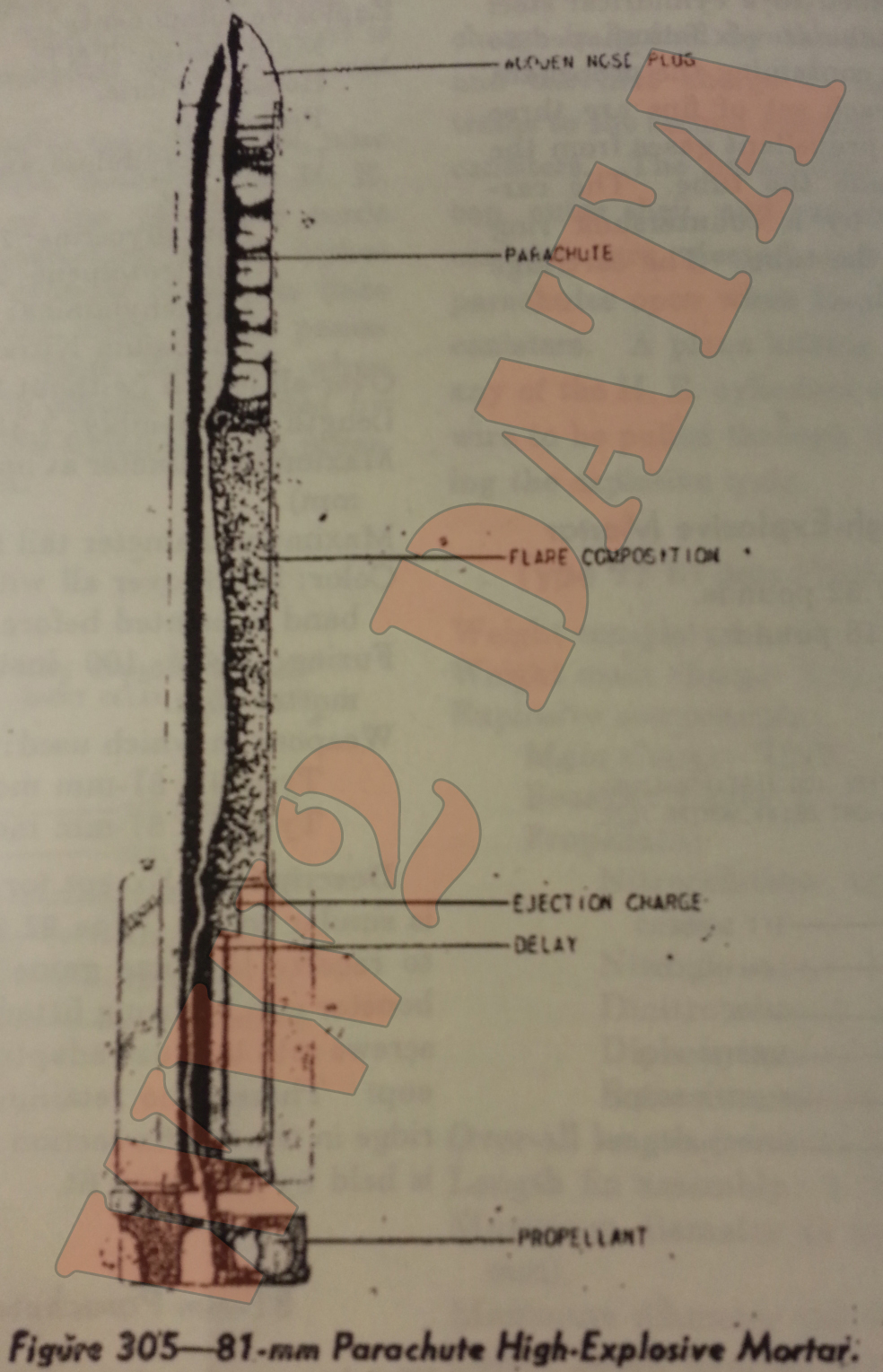
81mm Parachute H.E. Mortar


Weight of complete round: 3.87 lbs
Weight of main charge: 4 oz
Explosive components:
-Main Charge: RDX (1 block), TNT (2 blocks)
Overall length: 21.25 inches
Length of shell (less propellant container and nose plug): 18.5 inches
Diameter of shell body: 1.5 inches
Diameter of fins: 81mm
Diameter of H.E. cylinder: 1.37 inches
Length of H.E. cylinder: 7 inches

Color:
Black overall with an unpainted wooden plug in the nose.

Used in:
Standard 81mm smoothbore mortars

Description:
This mortar shell is a black steel tube with an ogival wooden block sealing the forward end. Six fins which give the shell an 81mm diameter are spot welded along the after part of the tub. A steel disc drilled through the center for the delay lead-in is welded to the tube 1/2 inche from the base. Forward of the disk is a 5 inch wooden block through the center of which runs the 12-second black powder delay element. The forward end of the wooden block contains the ejection charge. The H.E. cylinder and parachutes are located forward of the ejection charge. The cylinder consists of a steel case, a central tube containing the 45 second self-destruction delay train, a friction igniter, and three cylindrical explosive blocks fitted around the central tube. The booster fits in the forward block. The parachute which supports the cylinder is secured to a small fixed U-bolt on the cylinder by nine short (13 inch) shrouds. A second parachute above the first is secured to the friction igniter by a line 32'4" long. This line leads through a central hole in the lower parachute. The tinned steel propellant container is 81mm in diameter and 1 inch deep. A neck on the container cover fits into the base of the mortar shell and is secured by three small screws passing through the sides of the shell and the neck of the cover.

Operation:
When the shell is fired. the flash from the black powder primer ignites the propellant and the 12 second delay train. Setback shears the small screws securing the propellant container to the shell, and when the force of the propellant is expended the container falls free. Twelve seconds after firing, the delay train ignites the ejection charge forcing the H.E. cylinder and parachutes out the forward end of the shell. The 45 second self-destroying delay train is also ignited by the ejection charge. Planes striking the 32 foot parachute cord which is attached to the igniter will cause it to explode the H.E. cylinder. After 45 seconds, the self-destroying element detonates the cylinder.


81mm Parachute H.E. Smoke Mortar


Weight of complete round: No Data
Weight of main charge: No Data
Explosive component:
-Main Charge: Tetyl
Overall length: 21.87 inches
Lenght of shell (less propellant container and nose plug): 19.1 inches
Diameter of shell body: 1.5 inches
Diameter of fins: 81mm

Color:
Unpainted galvanized iron with a yellow wooden nose and a green band around the body

Description:
This shell is similar to the H.E. round except that there is a smoke pellet in the bottom of the suspended cylinder. Above the smoke pellet are two pellets of tetryl with a black powder delay train running through the middle. As with the H.E. round, the line to the upper parachute is attached to a pull ignited and, if pulled before the self-destroying feature operated, will detonate the charge.

Operation:
The operation is similar to the H.E. round except that the expelling charge ignites the smoke flare pellet, which burns about 53 seconds and which then ignites the short delay train which burns seven seconds before the self-destroying element functions.


81mm Parachute Flare Mortar


Weight of complete round: 4.87 lbs
Weight of flare composition: 409g
Explosive components:
-Flare composition: No Data
Overall length: 22.25 inches
Length of shell (less propellant container and nose plug): 18.75 inches
Diameter of shell body: 1.75 inches
Diameter of fins: 81mm
Diameter of flare cylinder: 1.37 inches
Length of flare cylinder: 7.75 inches

Color: Unpainted galvanized steel body with a red wooden plug in the nose.

Used in:
Standard 81mm smoothbore mortars

Description:
This mortar shell resembles in construction the 81mm H.E. parachute mortar shell, the only differences being in dimensions. A thin sheet metal tube containing the flare composition is located before the ejection charge. Two parachutes are packed in an inner sleeve 5.5 inches long made in two longitudinal half sections and are attached by means of 14 inch and 15'3" cords, respectively, to an eyebolt threaded into the forward end of the metallic flare composition. The wooden nose plug is secured to the outer shell by two small nails.

Operation:
The operation of this shell is the same as the 81mm H.E. parachute mortar shell. The ejection charge ignites the flare composition as it ejects the flare cylinder from the shell.


Type 94 90mm High Explosive Mortar


Weight of complete round: 11.8 lbs
Weight of main charge: 2.35 lbs
Explosive components:
-Main charge: TNT
-Booster: Picric (presumed)
Overall length (w/o fuze): 15.83 inches
Length of fin assemble: 4.02 inches
Maximum diameter at bourrelet: 90mm
Maximum diameter at tail fins: 90mm

Color:
Black overall with a red tip and a yellow band before the bourrelet.

Fuzing:
Type 93 Instantaneous short delay mortar fuze

Used in:
-Type 94 90mm Mortar
-Type 97 90mm Mortar

Description:
This shell is similar in construction to the Type 97 81mm Mortar shell.


Type 94 90mm Semisteel H.E. Mortar


Weight of complete round: 11.5 lbs
Weight of main charge: No Data
Explosive components:
-Main charge: TNT
-Booster: No Data
-Propellant: No Data
Overall length (w/o fuze): 14.25 inches
Length of fin assembly: 4 inches
Maximum diameter at bourrelet: 90mm
Maximum diameter at fins: 90mm

Color:
Black overall with a red tip and a green band before the bourrelet

Fuzing:
Type 93 instantaneous short delay mortar fuze

Used in:
-Type 94 90mm Mortar
-Type 97 90mm Mortar

Description:
This shell is similar in design to the Type 94 90mm H.E. shell, except that it is made of low-grade or semisteel instead of high grade steel.


Type 94 90mm Incendiary Mortar


Weight of complete round: 11.6 lbs
Weight of incendiary mixture: 2.2 lbs
Weight of burster charge: 2.75 oz
Explosive components:
-Burster charge: No Data
-Propellant: No Data
Incendiary filling: Phosphorus, carbon disulphide and 40 cylindrical rubber pellets.
Overall length (w/o fuze): 15.9 inches
Length of fin assembly: 4 inches
Maximum diameter at bourrelet: 90mm
Maximum diameter at tail fins: 90mm

Color:
Black body with blue bands around the nose, a yellow band halfway between the bourrelet and tail and white band at junction of body and tail.

Fuzing:
Type 94 instantaneous short delay mortar fuze (Presumed)

Used in:
-Type 94 90mm Mortar
-Type 97 90mm Mortar

Description:
This shell is similar in design to the Type 94 90mm H.E. mortar shell with the following exceptions:
1. An enlarge booster cup threads into the nose of the projectile. It contains a well for the lower fuze body and detonator, a burster charge, and a wooden block.
2. A fuze adapter threads into the forward end of the booster cup.

Remarks:
A shell of similar construction weight and measurements contains a filling of diphenylcyanarsine (DC). The shell is painted black overall and has a red band around the nose with a blue band adjacent to it. There is a yellow band aft of the bourrelet and a red band halfway between the bourrelet and the tail. There is a white band at the junction of the shell body and tail.


Next Time: We finish up the Imperial Japanese Army's Explosive Ordnance.

I am skipping entirely over fuzes

Monday, 13 July 2015

Soviet Explosive Ordnance - 57mm Projectiles

57mm Artillery and Tank Gun Projectiles


57mm Complete Round, Fixed, Frag, UO-271

  
This round is fired from the 57mm anti-tank guns M1941 and M1943 (ZIS-2).  The KT-1 and KTM-1 fuzes are used with the O-271 fragmentation projectile of this round.

The UO-271 complete round, with an O-271U projectile using a KTM-1 fuze, is a variant of the illustrated round.  It is fired from the same weapons.  The O-271U projectile has one bourrelet, near the ogive, and two rotating bands; the O-271, as shown in the above illustration, has one rotating band and two bourrelets: one near the ogive, the other below the rotating band.

Except for these differences in their projectiles, and differences in markings, the complete rounds UO-271 and UO-271U are almost identical in external appearnace.
  

Characteristics
Caliber: 57mm (2.24 in)
Weight of complete round: 6.29kg (13.89 lbs)
Weight of projectile, as fired: 3.75kg (8.27 lbs)
Weight of propellant, w/o igniter: 0.21kg (0.46 lb)
Type of projectile filler: TNT
Weight of projectile filler: 0.2kg (0.45 lb)

Packaging

The illustrated container has a capacity of five rounds, with a gross weight of about 50kg (110 lbs).  The rounds are packed in one level, and are held in place by contour blocking.

The gross weight may be shown on the side of the box, in the lower right-hand corner, by the marking: БРУТТО 50 КГ (Gross Weight 50kg).


57mm Complete Round, Fixed, AP-T, UBR-271
 

This round is fired from the 57mm anti-tank guns M1941 and M1943 (ZIS-2).  It is used against tanks, various types of armored vehicles, and field fortifications.  Its projectile contains a small base cavity filled with high-explosive.

The MD-5 fuze is used with the BR-271 armor-piercing tracer projectile in this round.  It is possible, however, that this projectile also may be found with an MD-7 fuze.

The same complete round (with projectile BR-271 and fuze MD-5, as shown in the above drawing) has been found with the identification code UBZR-271 stenciled on the cartridge case.  Although this code signifies an API-T complete round, analysis has disclosed that the projectile filling does not differ from that in the UBR-271 round.

The complete round UBR-271SP, with solid shot BR-271SP (which has a tracer assembly, but no explosive filler or fuze), is a variant of the illustrated round.  It is fired from the same weapons and, except for differences in markings, it is almost identical with the UBR-271 in external appearance.
  

Characteristisc
Caliber: 57mm (2.24 in)
Weight of complete round: 6.5kg (14.33 lbs)
Weight of projectile, as fired: 3.13kg (6.92 lbs)
Weight of propellant, w/o igniter: 1.5kg (3.3 lbs)
Type of projectile filler: RDX and Aluminum (74/22)
Weight of projectile filler: 0.018kg (0.04 lb)

Packaging

The illustrated container has a capacity of five rounds, with a gross weight of about 47kg (110 lbs). The rounds are packed in one level, and are held in place by contour blocking.

The gross weight may be shown on the side of the box, in the lower right-hand corner, by the marking: БРУТТО 47 КГ (Gross Weight 47kg).

This ammunition may also be found in a metal carrying case with a capacity of four rounds.  The case has a carrying handle and is provided with suitable wooden cradles.


57mm Complete Round, Fixed, HVAP-T, UBR-271P
This round is fired from the 57mm anti-tank guns M1941 and M1943 (ZIS-2).  When fired from either of these weapons, the round has virtually the same ballistic characteristics.  It is used for direct fire against tanks, other types of armored vehicles, and field fortifications.  It has a BR-271P high-velocity armor-piercing tracer projectile with a tungsten carbide core.

A windshield is threaded onto the forward end of the projectile body.  The rotating band is mild steel, instead of copper.  No fuze is used with the projectile in this round.

Note: Stamped numbers shown on the body of the projectile in the above illustration were taken from an actual projectile.  They are believed to identify the projectile by manufacturing plant, lot number, and year of manufacture.  A fourth number (possibly the smelt number) sometimes appears in the same line, or on the opposite side of the projectile.  The identification code number which is stenciled on all other types of projectiles apparently does not appear on HVAP projectiles.
  
Characteristics
Caliber: 57mm (2.24 in)
Weight of complete round: 5.39kg (11.88 lbs)
Weight of projectile, as fired: 1.76kg (3.87 lbs)
Weight of propellant, w/o igniter: 1.7kg (3.75 lbs)
Type of projectile filler: Tungsten Carbide
Weight of projectile filler: 0.51kg (1.12 lbs)
   
Packaging

The illustrated container has a capacity of five rounds, with a gross weight of approximately 43kg (110 lbs). The rounds are packed in one level, and are held in place by contour blocking.

This ammunition also may be found in a metal carrying case with a capacity of four rounds.  The case has a carrying handle and is provided with suitable wooden cradles.


Next Time: 76mm Projectiles (Part 1)

Imperial Japanese Army Ammunition: IJA Rockets, Mortars and Explosive Charges


Japanese Explosive Ordnance: Army and Navy Ammunition


20cm High Explosive Spin-Stabilized Rocket


Assembled Round:
-Weight of complete round: 84.51kg
-Length of complete round (with fuze): 38.58 inches
Head:
-Weight of filled head (w/o fuze): 39.2kg
-Weight of filling (cast TNT): 16.2kg
-Length of head (w/o fuze): 17.52 inches
-Diameter of head: 7.87 inches
Filling: Cast TNT - 16.2kg

Fuzing:
-Army Type 100 mortar fuze - Selective: Instantaneous, short delay

Motor:
-Weight of filled motor: 45.31kg
-Weight of propellant: 9.52kg
-Length of motor: 19.06 inches
-Diameter of bearing surface: 7.99 inches

Propellant:
-Type: Smokeless powder B
-Weight: 9.52kg
-Number of sticks: 6 long, 2 short
-Smokeless powder B by analysis is a mixture of 27.71% N.G., 63.50% nitro-cellulose, 0.45% graphite, 0.34% percent ash, 3.81% ethylcentralite, 3.68% diphenyl formamide, and 1.30% volatiles. Six long sticks (34cm x 5.8cm x 1.05cm perforation) and two short sticks same diameter and perforation and 1/2 length. In some cases, one or both of the short grains have been omitted in assembly.

Ignition Mechanism:
-Igniter: Pull friction igniter
-Ignition charge (B/P/ in two blue lacquered silk bags)
-Weight of ignition charge: 0.04kg

Color and Markings:
Black overall, Head carries single yellow band at its junction with rocket motor. Weight of head and motor stenciled on each component.

Launcher:
The only launcher recovered for use with this round is a single barrel-type launcher

Remarks:
A newer model of this round has been recovered, similar to the first but with the rocket motor wall diametrically reduced to 18.9cm, giving a bourrelet effect at each end of the motor. The motor weight is correspondingly reduced to 42.43kg. Neither the head nor the motor is interchangeably with its respective component in the older round.


Type 89 58mm H.E. Mortar


Weight of complete round: 1.6 lbs
Weight of main charge: 5.4 oz
Explosive Components:
-Main charge: TNT
-Propellant: Nitrocellulose diphenylamine flaked powder.
Overall length: (w/o fuze): 4.33 inches
Maximum diameter: 50mm

Color:
1. Black overall with red band at nose, and
-A. A yellow band below the bourrelet and white band forward of rotating band
-B. Yellow band midway on the shell
2.Maroon color overall for Navy use
3.Green nose, black body with yellow and white bands.

Fuzing:
-Type 88 small instantaneous fuze

Used in:
-Type 89 grenade discharge

Description:
The body of this shell is made of three parts.
-The propellant base housing houses the propellant container and the percussion primer.
-The main shell base cover is threaded to the top section on one end and to the propellant housing on the other.
-The top section has an opening in the top to receive the fuze.
On firing, the gases generated blow through the ports in the base housing, expanding the copper rotating into the rifling of the discharger giving a gas seal and imparting rotating to the seal.

Remarks:
The Navy version of this shell is exactly the same in construction as the Army version the only variation being in the color scheme, Two minor variations of construction have been found.
1. The nose portion screws on (LH) the body directly below the bourrelet. The base is solid instead of being closed with base plate.
2. Similar to the first variation except the threads are right hand (RH).


I believe this entry is a typo and should read 50mm rather than 58mm


Type 95 50mm Smoke Mortar


Weight of complete round: 1.9 lbs
Weight of smoke filling: 3.7 oz
Filler:
-Smoke compound: Hexachlorethane smoke mixture
-Propellant: Nitrocellulose diphenylamine flaked powder.
Overall length (w/o fuze): 4.33 inches
Maximum diameter: 50mm

Color:
Black overall with a red band at the nose and two white bands, one immediately below the bourrelet and the other before the rotating band.

Fuzing:
-Type 89 small time fuze

Used in:
-Type 89 grenade discharger

Description:
The projectile casing is of forged steel. The nose screws onto the main body at a point just behind the bourrelet. The main body is joined to the base with a press-fit held by four screw shear pins. The propellant base housing which screws onto the shell base is similar in construction and operation to that of the H.E. shell. The smoke mixture is held in a brass can inside the main body and has attached to it by a short cord a steel retarder cup to slow its decent.

Operation:
When the fuze gaine fires, it ruptures the thin plate in the base of the gaine, ignites the smoke mixture, and expels the smoke candle from the shell casing.


Type 89 50mm Incendiary Mortar


Weight of complete round: 1.25 lbs
Weight of incendiary mixture: 10.7 oz
Filling: Incendiary Mixture:
-Potassium nitrate: 47.7%
-Aluminium: 21.7%
-Antimony trisulphide: 6.1%
-Wax: 2.8%
Propellant: Nitrocellulose powder
Overall length: 6.25 inches
Length of propellant containers: 1.25 inches
Diameter propellant container: 1.02 inches
Maximum diameter: 50mm

Color:
Natural brass body with black propellant container

Fuzing:
Powder delay train

Used in:
-Type 89 grenade discharger

Description:
The shell is a cylindrical sheet metal tube with a hemispherical nose and is covered with clear lacquer. Around the side of the casing are four silver-foil disks, each disc covering seven ports in the shell casing. The casing is crimped over the base, which contain two black powder delay trains and is threaded to receive the propelleant housing. The propellant housing is of steel with six gas escape ports in the sides and a percussion cap set in the screwed in base. The propellant is contained in a copper cup inside the propellant housing.

Operation:
The flash from the propellant ignites the delay trains in the base of the shell, which in turn ignite the incendiary filling.

Remarks:
Another incendiary shell, the Type 10 year, is similar in appearance and operation to the Type 89 shell. It is 5 and 7/8 inches in length; the color of the body is natural brass; and the propellant assembly is black. There are eight sets of perforations covered with silver-foil disks. The Type 10 year shell is fired from the Type 10 year grenade discharger, an obsolete weapon that was the forerunner of the Type 89 grenade discharger.


50mm Finned Bangalore Torpedo


I'm unsure if this is a printing error or if there is no visual documentation of the item.

Weight of complete round: 8.11kg
Weight of main charge: 2.87kg
Main charge: Picric
Overall length (w/o fuze): 78.37 inches
Base section length: 33.25 inches
Length from after end of base to forward bearing surface of base section: 12.75 inches
Maximum diameter of explosion tube: 50mm

Fins:
-Length: 14.75 inches
-Maximum width: 3.5 inches
-Minimum width: 2.5 inches

Color:
Fins and bangalore section are painted tan with a red band at the top of each section. The modified portion of the base section is painted black.

Fuzing:
-Instantaneous delay fuze for bagalore mortar

Used in:
-Type 98 discharger

Description:
The projectile is constructed in two sections. The nose section is a standard bangalore length, while the base section is a bangalore length cut off and modified to fit into the barrel of the discharger. This section also has three spot-welded brackets to which the sheet metal fins are bolted. A cap, having two circumferential grooves cut into it to divide the surface into three after bearing surfaces, is welded around the after end of the base section. A length of 50mm tubing is welded to the base section and serves as a forward bearing surface for the projectile. A plate is welded to the bangalore base section to prevent the bangalore from sliding too far down into the launcher tube.


50mm Stick Charges


(SM) Small (LA) Large
Weight of complete round: (SM) 15.62 lbs - (LA) 17 lbs
Weight of main charge: (SM) 7 lbs - (LA) 10 lbs
Explosive components:
-Main charge: (SM) Picric - (LA) Picric
-Propellant: (SM) Black Powder - (LA) Black Powder
Overall length: (SM) 27.35 inches - (LA) 25.5 inches
Length of explosive container: (SM) 6.75 inches - (LA) 4.5 inches
Width of explosive container: (SM) 4.5 inches - (LA) 6.25 inches
Height of explosive container: (SM) 4.5 inches - (LA) 6.25 inches
Wall thickness: (SM) 0.05 inches - (LA) 0.25 inches
Diameter of stick: (SM) 50mm - (LA) 50mm

Color:
The metal explosive container is painted black, while the wooden "stick" is left unpainted. The large model has a white stripe fore and aft around the explosive box.

Used in:
Type 98 discharger

Fuzing:
Two pull igniters

Description:
The projectile consists of a cast iron box containing blocks of picric acid mounted on a wooden pole 50mm in diameter. Two pull igniters are inserted in the bursting charge and are tied to metal loops on each side of the launcher tube collar. When the projectile is fired these pull igniters are initiated and will in turn set off the bursting charge after a short delay. The black powder propellant in silk bags is placed in the launcher tub below and independently of the projectile. The propellant is fired by a pull igniter inserted in the ignition aperture in the side of the launcher tube.


Next time: 70mm Mortar rounds, including the interesting High Explosive Anti-Aircraft Barrage Mortar Projectile 

Monday, 6 July 2015

Soviet Explosive Ordnance - 37mm and 45mm Projectiles


37mm and 45mm Artillery and Tank Gun Projectiles


37mm Complete Round, Fixed, Frag-T- UOR-167
 
This round is fired from the 37mm anti-aircraft gun M1939.  It is used against aircraft, personnel, and equipment.  The wall thickness and material of the projectile, in conjunction with the type and weight of the explosive filler, are designed to produce the maximum number of lethal fragments.

The MG-8 fuze is used in this round.
 
Characteristics
Caliber: 37mm (1.46 in)
Weight of complete round: 1.47kg (3.23 lbs)
Weight of projectile, as fired: 0.73kg (1.61 lbs)
Weight of propellant, w/o igniter: 0.21kg (0.47 lb)
Type of projectile filler: TNT
Weight of projectile filler: 0.035kg (0.077 lb)


Packaging
 

The illustrated container has a capacity of 30 rounds.  The ammunition is packed in two levels (15 rounds in each level) and is held in place by contour blocking.  Rounds may be fuzed, or may have a plastic shipping plug in the fuze well.

When filled with fuzed rounds, the container weighs about 66.7kg (147 lbs); with unfuzed ammunition, it weighs about 56.2kg (124 lbs).  The gross weight, given in the form БРУТТО 66 КГ, may be stenciled on the box.


37mm Complete Round, Fixed, AP-T, UBR-167


This round is fired from the 37mm anti-aircraft gun M1939.  The round is normally fired against ground targets, such as light armored vehicles.  The armor-piercing tracer projectile BR-167 is a solid shot, without armor-piercing cap.

A windshield is secured to the projectile body by a 360 degree crimp just forward of the bourrelet.  A tracer element is screwed into the base of the projectile.
No fuze is used in this round.
 
Characteristics
Caliber: 37mm (1.46 in)
Weight of complete round: 1.47kg (3.23 lbs)
Weight of projectile, as fired: 0.77kg (1.69 lbs)
Weight of propellant, w/o igniter: 0.21kg (0.47 lb)
Type of projectile filler: None (Solid Shot)
Weight of projectile filler: Not Applicable

  
Packaging
 

The illustrated container has a capacity of 30 rounds, with a gross weight of approximately 69kg (151 lbs).  The ammunition is packed in two levels (15 rounds in each level) and is held in place by contour blocking.
  

45mm Complete Round, Fixed, Frag, UO-243


This round is fired from the now obsolete 45mm anti-tank guns M1932, M1937, and M1942; and from the 45mm tank guns M1932 and M1934, which were mounted in the obsolete Soviet T-70 light tank. (The T-70 tank is obsolete, but its reappearance is still possible.)

Fragmentation rounds are used to destroy personnel and equipment.  They are designed to produce the maximum number of lethal fragments.  Either the KT-1 or KTM-1 fuze is used in this round.

The following complete rounds are variants of the illustrated round:
UO-243A, with O-240A projectile using the KTM-1 fuze; and
UO-243M with O-240 or O-240M projectile using the KTM-1 fuze.

These variants are fired from the same weapons and, except for differences in markings, are similar to the UO-243 in external appearance.

 
Characteristics
Caliber: 45mm (1.77 in)
Weight of complete round: 2.8kg (6.31 lbs)
Weight of projectile, as fired: 2.1kg (4.64 lbs)
Weight of propellant, w/o igniter: 0.1kg (0.22 lb)
Type of projectile filler: Cast TNT
Weight of projectile filler: 0.1kg (0.22 lb)

Packaging
 

The illustrated wooden container has a capacity of 10 rounds.

This ammunition may also be found in an olive-drab metal carrying case with a capacity of five rounds.  The case is provided with suitable wooden cradles.

   
45mm Complete Round, Fixed, AP-T, UBR-243

This round is fired from the now obsolete 45mm anti-tank guns M1932, M1937, and M1942; and from the 45mm tank guns M1932 and M1934, which were mounted in the obsolete Soviet T-70 light tank. The round is used against tanks, various other types of armored vehicles, and field fortifications.  Its projectile contains a small base cavity filled with high explosive.

The BR-240 armor-piercing tracer projectile in this round uses the MD-2 or the MD-5 fuze.  The same complete round (with projectile BR-240 and fuze MD-2 or MD-5, as shown in the above drawing) has been found with the identification code UBZR-243 stenciled on the cartridge case.  Although this code signifies an API-T complete round, analysis discloses that the projectile has no incendiary element.

The complete round UB-243, with armor-piercing projectile B-240 and fuze MD-2 or MD-5, is a variant of the illustrated round.  It is basically the same as the UBR-243, but its projectile has no tracer element.  It is fired from the same weapons and, except for differences in markings, it is almost identical to the UBR-243 in external appearance.


Characteristics
Caliber: 45mm (1.77 in)
Weight of complete round: 2.42kg (5.33 lbs)
Weight of projectile, as fired: 1.45kg (3.15 lbs)
Weight of propellant, w/o igniter: 0.36kg (0.79 lb)
Type of projectile filler: RDX/Aluminium (74/22)
Weight of projectile filler: 0.03kg (0.06 lb)
  

Packaging
 

The illustrated wooden container has a capacity of 10 rounds, with a gross weight of about 33kg (73lbs).  The gross weight may be stenciled on the box, in the form БРУТТО 33 КГ.

This ammunition may also be found in an olive-drab metal carrying case with a capacity of five rounds.  The case is provided with suitable wooden cradles.


45mm Complete Round, Fixed, HVAP-T, UBR-243P

This round is fired from the now obsolete 45mm anti-tank guns M1932, M1937, and M1942; and from the 45mm tank guns M1932 and M1934, which were mounted in the obsolete Soviet T-70 light tank. The round is used against tanks, various other types of armored vehicles, and armored fortifications. Its projectile is a solid shot with a tungsten carbide core.

The BR-240P high-velocity, armor-piercing tracer projectile in this round has no fuze.

Note: Stamped numbers shown on the body of the projectile in the above illustration were taken from an actual projectile.  They are believed to identify the projectile by manufacturing plant, lot number, and year of manufacture.  A fourth number (possibly the smelt number) sometimes appears in the same line, or on the opposite side of the projectile.  The identification code number which is stenciled on all other types of projectiles apparently does not appear on HVAP projectiles.
  

Characteristics
Caliber: 45mm (1.77 in)
Weight of complete round: 1.86kg (4.1 lbs)
Weight of projectile, as fired: 0.87kg (1.91 lbs)
Weight of propellant, w/o igniter: 0.35kg (0.76 lb)
Type of projectile filler: Tungsten Carbide
Weight of projectile filler: 0.254kg (0.56 lb)

Packaging


The illustrated wooden container has a capacity of 10 rounds, with a gross weight of about 27kg (59 lbs).  The gross weight may be stenciled on the box, in the form БРУТТО 27 КГ.  The abbreviation ПОДКАЛ, as shown in the above drawing, means that the packing box contains "subcaliber" (HVAP) ammunition.

Two types of metal carrying cases, each with a capacity of five rounds, may also be found.  One type is provided with wooden cradles; the other has built-in pressed-metal contour blocking.  Both types have a hinged lid, finger-tip pressure latches, and a carrying handle.
    

45mm Complete Round, Fixed, Canister, UShch-243


This round is fired from the now obsolete 45mm anti-tank guns M1932, M1937, and M1942; and from the 45mm tank guns M1932 and M1934, which were mounted in the obsolete Soviet T-70 light tank.  The round is used exclusively against personnel in the open, at short range. 

Its projectile consists of a light case (usually made of a heavy cardboard) containing 137 balls of a lead and antimony composition.  The case breaks upon leaving the muzzle of the gun, and the balls scatter in a manner of a shotgun shell.

The Shch-240 canister projectile in this round has no fuze.
  
Characteristics
Caliber: 45mm (1.77 in)
Weight of complete round: 2.36kg (5.19 lbs)
Weight of projectile, as fired: 1.57kg (3.44 lbs)
Weight of propellant, w/o igniter: ?kg (? lb)
Type of projectile filler: Ball Shrapnel (137 metal balls)
Weight of projectile filler: 1.48kg (3.25 lb)


Packaging

The illustrated container has a capacity of 10 rounds, with a gross weight of 30.39kg (67 lbs).

This ammunition may also be found in an olive-drab metal carrying case with a capacity of five rounds.  The case is provided with suitable wooden cradles.
 
Next Time: 57mm Projectiles

Imperial Japanese Army Ammunition: 15cm (150mm) and 30cm (305mm) Projectiles


Japanese Explosive Ordnance: Army and Navy Ammunition


15cm Ammunition

There are three 150mm Howitzers and for 150mm Gun in use by the Japanese Army. These weapons vary greatly in design from a very short range howitzer to long range field guns. The projectiles for 150mm ammunition are not as interchangeable as in the 75mm or 105mm sizes. Usually there is one type of projectile designed for use in the howitzers and another type designed for use in the guns.

Even when the same projectile is used in both howitzers and guns, it will differ in that it will have a single rotating band when it is used in a howitzer, but when used in a gun it will have a double rotating band. All the weapons with the exception of the Type 89 gun, which uses a bag charge, use semifixed ammunition. The cases and projectiles will be treated separately, as was done with 75mm and 105mm ammunition.


Type 92 15cm (150mm) High Explosive Projectile


Weight of projectile complete: 36kg
Weight of filling: No Data
Filling: Angoyaku (RDX and ammonium nitrate)
Diameter at bourrelet: 149mm
Length overall (w/o fuze): 563.6mm
Length protruding from case (w/o fuze): 506.4mm
Width of rotating band: 20mm

Fuzing:
-Type 88 instantaneous nose fuze
-Type 88 short delay nose fuze

Used in:
-Type 4 year howitzer, case A 10 and 3/16 inches - case B 8 and 7/8 inches
-Type 96 howitzer, case 12 and 5/8 inches
-Type 38 howitzer case 4 and 1/4 inches


Type 93 15cm (150mm) High Explosive Projectile


*I believe the this projectile is named incorrectly in its drawing

Weight of projectile, filled (w/o fuze): 40.29kg
Weight of filling: No Data
Filling: Cast TNT
Diameter at copper bourrelet: 149.3mm
Length overall (w/o fuze): 593.7mm
Length protruding from case (w/o fuze): 544mm
Width of rotating band:
-Forward: 25.4mm
-Aft: 19.1mm
Width of copper bourrelet: 31.75mm

Fuzing:
-Type 90 instantaneous short delay fuze

Used in:
-Type 89
-Type 45 gun, case 48 and 1/32 inches
-Type 7 year gun, case 48 and 1/32 inches
-Type 90 gun, case 48 and 1/32 inches


Type 92 15cm (150mm) High Explosive Long Pointed Projectile


Weight of projectile, filled (w/o fuze): 30.9kg
Weight of filling: 5.0kg
Filling: Cast TNT
Diameter at bourrelet: 148mm
Length overall (w/o fuze): 581mm
Length protruding from case: 492.1mm
Width of rotating band: 14.28mm
Width at copper bourrelet: 19.1mm

Fuzing:
-Type 88 instantaneous nose fuze
-Type 88 short delay nose fuze

Used in:
-Type 4 year howitzer, case A 10 and 3/16 inches - case B 8 and 7/8 inches
-Type 96 howitzer, case 12 and 5/8 inches
-Type 38 howitzer case 4 and 1/4 inches


Type 93 15cm (150mm) High Explosive Long Pointed Projectile


Weight of projectile, filled (w/o fuze): 40.23kg
Weight of filling: No Data
Filling: Cast TNT
Diameter of copper bourrelet: 149.2mm
Length overall (w/o fuze): 620.2mm
Length protruding from case (w/o fuze): 516mm
Width of rotating band:
-Forward: 25.4mm
-Aft: 19.1mm
Width of copper bourrelet: 31.8mm

Fuzing:
-Type 90 instantaneous short delay fuze

Used in:
-Type 89
-Type 45 gun, case 48 and 1/32 inches
-Type 7 year gun, case 48 and 1/32 inches
-Type 90 gun, case 48 and 1/32 inches


Type 95 15cm (150mm) Armor Piercing High Explosive Projectile


Weight of projectile, filled and fuzed: 36.1kg
Weight of filling: 2.3kg
Filling: Two preformed blocks of high grade TNT
Diameter at bourrelet: 150mm
Length of projectile (w/o fuze): 449.3
Length protruding from case: 406.4mm
Width of rotating band: 20.6mm

Fuzing:
-Type 95 medium howitzer mortar base fuze

Used in:
-Type 4 year howitzer, case A 10 and 3/16 inches - case B 8 and 7/8 inches
-Type 96 howitzer, case 12 and 5/8 inches
-Type 38 howitzer case 4 and 1/4 inches
-Type 45 gun, case 48 and 1/32 inches
-Type 7 year gun, case 48 and 1/32 inches
-Type 90 gun, case 48 and 1/32 inches
-Type 89 gun, Bag Charge

Remarks:
When this projectile is used in a howitzer, it has a single rotating band, but when it is used in guns it has a double rotating band.


15cm (150mm) Armor Piercing High Explosive Projectile


Weight of projectile, filled: 44.54kg
Weight of filling: 5.2kg
Filling: Picric acid in two preformed, paper-wrapped blocks.
Diameter at copper bourrelet: 149.2mm
Length overall: 584.2mm
Length protruding from case (w/o fuze): 544.5mm
Width of rotating band:
-Forward: 25.4mm
-Aft: 19.1mm

Fuzing:
-Type 88 small base fuze

Used in:
-Type 4 year howitzer, case A 10 and 3/16 inches - case B 8 and 7/8 inches
-Type 96 howitzer, case 12 and 5/8 inches
-Type 38 howitzer case 4 and 1/4 inches
-Type 45 gun, case 48 and 1/32 inches
-Type 7 year gun, case 48 and 1/32 inches
-Type 90 gun, case 48 and 1/32 inches
-Type 89 gun

Remarks:
When this projectile is used in a howitzer, it has a single rotating band, but when it is used in guns it has a double rotating band.


Type 13 Year Smoke (W.P.) Projectile


Weight of projectile, filled (w/o fuze): 33.63kg
Bursting Charge: Cast Picric Acid - 1kg
Chemical Agent: 3.62kg
-W.P. is contained in a brass cylinder fitted below the bursting charge. To prevent movement within the projectile, the container is surrounded by wax.
Diameter at bourrelet: 149.2mm
Length overall (w/o fuze): 487.4mm
Length protruding from case (w/o fuze): 471.5mm
Width of rotating band: 15mm

Fuzing:
-Type 88 instantaneous nose fuze (Howitzer, Mortar)

Used in:
-Type 4th Year howitzer, case A 10 and 3/16 inches - case B 8 and 7/8 inches
-Type 96 howitzer, case 12 and 5/8 inches
-Type 38 howitzer, case 4 and 1/4 inches


30cm (305mm) Armor Piercing High Explosive Projectile


Weight of projectile: No Data
Weight of filling: No data
Filling: No Data
Diameter at bourrelet: 305mm
Length overall: 1,071mm
Length protruding from case: 1,027
Width of rotating band: 53mm

Fuzing:
-Type 95 Large Mk 2 Model 2 base fuze

Used in:
-Type 7 year 30cm Howitzer


30cm (305mm) Armor Piercing High Explosive Projectile


Weight of projectile (approx.): 680 lbs
Weight of filling: No Data
Filling: No Data
Diameter at bourrelet: 305mm
Length overall: 1,240mm
Length protruding from case: 1,198mm
Width of rotating band: 53mm

Fuzing:
-Type 95 large Mk 2 Model 2 base fuze

Used in:
-Type 7 year 30cm howitzer


Next Time: IJA Rockets and the beginning of the IJA Mortar Projectiles